
Avignon encore


Play
Festival d'Avignon remains at the very heart and soul of contemporary French theatre
After watching 20 performances – including one at midnight and another at 4.30am – in nine days on my first visit to Avignon three years ago, I opted for a more leisurely approach this year, taking time to enjoy more of the city on foot and play the occasional game of catch with the canine master of my guesthouse. In the end, I watched just four performances in four days and thus was able to absorb the true spirit of the festival and reflect on the message in the programme penned by its director Olivier Py.
“The values of the Festival are those of universalism. The fate of France is universalism, and it manifests itself through culture,” the actor and director wrote..
“Our country imagined a culture that would be neither local nor national or that of a specific community, but a culture created by all, a culture that believes that all cultures find their source in the same essential interrogations.”
Py’s message was evidenced by the works included in this 68th annual edition of Festival d’Avignon. They included a new contemporary dance work by Israeli choreographer Arkadi Zaides co-produced by the festival, Shizuoka Performing Arts Centre’s adaptation of “Mahabharata” at the very same venue Peter Brook staged his monumental version a few decades ago, and the same Japanese company’s new version of symbolist play “The Interior” directed by a French playwright.
More universal subject matter coursed through the veins of the entire festival.
The Radu Stanca National Theatre Sibiu’s production of “Solitaritate”, written and directed by Gianina Carbunariu, is part of the “Cities on Stage” project initiated by the Brussels National Theatre, and brings together six theatres to work on the theme of “living together in the city”, with strong support from the European Commission.
Outside the venue, a temporarily transformed school gymnasium, a small exhibition showed various political and social conflicts in contemporary Europe. Performed in Romanian, with French and English surtitles in two hours without an intermission, the five fictional scenes inspired by real events were filled with political and social issues specific to contemporary Romania yet comprehensible to all. Apart from the main theme of segregation, including the role of Filipino maids in Romania today, the play also commented on the idolisation of Romanian-French playwright Eugene Ionesco through the funeral of a character named Eugenia Ionescu.
Py, who is renowned for his works in opera, showed his talent for adaptation and directing in “La jeune fille, le diable et le moulin” (“The Girl, the Devil and the Windmill”), inspired by a tale by the Grimm brothers. In this short musical on a small stage inside a church, he made full use of his four performers as they acted, sang, danced and performed live music, fully entertaining young and adult audiences alike with a story that balanced beauty with violence.
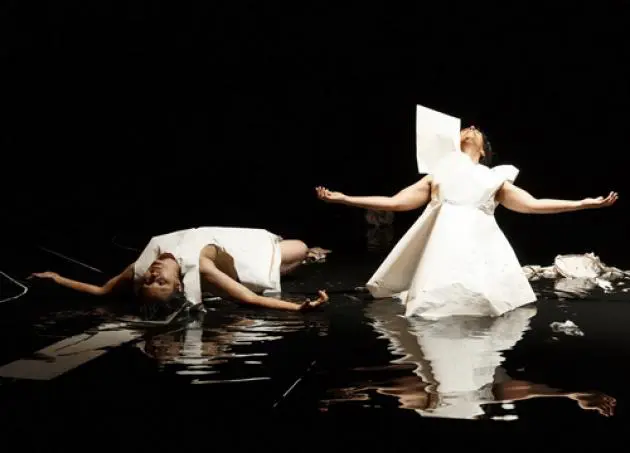
Globally acclaimed French choreographer Julie Nioche revisited her 2008 work “Matter” and worked with her Turkish, Norwegian and Swedish counterparts, with each of them, clad in a paper costume, showing her relationship with her body, womanhood and dance background on a raked stage filled with muddy water.
While the result was well unified as a whole, each dancer showed unique individuality in their solos. I have already suggested to the organisers of La Fete that they bring this work to Thailand and have Nioche work with three contemporary Thai dancers, who have been trained in different styles and traditions. This would also be in accordance with the festival’s new direction of promoting more French-Thai collaboration, instead of simply showing the ready-to-tour finished works.
In presenting “Notre peur de n’etre” (“Our Fear of Not Being”), a brand new work by 30-year-old playwright and director Fabrice Mugia, the festival proved that it doesn’t play safe with established names but also supports up and coming hotshots. His use of live video was extensive in this visually engaging production, which made a strong statement on how people take themselves out of the actual world and immerse themselves deep into the virtual one. That’s another subject with which Thai audiences can easily identify.
Like Edinburgh in August, Avignon is a haven and heaven for all theatre lovers and I look forward to returning in the near future.
The writer wishes to thank Festival d’Avignon for all assistance.
THE BIENNALE
Next up in France is the 16th Biennale de la danse a Lyon from September 10 to 30. Find out more at www.BiennaleDeLaDanse.com.
To keep track of the next Festival d’Avignon in July 2015 and the other cities where these performances can be seen, visit www.Festival-Avignon.com.
