
Still sinister after all these years


Play
Viewed through the gauze of the 1940s, '50s or even '70s, the mafia might seem quaint. It never was and certainly isn't now
It’s difficult to believe there could be a more interesting, edifying and extensive study of Italy’s organised criminal societies than “Mafia Republic”. Previous books about the mafia released to the general public pale in comparison. And that includes “Blood Ties”, reviewed here in March 2013, which opened up a whole new vista on the ’Ndrangheta, the least known of the crime gangs.
“Mafia Republic” constantly turns the turret of our heavily armoured attention back and forth among Reggio Calabria in the toe of Italy’s boot, home turf of the ’Ndrangheta, the Sicilian heartland of the Cosa Nostra at which the kick is aimed, and Campania above the instep, where the streets of Naples quite literally run with camorra thugs, if not the blood of their victims.
Dickie is a professor of Italian studies at University College London, but this is no dry scholarly treatise. The prose is lively and supple and laced with the sort of ironic smirks that seem unavoidable when confronting Italy and its gangsters (or about Italian gangsters in the US, among whom the TV series “The Sopranos” mined so much black humour).
There is the expected “perp walk” of amusing nicknames, like Pasquale “The Animal” Barra, Carmine “Mr Angry” Alfieri, Bernardo “The Tractor” Provenzano, Giovanni “The Pig” Brusca and Antonio “The Ferocious Dwarf” Imerti.
Make no mistake, though: The humour is so black as to be terrifying, not only in the ghastly murders described with chilling subtlety but in the sheer scale of the menace posed by the mafia societies to society at large.
One reason the book runs to 500 pages is that Dickie goes to considerable lengths outlining the context of Italy’s political dysfunction, a history of post-war upheavals and lucky reprieves. This is crucial in understanding how the mafias have developed – and how they continue evading eradication to this day despite a massive recent ground shift in public attitude.
In the 1980s Italy enjoyed an economic boom deemed miraculous. But tagging along with it was money’s old pal, corruption. “The miracle also opened up roads to riches for the mafias,” Dickie writes. “The mafias’ economic miracle would long outlast the first spurt of growth in lawful industry ... [And] burgeoning criminal wealth wrought a whole series of other changes. The liaison between organised crime and the Italian state grew both more intimate and more violent.”
What emerged was “the rule of non-law”, in which the authorities were unwilling or manifestly unable to stem the mafia infiltration into what Tony Soprano disarmingly called “legitimate business”. Nor was the Italian state (or any other state) capable of curbing the drug trade, which blossomed anew with the demand-driven shift from heroin to cocaine.
In Sicily, where the mafiosi always referred to themselves as members of “the honoured society” until the fictitious name Cosa Nostra (literally, “our thing”) caught on in the US and was duly imported, a handful of prosecutors started getting conscientious about their job. Everyone laughed.
As recently as 1992 there were still students of criminology unconvinced there was an organised criminal brotherhood in the island province. It was only that year, at the end of “Sicily’s longest decade” – 1979 to 1992, a period of ferocious internecine mafia wars that spread across the country – that the argument was put to rest.
The horrific car-bomb assassinations of high-profile crime-busters Giovanni Falcone in May 1992 and Paolo Borsellini two months later (Brusca the Pig lay his pork belly on a skateboard to roll into a tunnel beneath a road and plant the bomb that blew up Falcone) shocked Italy into realising what it was up against. Still not avenged of the merciless crackdown launched by the two magistrates, the Cosa Nostra and its brethren bombed a slew of public places across the country (and even planned to give the Leaning Tower of Pisa a fatal shove).
There came a rush of confessions of guilt from mafiosi who felt the jig was up and shed their oaths of omerta silence. The truth proved appalling. In death the martyrs Borsellini and Falcone managed to inspire a grassroots uprising against the mob and the government corruption that fed it. It became illegal to pay protection money. Industry and retail organisations kicked out members that did so.
Dickie ends “Mafia Republic” virtually pleading with citizens to keep up the fight against the hoods, the politicians and the affaristi (opportunistic predator businessmen). Much has been accomplished in the war on crime in the past decade, but Dickie lists the remaining gaps in the legal arsenal. And for this alone, “Mafia Republic” might be an educational read for reform-minded Thais.
Dickie calls the following scenario from the late 1990s “a very Italian paradox”. Perhaps not.
“Ties between the palaces of power and the country ‘out there’ became both utterly remote and stiflingly intimate. ‘Remote’ because the obsession with promoting allies and friends, with occupying ‘centres of power’, made reform close to impossible. The real rights and needs of the Italian people – among them the rule of law – went unserved. Yet also ‘intimate’ because, as the state gradually occupied more and more of society, citizens had to make political allies and friends to get a job, or get anything done.”
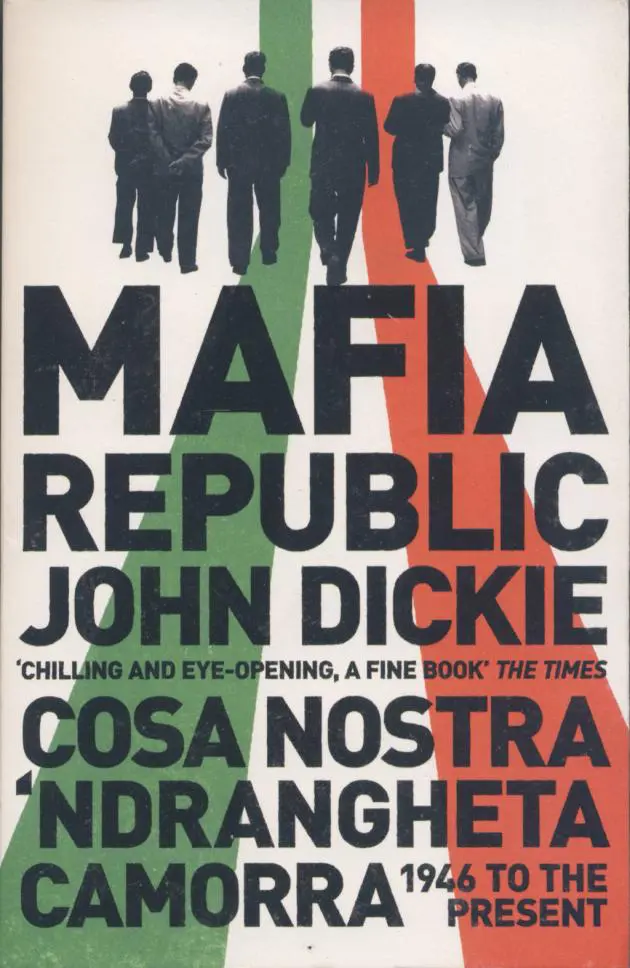
Mafia Republic: Italy’s Criminal Curse: Cosa Nostra, ’Ndrangheta and Camorra from 1945 to the Present
By John Dickie
Published by Sceptre, 2014
Available at Asia Books, Bt450
Reviewed by Paul Dorsey
