
The charms of Chengdu


Play
Art centres and museums add class to Sichuan's provincial capital
Chengdu, homeland of pandas and the capital of Sichuan, is a land of abundance and rich in history, art and culture. One of China’s most important economic centres and the fourth most populous city in the country, it’s home to a wealth of museums and for this visitor at least, awakened a love for art that I had not felt since my university days.
Founded in 2009, the Blue Roof Fine Arts Museum, which gets its name from the town’s local artist community, is committed to promoting Chinese contemporary works. Its stated mission is to increase public knowledge, understanding, and enjoyment of both Chinese and international art and it assembles collections of paintings, installations and multimedia artworks from around the globe.
Surrounded by plants and looking out over the fields, the single-storey museum, which is constructed of concrete, glass, wood and red brick, is a pleasant place to while away the hours.
I also discover to my surprise that it has a large residency programme that draws artists from different countries and regions for further communication and creation. Artists taking up residence at Blue Roof can stay for as long as 50 years, each of them paying a very low rental free that’s set by government. Today, the zone is home to 300 painters, designers and commercial artists. Free studio space is also available and the centre’s exchange programme is thriving.
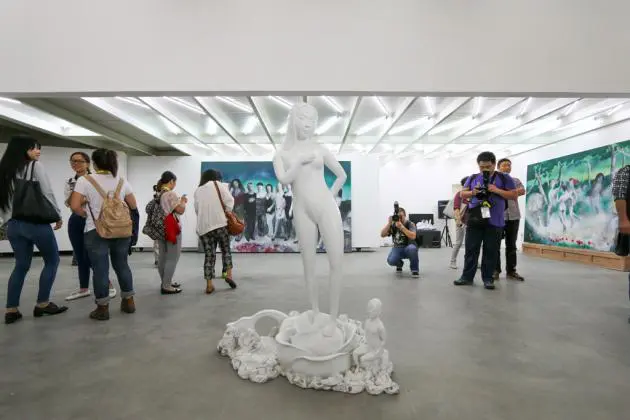
We’re invited into the residence of 53-year-old Chinese artist Luo Fahui, which features a large studio and a swimming pool decorated with sculptures of women standing on a rose petals. The walls are covered with large oil paintings of female bodies against grey backgrounds and with hints of colour and blood on their subjects.
Nor far away is the residence of Yang Mian and the first work that greets my eyes is large painting of colourful dots, the artist’s take on Vincent van Gogh’s “Starry Night”. The 44-year-old painter began his “CMYK” series in 2009, creating works intuitively similar to the pointillism of the Neo-impressionists. His art reflects well-known images from Western culture like Andy Warhol’s “Marilyn Monroe”, and others from Piet Mondrian, Morris Louis, Jackson Pollock.
My only disappointment is that we are a few days too early to see Chengdu Blue Roof Art Festival, the centre’s first modern art extravaganza that ends next week.
Consolation comes in the form of a visit to Jinsha Relics Site, one of the biggest and most important archaeological discoveries in China and located in the western suburbs of the Qingyang district.
The museum was built to protect, study and display the archaeological finds of the site, which dates back about 3,000 years ago from the late Shang Dynasty to the early Spring and Autumn Period. Divided into four halls with separate themes, visitors usually start with the Relics Hall, home to artefacts that demonstrate the development, and evolution of the civilisation of ancient Shu State. The Exhibition Hall, meanwhile is spread over four floors and boasts sound and light painting technology of life scenes from 3,000 years ago including the hunt for wild boar, a mother holding a baby in her hands, and elephants. I am particularly impressed by the “Gold Sun God Bird”.
The museum’s Cultural Heritage Protection Centre is, as the name replies, designed for the protection and study of the cultural relics unearthed there. The last stop is an Academic Lecture Hall and its adjacent ecological garden, home to several large and very old trees as well as the “Sun Bird Sculpture”, “Western Hills”, “Jade Road” and “Ebony Forest”.
Another must-see in Chengdu is the Sichuan Cuisine Museum, which showcases more than just an impressive collection of ancient dining utensils, food containers and clay figures of chefs, but also the food itself. Every item tells a “spicy story”, not least because Sichuan cuisine often contains food preserved through pickling, salting, and drying. More adventurous visitors can even have a go at cooking some of the province’s most famous dishes.
My all-too-short visit to Chengdu ends at Tian Yuan Ji Yi museum, which explores traditional farming and rural lifestyles. Here I am impressed by the government’s policy of building farmers’ houses that the agriculturalists can then buy on low instalments. With Thailand’s farmers facing such hard times, this is a good welfare programme that our own government would do well to adopt.
