
In the glow of the 'Teardrop'


Play
Arin Rungjang is in the running for one of AsiaPacific's top art prizes
Thailand's Arin Rungjang will next month vie with 14 other Asian artists for the Signature Art Prize for contemporary art offered once every three years by the Singapore Art Museum and Asia Pacific Breweries Foundation.
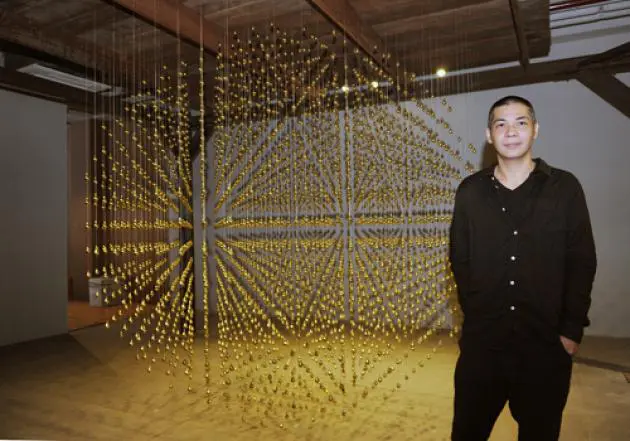
Nominated by Gridthiya Gaweewong, art director of the Jim Thompson Art Centre, Arin is again presenting his critically acclaimed “Golden Teardrop”. The immense chandelier-like sculpture was part of the installation “Poperomia/Golden Teardrop” that he and Wasingburee Supanichvoraparch mounted at the Thai Pavilion at last year’s Venice Biennale.
Having wowed the crowd in Italy (although there was criticism as well), the installation returned home for a stint at the Siam Centre in August and drew nothing but positive feedback.
Arin’s thought-provoking “Golden Teardrop” is in Singapore, where the Art Museum will next month present the works of 15 finalists selected from among 105 nominees in 24 countries and territories.
The triennial APB Foundation Signature Art Prize is in its third year of weeding out the best contemporary art in the Asia-Pacific region.
“The Golden Teardrop” showers its darkened room with a glittering spectrum of light reflected from 6,000 bronze globules. Each “teardrop” is beautifully constructed, hung from the ceiling on a thread. Collectively they form a huge ball, and the surrounding void acts to solidify the shape and stress the immense volume.
The chandelier echoes the venerable “golden teardrop” dessert that the Siamese of Ayutthaya concocted, based on a treat imported by the Portuguese who came here to trade 500 years ago.
Arin’s 30-minute video is screened as part of the exhibition, depicting a Japanese woman in modern-day Rattanakosin making thong yod, and Thai goldsmiths sculpting the bronze teardrops for his chandelier. The film juxtaposes the histories of Siam, Japan and Portugal amid his conversation with Australian art scholar and critic David Teh.
“The video installation and a sculpture are based on an amalgamation of grand narratives and small narratives, rethinking history by using sugar and a famous sweet, the golden teardrop, as a point of departure,” Gridthiya explained in her nominating papers.
“Thais assume that this is our traditional desert introduced during the Ayutthaya Period in the 17th century. In fact the golden teardrop was introduced to the Thai court by Maria Guyomar de Pinha, a woman of Japanese, Portuguese and Bengali descent and the wife of Constantine Phaulkon, the Greek court counsellor to King Narai.”
She says Arin offers “a better understanding of the role of Ayutthaya and how it was affected and influenced by colonisation”.
The judges in Singapore are Chris Saines of Australia’s Gallery of Modern Art, Chinese critic and curator Feng Boyi, Luckana Kunavichayanont of the Bangkok Art and Culture Centre, Pooja Sood of the KHOJ International Artists’ Association of India, and Susie Lingham of the Singapore Art Museum.
Singapore has two contenders for the prize. Ho Tzu Nyen’s interactive video installation “Pythagoros” is about the concealment of power, while Zhao Renhui draws on his travels in the stark Arctic for “Eskimo wolf trap often quoted in sermons”.
Indonesian Melati Suryodarmo presents performance art in the form of “I’m a Ghost in My Own House”, in which he spends 12 hours grinding charcoal, a symbol of life’s energy.
Australian Owen Leong’s poetic performance piece “Infinite Love” explores the body as a site for social, cultural and political forces in relation to his mixed-race identity.
Japanese Go Watanabe uses meditative visuals in “One places/on ‘the room’” to challenge the way we look at time and space. Indian Ranbir Kaleka’s “House of Opaque Water” examines displacement and society’s response to it. New Zealander Lisa Reihana’s “In Pursuit of Venus” reflects the beauty of the Pacific Islands and their colonial legacies.
From China, Liu Jianhua’s “Trace” gives voice to societal ills in traditional calligraphy and porcelain, and Peng Wei’s “Letters from a Distance” melds the text of old scrolls and leaves with Western philosophy.
South Korean Choe U-Ram’s “Custos Cavum (Guardian of the hole)” takes the form of a mesmerising sculpture of a mythical creature from the past – and also from an apocalyptic future.
The Taiwanese collective Yao Jui-Chung and Lost Society Document delves into another social issue in “Mirage – Disused Public Property in Taiwan”.
Vietnam’s Nguyen Trinh Thi looks at freedom of expression in “Unsubtitled”, referring to a suppressed literary movement of the 1950s.
Pakistan’s Farida Batool’s “Kahani Eik Shehr Ki (story of a city)” walks down a busy street in Lahore 21 stretched prints.
And Naeem Mohaiemen of Bangladesh draws on personal memories in “Rankin Street, 1953”, an evocation of his family home in vintage photographic negatives.
CAST YOUR VOTE
The exhibition at the Singapore Art Museum runs from November 14 through March 15. The winners will be announced on January 22.
The APB Foundation Signature Art Prize is worth S$60,000 to the winner. Two Jurors’ Choice Award winners will receive $15,000 each and $10,000 goes to the winner of the People’s Choice Award.
Cast your vote online at www.SingaporeArtMuseum.sg/apbfSAP2014.html.
