
More glory for 'Golden Teardrop'


Play
Arin Rungjang's thrilling chandelier installation is in the running for a major regional prize
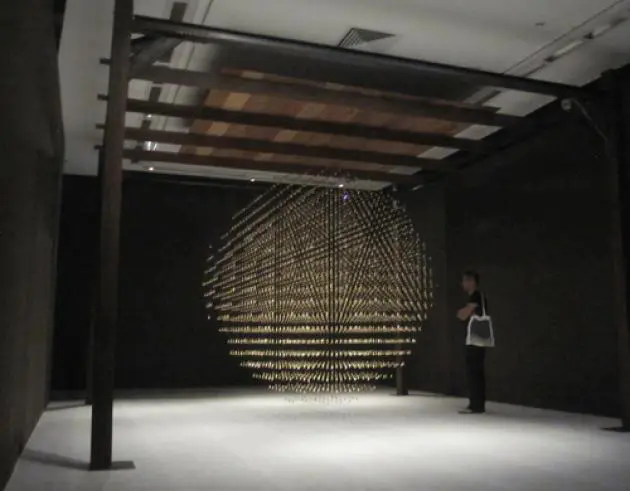
Thailand’s Arin Rungjang’s “Golden Teardrop” and Singaporean Ho Tzu Nyen’s “Pythagoras” – installations now part of the permanent collection at the Singapore Art Museum through March – are both vying for the prestigious APB Foundation Signature Art Prize for contemporary art. The winner pockets S$60,000 (Bt1.5 million).
Arin and Ho are among 15 artists in 13 countries short-listed for the prize awarded every three years by the museum and the Asia Pacific Breweries Foundation. The winner will be announced on Thursday.
The finalists were selected from among 105 nominated works from 24 countries. Their creators hail from Australia, Bangladesh, China, India, Indonesia, Japan, New Zealand, Pakistan, Singapore, South Korea, Taiwan and Vietnam.
“The short-listed works truly demonstrate creative exploration of form and medium, and are conceptually well-wrought at the same time,” says Singapore Art Museum director Susie Lingham. “Diverse social, cultural and political issues are engagingly and accessibly expressed in these extraordinary artworks, where each embody the transformative quality of art.”
Displayed across two floors, the contending artworks are dominated by installations, but there is also video art, a movable sculpture, mixed-media work, a painting and photography.
Arin’s monumental “Golden Teardrop” utilises heavy wooden beams from an old Ayutthaya house and iron trusses from a post-war factory to frame a delicate sculpted “chandelier” of bronze globules.
The chandelier echoes the venerable “golden teardrop” dessert that the Siamese of Ayutthaya concocted, based on a treat imported by the Portuguese who came here to trade 500 years ago.
Thanks to the museum’s spaciousness, the installation is even bigger than what Arin was able to mount at the 2013 Venice Biennele, he says. He tells The Nation that he’s working on a new version for a show in the US.
Ho Tzu Nyen’s powerful, interactive video installation “Pythagoros” is about the concealment of power. He’s built a darkened 360-degree theatre beyond red curtains and used four-channel HD video, eight-channel sound and elaborate stage lighting.
You see characters from film and literature, such as the Wizard of Oz, Fritz Lang’s Doctor Mabuse, Stanley Kubrick’s Hal 9000 computer and Jean-Luc Godard’s Alpha 60. Historical figures from Ho’s earlier works join in, including Isaac Newton, the poet John Milton and pianist Glenn Gould.
Viewers note how, like Pythagoras, the Wizard and Mabuse conceal their faces to give their words more authority, while the artificial intelligence systems of Kubrick’s and Godard’s sentient machines allow them to speak outside of mind as humans understand it. When the image and sound stop, the curtain reveals a controlling mechanism!
Haunting the museum’s central terrace is the impressive installation “I’m a Ghost in My Own House” by Germany-based veteran Indonesian Malati Suryodarmo. She based it on research and personal experience regarding the meaning of “home” and “loss”, ultimately rendered as “homeless”.
Malati has covered the floor with more than 150 kilograms of charcoal, with a ghost-like white dress suspended above. A wall monitor shows an excerpt from her 12-hour performance in 2012 – Malati emotionally crushing and then sleeping on the charcoal.
Vietnamese Nguyen Trinh Thi’s “Unsubtitled” has low murmuring and other soft sounds like chewing and swallowing that reverberate in a darkened space through which loom life-size projections of 19 artists, curators and writers from Hanoi. They’re seen eating their favourite food while standing, an artificial and uncomfortable situation, while they’re asked to state their names and tell what they’ve eaten in a sort of interrogation process. It recalls Maoist self-criticism, in which people had to explain every intention, revisit every action, and account for his or her very existence.
In another gloomy room, Japan’s Go Watanabe uses meditative visuals in “One places/on ‘the room’” to challenge the way we look at time and space. The 28-minute-video installation consists of two different CGI animations of a seemingly normal bedroom, “” and “”.
The first is a view toward the window, the second the back of the room. These are projected on different sides of a single screen so that only one perspective can be seen at a time – you have to circle around to get the full picture. The uncanny realism of the images is heightened when the objects and furniture in the room start to come apart, and assume increasingly abstract and autonomous forms. Watanabe thus proposes alternative visual possibilities that are apt for contemporary existence marked by plurality and the virtual.
Indian Ranbir Kaleka’s “House of Opaque Water” three-projection installation depicts an elderly Indian man to raise themes of displacement and society’s poor response to it.
Cast your vote
The winners of the APB Foundation Signature Art Prize will be announced on Thursday.
Two Jurors’ Choice Award winners will receive S$15,000 each and $10,000 goes to the winner of the People’s Choice Award, for which your vote is welcome – by Wednesday – at www.SingaporeArtMuseum.sg/apbfSAP2014.html.
The exhibition continues through March 15.
