
Nothing so unique as unikko


Play
Finland's flowery lifestyle brand Marimekko arrives in sunny Thailand
Residents of Finland are used to weeks without sunshine every winter, but certainly there are coping mechanisms that help, such as the Unikko poppy-flower pattern that adorns clothes from local firm Marrimekko. In fact it’s been brightening up the day for people around the world for half a century.
Now the cheerful clothier has a store in Bangkok, at CentralWorld.
Marimekko designer Mika Piirainen was at the recent grand opening, among other things confirming the perennially high rating given Finland’s education system – he studied fashion design in both Helsinki and London and insisted the former was better.
“The main difference is definitely the fact that nature is more rugged in Finland, so human life is more natural as a result. In Scandinavia it’s always dark in winter and the summertime is just the opposite: It’s light for almost 24 hours a day. We Finns are quite strange people, as well – our food, etc – it’s a very different kind of experience.
“So Marimekko is very much influenced by nature,” said Piirainen, who’s worked there since 1994. “And I’m a nature lover. I love the silence. In our photo shoots, for example, you can see the water is so clear and the mist rolling in. Our models aren’t overly made-up.”
Armi Ratia founded Marimekko in 1951 with a clear vision that was immediately evident in her lively use of colours and bold approach to shapes. She spoke of the need to “stand out from the rest”. For one thing, that meant none of the floral patterns that predominated in clothing at the time. She wanted to tap into the look of modern homes with their streamlined furniture.
But, ironically enough, in 1964, it was a floral pattern conceived by one of her designers, Maija Isola, that brought the firm its greatest success – the famous red-and-white Unikko poppy motif.
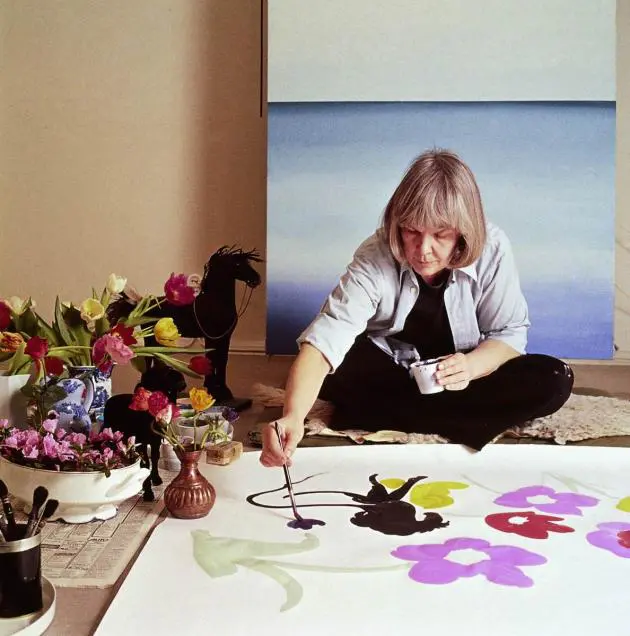
“Isola was like a rebellious child,” Piirainen chuckled. “She went home and created eight different flower prints in protest, one of which was Unikko, and Ratia was wise enough to see the potential in Unikko, so she put it in the collection.
“This shows that you can never really say ‘no’ to anything, in a way. That print has been used in thousands and thousands of colourways [combinations], and for next autumn’s collection I’ve made a new Unikko colourway in hot pink.”
Piirainen explained that Marrimekko translates as “Mary’s dress”, a deliberately plain term for what was intended to be a timeless philosophy of design. “It means practical and functional as well as aesthetical. Design has to last. It sounds very simple, but when you try to do it, it’s very difficult!
“We draw inspiration mainly from the contrast between nature and architecture. You travel around and keep your eyes and ears open – to movies, music, everything. We don’t do much cutting so as not to mess up the print. We want prints that make people happy, playful with optimism and humour.”
Another of Piirainen’s favourite patterns is called Tuilli, created in 1972, also by Isola. “The word means ‘wind’. Marimekko clothes are often regarded as ‘loud’, but here we have a print that’s peaceful and quiet. Maybe the idea came from nature in winter, when it’s very quiet because there are few birds singing.”
He’s expanded the scale of some of the patterns from the 1960s and ’70s and altered the colourways “and suddenly they become a big hit”.
“There’s so much diversity. We love dots, too. It’s the best shape in the world – people say it’s a friendly shape. So I’ve been using lots of dots. And I also like stripes. I think I like everything! You can’t work at Marimekko if you’re limited. You have to be very wide open.”
There are also some Marimekko dresses without prints that instead appeal with architectural twists in the shape, but the firm’s chief design secret, Piirainen said, is to offer both “silence colours”, like greys, blacks and whites, as well as clothes full of colour.
“At Marimekko, when you make prints, you have two colours being screened at the same time, and then they’re overlapped and you get an extra colour – this is a technique we use a lot. It’s very Marimekko, when the two colours meet. The colour combination is very original.
“In the old days we did all the printing by hand, and some people thought the extra colour was a mistake, but it’s actually a very smart technique. Maybe I’m stupid to be telling you this because now other people can do it – no more secret!” he laughs.
Nevertheless, the brand utilises sizes and shapes in the prints that few other firms attempt. “Nowadays we let our young designers do the prints freehand again, but it’s the hardest thing in the business. How to keep the brand’s DNA in the new prints – that’s the real challenge.”
FINNISH LINE
n Tanachira Retail Corp imports the full range of Marimekko’s Thailand lifestyle store at CentralWorld, including apparel, children’s clothes, bags and accessories and home decor.
