
Modigliani in East Java


Play
Singapore’s new Pinacotheque museum shows how Southeast Asia influenced modern Western art
THE ART focus in Singapore has been on the massive new National Gallery – you can see 10,000 artworks there. Yet that’s no reason to skip the Pinacotheque, just opened in the Fort Canning Art Centre.
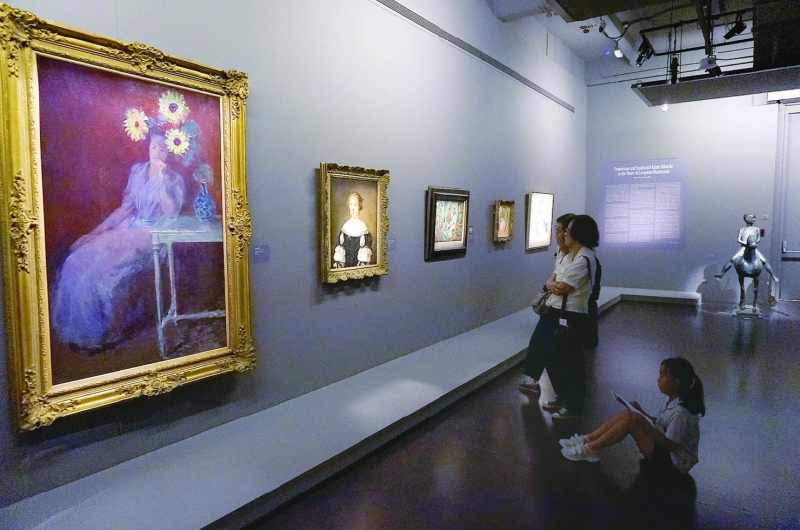
It’s only got 40 pieces on view, but they’re authentic masterpieces – Picasso, Monet, Renoir, Rembrandt and Pollock among them.
French art historian Marc Restellini opened the original Pinacotheque in Paris in 2007. Now he has his first overseas outlet, a 5,500-square-metre branch in Singapore flouting the same principle of “transversality”. That means shunning the standard system of classifying artwork according to period, genre and artist. The pieces are instead arranged as a thematic “visual dialogue”.
“It’s an approach that helps explain how small communities of artists from all times, cultures and origins are united by a similar way of thinking, reflecting and behaving,” Restellini says. “I combine them according to my own sensitivities and with an iconographic and aesthetic logic.”
The art comes from private collections around the world and provides a rare opportunity to see some extraordinary and very famous works.
There are three main galleries – the Features, ready to host temporary exhibitions twice a year, and the Collections and the Heritage with permament displays.
The inaugural show for the Features, “The Myth of Cleopatra”, has just ended and another opens this month, but in the Collections, in a bid to illustrate the historical relationship linking Southeast Asian, African and Western art, Restellini has mounted Western masterpieces and Southeast Asian tribal art in a conversation about primitivism. “Young Lady with Earrings” (1915) by the Italian Amedeo Modigliani, who was directly influenced by African carvings, is placed next to a bronze death mask from East Java, which could have been made anytime between 400 BCE and 200 CE. The similarities are both clear and startling.
“Works from different times and different places make the connection,” says Chong Min Tse, who’s in charge of the Pinacotheque art academy. “In the 20th-century painting, the elongated face, long-ridged nose and almond-shaped eyes form a mask-like face that’s similar in style to the ancient death mask.”
American abstract expressionist Jackson Pollock’s “Composition with Cubic Forms” (1934) is even more remarkably in tune with a late-19th-century shamanic figure from Mentawai Island in Indonesia.
“Inspired by the similarities between the artwork of the Batak people of Sumatra and those of East Africa, I wondered if there was a bridge between these two far-flung geographies,” Restellini writes in the catalogue.
“I discovered that there are historical indications that the Austronesians – the ancestors of the
Malays and Indonesians – sailed thousands of years ago to Madagascar in Africa. Their aesthetic influenced that of Africa and from there travelled to Europe and eventually inspired artists in the early 20th century. Such realisations are important because they shed light on primitivism and its profound impact on artists and movements.”
Alongside a 1640 etching by the Dutch master Rembrandt of the beheading of St John is the 1630 painting “A Painter in His Studio”, thought to be by one of his students. It’s an interesting contrast in approaches.
French Impressionist Claude Monet is represented by “Suzanne with Sunflowers” from 1890, a portrait of his stepdaughter. The sunflower symbolises hope for the young lady, who was battling cancer. Adjacent is “Portrait of Maria Dircksdr Bogaert” (1670) by Gerbrand van den Eeckhout’s, depicting a 19-year-old family member.
The Heritage Gallery has more about the Austronesians’ voyages to Southeast Asia 5,000 years ago. Bruce Carpenter, an independent curator based in Bali, has assembled artefacts from the Neolithic and early Bronze Age in this region and examples of tribal, Islamic and Peranakan Chinese art.
The Austronesians, seen as the ancestors of Malays and Polynesians, among others, left their original homeland in today’s Taiwan and settled as far south as the Philippines and Indonesia. There they split into several branches, including one that would “discover” India and another that probably reached South America.
On display is a fertility-goddess figurine from East Java (1,500 BCE to 100 BCE). Indicating Indian influence are a 10th-century uisa crown shaped like the bump on the Buddha’s head, an ear cuff bearing a garuda, a gold necklace adorned with a goddess and plaques decorated with birds.
Elaborately crafted Peranakan Chinese jewellery from the 19th and 20th centuries indicate clear Chinese influences on the surface, and yet there are Malayu hints as well. These include “hair” fashioned for a wedding headdress and a gold belt with animal and automobile motifs.
An eight-metre interactive wall comprised of moving parts and touch-screens renders the show fully immersive, and a mobile application can be downloaded for free to provide a personal guide to the facility, complete with a search engine.
One corridor of the museum is a “graffiti walk” with seamless paintings by artists from every continent. Another corridor at the back has “garden walk” designed by French artist Julie Navarro with views of a Spanish-style garden. In a play of light and shadow, a mashrabiya (a window typical of a Spanish patio) appears on the floor in a trompe-loeil effect created with mosaic tiles.
The writer’s trip was made possible by the Singapore Tourism Board.
AMID THE MASTERS
The Singapore Pinacotheque de Paris is at the Fort Canning Arts Centre.
It’s open daily – Sunday through Thursday from 10 to 7.30 and Friday and Saturday from 10 to 8.
Admission is S$28 (Bt720), $19 for students and $9 for children.
Find out more at www.Pinacotheque.com.sg.
