
Talking survival


In 1940, during the early days of World War II, hundreds of thousands of Allied soldiers from Britain, Belgium and Canada find themselves trapped on the beach of the French coastal town of Dunkirk as they face an impossible crisis. They've been cut off and surrounded by ruthless German Nazi troops. Over the course of eight days, the men must struggle to survive and hope for rescue.
Christopher Nolan’s new film “Dunkirk”, whichis already receiving critical acclaim, tells from those three perspectives – land, sea and air. Each storyline actually follows its own distinct timeline – a week with the soldiers on land; a day on the sea, with the people on one of these ships; and an hour in the air in the Spitfires.
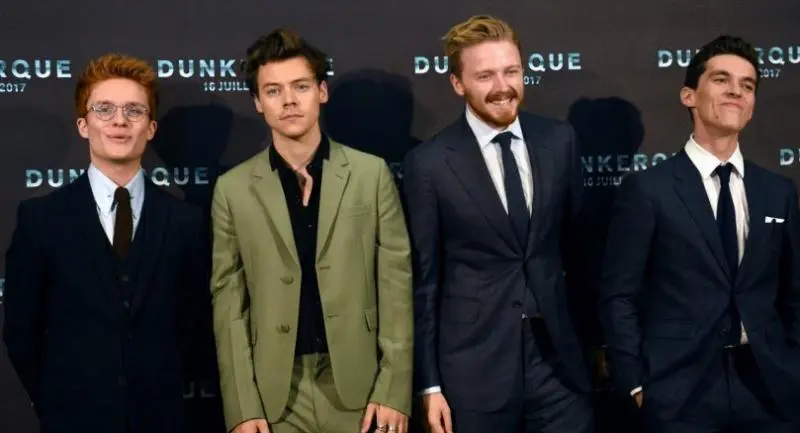
Actors Fionn Whitehead, Harry Styles, Jack Lowden and Tom Glynn-Carney who star in Christopher Nolan’s released war thriller film “Dunkirk” chat about their experiences and what the story meant to them personally. Excerpts:
What was it like meeting writer/director Christopher Nolan for the first time, and what impressed you the most about working with him?
TOM GLYNN-CARNEY: It was his composure, and how welcoming he was. I was only intimidated by him for about five minutes [laughs].
JACK LOWDEN: It’s kind of like meeting the [former Manchester United’s legendary manager] Alex Ferguson of the film world [laughs]. I just found him remarkable to watch. It’s phenomenal to see a guy in charge of a project that size, with that big of a crew, and with full control of the concept, and yet still remain so focused on the characters and the actors. It’s extraordinary. He just commands such respect. I’ve grown up admiring his films and itching to see his next film, and I now know one of the main reasons why.
HARRY STYLES: When you meet him and spend a little time with him, especially on set, you understand why he takes so much time between films: he invests so much in every project he does. He doesn’t just churn them out; I think he would rather wait and know everything there is to know about what he’s going to do, and if he’s going to do it justice in a film. He has researched everything about Dunkirk to the nth degree – from the costumes, to hair and make-up, to lighting. Everyone, even people who have done their jobs for 20 years, all said that they learn something from him on every film.
FIONN WHITEHEAD: Everyone knows that he’s the man. I think the thing that makes Chris so unique is that he has his own vision for this piece of art he’s creating and he’s completely in charge, which is an amazing thing for an actor. It gives you a bit more breathing room because you’re not trying to tend to anyone else’s needs.

How did it feel when you first arrived on the set and saw the scope of the production?
TGC: It was just… wow. The scale of the thing was epic. You feel tiny in comparison to the huge production that’s happening around you. The first day I was on the set, we went out in the Moonstone, and sailed past a real destroyer ship. That was just absolutely mental – like a baptism of fire. It was all pretty overwhelming. At the same time, you felt like part of this machine that was moving towards making an exceptional piece of film, and you’re just so giddy and excited, you don’t really know how to process it.
FW: The whole first week I was on the beach made me realise the sheer magnitude of the operation – thousands of extras running around, explosions going off, a real Spitfire flying over your head. It was definitely epic, but there’s no other way to do justice to the real Dunkirk evacuation. Being on that beach and standing on the Mole that they built, it was like walking through documentary footage. I just felt really lucky to be part of the project.
JL: It does feel like there’s nothing I haven’t experienced because Chris does everything for real on his films. I’ve been swooping around over the Channel with real Spitfires, dunked under the water, hanging off a cliff on a gimbal. I told Chris, ‘Every single job I do after this will seem boring because it’s just been one thrill ride after another.’
HS: It was definitely bigger than you expect, but the best part about it was that even when all of this was going on around you, as soon as you started filming, it always felt like it was just you and Chris and the camera. I think he’s amazing at making you feel comfortable on set in a way that doesn’t stress you out.
What was the toughest aspect of the shoot?
FW: The most physically challenging aspect was probably being in the water. We spent a whole day shooting in the sea, on and off.
HS: It felt like someone pulled you out of the bed, dumped you in the water, and then put you back in bed. But those were good days. Those were the ones that you’d get back from afterwards and everyone feels like [whistles], ‘That was a big day’.
FW: Yeah, ‘Let’s have a beer’ [laughs]. You’re so tired, but then it hits you that it’s just a tiny slice of what the real thing must have been like.
How much did you know about the events at Dunkirk prior to becoming involved in this project?
FW: In England, the Second World War is hammered home from a young age, and I think it desensitises you to it a bit. As you grow up, Dunkirk becomes just another event in history, as opposed to a real-life experience for these poor lads who were younger than me, some of them. So, making this movie on the actual beach where it happened, and going to the museum and seeing footage of the real Dunkirk evacuation definitely brings it home and makes it real.
HS: When you’re at school, learning about history and World War II, Dunkirk is not as emphasised as some of the big battles, but it’s actually an incredibly important moment in the war. The world might be very different if things hadn’t gone the way they did.
Do you have a feeling of responsibility, given that this film is telling the story of a real event that happened in 1940?
TGC: Absolutely. I think it’s difficult not to. Even though the story we’re telling is fictional and we are not playing real people, we are playing a situation that real people experienced – people our own age. So, you have to show respect for that. As realistic as this film is, and as real as Chris made the experience for us, it’s impossible to really put yourself there because we’ve never been through anything like that and probably never will. But it was important to all of us to invest in it as much as possible and attempt to do it justice.
FW: Definitely. I think that one of the best things, hopefully, about Dunkirk, is that it’s really trying to put you in that situation so that you feel what it must have been like to be there and appreciate what those people went through and how brutal and terrifying it was. I hope people take from this that we need to never go back to a place where something like Dunkirk can happen.
JL: It really was a country fighting for its survival, and what turned a defeat into a miracle was the sheer power of togetherness. The people of Britain came together to make the Miracle at Dunkirk happen – not just the three military forces, but all those civilians who had the courage to brave the barrage of enemy dive-bombers and U-boats to save those soldiers. It must have been an incredible thing to be part of – a terrible thing, but an incredible thing.
