
Beyond the Runway: How Thailand is Trading Heritage for Global Clout


Officials, designers and craft experts outline how Thai textiles and intangible heritage are being reshaped into global cultural capital
- Thailand is implementing a coordinated national strategy, involving multiple government agencies, to transform its cultural heritage and craft traditions into sources of international economic and diplomatic power.
- The approach involves both safeguarding traditions through UNESCO inscriptions (like Nuad Thai and the national Chut Thai) and actively monetizing them through creative industries and design centers.
- Royal patronage, particularly from the late Queen Mother Sirikit and HRH Princess Sirivannavari, has been crucial in preserving crafts and inspiring contemporary designers to incorporate traditional textiles into modern fashion.
- The country is actively promoting its cultural capital through high-profile international exhibitions, such as a royal costume display in Paris and fashion showcases in Tokyo, to prove the global appeal of its craftsmanship.
Officials, designers and craft experts outline how Thai textiles and intangible heritage are being reshaped into global cultural capital.
Beneath the polish of a study tour reception, a rather more consequential conversation was taking place. Gathered on stage for a panel titled "Thai Cultural Capital: Unlocking Global Opportunities", five speakers — spanning government, industry and fashion — set out how Thailand intends to convert centuries of craft tradition into economic and diplomatic leverage abroad.
The session, organised by Thailand's Government Public Relations Department as part of a media field trip, doubled as a progress report on one of the kingdom's quieter but more ambitious projects: turning heritage into a currency that trades internationally.
The discussion opened with the machinery of preservation.
Kittiporn Chaiboon, acting director of the Intangible Cultural Heritage Division at the Department of Cultural Promotion, explained that her department operates under the 2003 UNESCO Convention for the Safeguarding of Intangible Cultural Heritage, ratified by Thailand in 2016.
Since then, six Thai practices have been inscribed on UNESCO's list, including Nuad Thai traditional massage, the Nora dance-drama, and – most recently, in 2024 – Tom Yum Kung.
She noted that one inscription—the traditional Kebaya attire—was a joint submission with several neighbouring Southeast Asian states. This was a deliberate choice, as UNESCO encourages countries sharing a cultural practice to nominate together rather than compete for individual recognition, turning heritage diplomacy into an exercise in regional goodwill rather than rivalry.

A further submission — covering the knowledge, craftsmanship and customs surrounding Thailand's national dress, the Chut Thai — is now under evaluation, with an intergovernmental committee meeting scheduled in China between 30 November and 5 December.
Kittporn described the filing as deliberately expansive, encompassing not just the garments themselves but also the weaving, embroidery, jewellery-making and social occasions bound up with wearing them – "a complete package", as the moderator put it, rather than a single object frozen in amber.
If the Ministry of Culture supplies the safeguarding, the Creative Economy Agency (CEA) supplies the monetisation.
Its director of creative product and service industries, Asa Piwkhum, illustrated the agency's philosophy with an image of mango and sticky rice ice cream – a single Thai culinary asset that, once combined with creativity and technical know-how, can generate income across an entire chain of vendors, boatmen and tuk-tuk drivers.
Culture, creativity and technology, he argued, form the CEA's working formula for converting heritage into a broader economic ecosystem rather than a single product line.

That philosophy underpins the agency's network of Thailand Creative and Design Centres, currently operating in four cities, including one that opened only last month, with plans to reach 24 nationwide within two years.
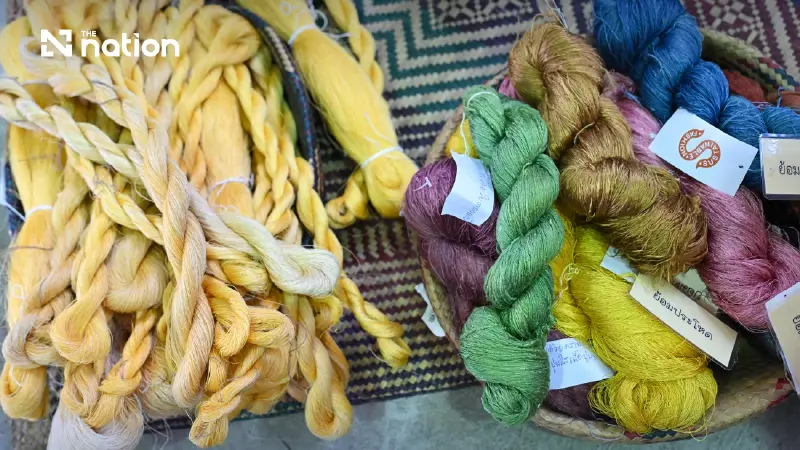
A new hub in the north-eastern province of Surin will specialise in silk, reflecting a broader strategy of decentralising the creative economy away from Bangkok and into the provinces where the raw materials — and the artisans — actually are.

The Sustainable Arts and Crafts Institute of Thailand (SACIT), founded 24 years ago under the Ministry of Commerce, provided the panel's most poignant moment.
Its director, Assistant Professor Dr Anucha Thirakanont, described a landmark exhibition currently running in Paris, near the Louvre, showcasing royal costumes worn by the late King Rama IX, the late Queen Mother Sirikit, the present Queen and HRH Princess Sirivannavari.
Timed to mark 170 years of Thai-French diplomatic ties, the exhibition has taken on an unexpectedly elegiac tone: much of the planning coincided with the death of the Queen Mother, whose decades-long patronage of silk weaving, embroidery, basketry and metalwork underpins the entire modern Thai handicraft sector.
The show runs until 1 November and has drawn queues of Parisian visitors — a detail the panel returned to more than once as evidence that Thai craftsmanship translates well beyond its country of origin.
Institute officials noted that while the exhibition itself is not a retail venture, SACIT's own outlets sell prototypes and prize-winning designs from its craft competitions.

The panel's most vivid testimony, however, came from two working designers. Bhubawit Kritpholnara, founder of the fashion label ISSUE, said his house — established 28 years ago — only began working seriously with Thai textiles five years ago, after collaborating with HRH Princess Sirivannavari on costume design.
That experience, he said, converted him to the intricacy of Thai fabric and reinforced his pride in a national craft tradition he had previously overlooked.
Actress-turned-designer Janesuda Parnto Sirisant offered a similar account: her label, founded 13 years ago without any Thai textile component, was transformed after village visits with the princess, during which she learnt that a single piece of woven cloth can represent an entire community's collaborative labour — one household dyeing, another weaving, a third adding pattern.

Both designers credited Princess Sirivannavari's post-pandemic initiative to support weavers whose incomes had collapsed during Covid-19, an effort framed explicitly as a continuation — in a modern idiom — of the Queen Mother's original mission to uplift rural artisans.
The princess's own concept, loosely translated as "fun to wear Thai textile," has driven a series of seasonal trend books produced with government support to help young designers and weaving communities align on colour palettes and silhouettes without the cost of Western trend forecasting subscriptions.
Forthcoming events suggest the momentum is far from ceremonial. A Chut Thai exhibition and fashion showcase, already staged in the Netherlands in April, will travel to the Tokyo National Museum in mid-September and to Paris in October.
The CEA, meanwhile, said it participates in eight to ten Thai festivals worldwide each year, alongside trade fairs such as Milan Design Week, in partnership with the Department of International Trade Promotion.

Asked about the sector's principal challenge, Dr Anucha pointed to environmental sustainability and the tastes of younger consumers, while Bhubawit suggested authenticity — deployed wisely through social media — remains Thai fashion's most durable competitive advantage in an increasingly crowded global market.
Taken together, the panel painted a picture of a national strategy still finding its final shape but with its underlying logic firmly established: safeguard the craft, professionalise its economics, and let designers translate heritage into contemporary form.
Whether that formula can scale beyond flagship exhibitions and royal patronage into a genuinely self-sustaining export industry remains the open question – one Thailand's cultural institutions appear determined to keep testing on the world's stage.
