
Muted Indigos and Desert Gold: How Thai Craft Heritage is Being Redesigned for Foreign Lifestyles
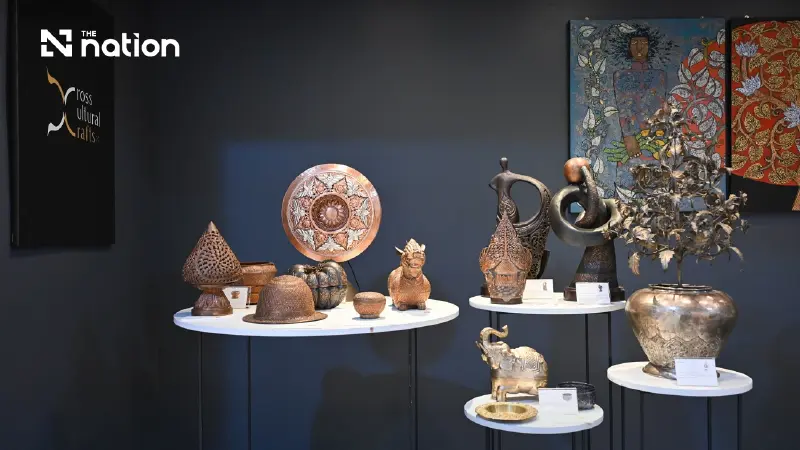


How a strategic pivot toward Japanese minimalism and Middle Eastern luxury is rescuing Thailand’s endangered artisanal heritage from the history books
- Thailand's Sustainable Arts and Crafts Institute (SACIT) is strategically adapting traditional crafts for international markets to ensure their survival.
- For the Japanese market, complex Thai designs are simplified to embrace minimalism, using muted indigos and earthy tones for functional, everyday items.
- In contrast, for the Middle Eastern market, the focus is on luxury and opulence, redesigning crafts with gold and premium porcelain to create grand home decor.
- This initiative is a calculated commercial strategy to boost exports and direct revenue back to the rural artisan communities where these crafts originate.
How a strategic pivot toward Japanese minimalism and Middle Eastern luxury is rescuing Thailand’s endangered artisanal heritage from the history books.
For centuries, the identity of Thai textiles and handicrafts has been explicitly clear: vibrant, multi-coloured regional weaves, intricate gold ornamentation, and complex motifs.
These are not merely everyday materials but historic cultural artefacts reflecting local wisdom passed down through generations. Yet, a hard truth has loomed over the loom.
Without adapting to the shifting habits of modern consumers, these ancient practices risk fading into obsolescence. Enter the Sustainable Arts and Crafts Institute of Thailand (SACIT).
Operating as an institutional "craftsman" under the Ministry of Commerce, the public organisation has spearheaded a rigorous structural pivot.
Rather than treating cultural heritage as an unalterable relic, SACIT is pushing a highly strategic approach to international markets. The philosophy is straightforward: to survive, traditional craftsmanship must harmonise with foreign lifestyles.
The most compelling evidence of this strategy lies in how SACIT is tailoring design development to navigate two vastly different, high-value global territories: Japan and the Middle East.

In the Japanese market, the project operates under a "Cross-Cultural Craft" initiative. Here, the lavish complexity of traditional Thai design is completely stripped back.
Japanese consumers value minimalism, quiet textures, and everyday functional utility. SACIT has responded by encouraging young creators to lean into raw materials, earthy tones, and monochromatic indigos.
A master weaver from rural Thailand might find themselves trading the electric pinks and bright yellows of traditional silks for muted blues and slate greys—producing sleek, understated scarves and home accents designed to fit seamlessly into a minimalist Tokyo apartment.
Furthermore, under this cross-cultural exchange, select young Thai artisans under the age of 45 are dispatched directly to Japan to study traditional lacquerware techniques, fusing foreign precision with Thai raw materials.

Conversely, the "SACIT for Middle East" initiative flips this design brief entirely on its head. In collaboration with the Ministry of Foreign Affairs, SACIT conducted deep-dive market research into Gulf consumer psychology.
The results directed artisans toward scale, luxury, and opulence. Instead of minimalism, the Middle Eastern focus channels Thailand’s traditional masteries of gold ornaments, premium silverware, and highly detailed Benjarong porcelain into bespoke, premium home decor that complements the grand interior architectures preferred in the region.

This is not a story of diluting cultural heritage for commercial gain, but rather a calculated strategy to tap into a massive global creative economy.
According to SACIT data, Thai handicraft exports reached a staggering 340.8 billion baht (approximately 9.3 billion US dollars), driven by core assets like gold ornaments, silverware, furniture, travel equipment, and fine textiles. Major global epicentres, including the United States, Hong Kong, Japan, Germany, and the United Kingdom, remain primary targets.

By expanding dedicated e-commerce platforms, the agency expects to inject 550 billion baht annually into the industry. Crucially, the objective is wealth distribution, ensuring international revenue flows directly back to the rural, grassroots communities where these crafts are born.
However, balancing rapid commercial adaptation with true cultural preservation remains a delicate tightrope. While items are redesigned for global showrooms, SACIT is concurrently reinforcing the foundations of domestic pride.
The agency is currently collaborating with the Ministry of Culture to push for the formal inscription of Chud Thai—the knowledge, craftsmanship, and practices of the Thai national costume—on the UNESCO Representative List of the Intangible Cultural Heritage of Humanity.

The convergence of these two worlds—the preservation of sacred techniques alongside radical commercial evolution—will take centre stage at the upcoming SACIT Symposium, scheduled for 6-7 August in the historic Bang Sai District of Phra Nakhon Si Ayutthaya Province.
Framed as a critical policy and academic dialogue, the event will serve as a testing ground for how local, ASEAN, and global contexts intersect. For the new generation of artisans, the future path is clear: heritage is no longer something merely to be kept under glass but a dynamic, living capital designed to be worn, used, and traded across borders.
