
CP Group confirms rail commitment after PM warns against unilateral withdrawal
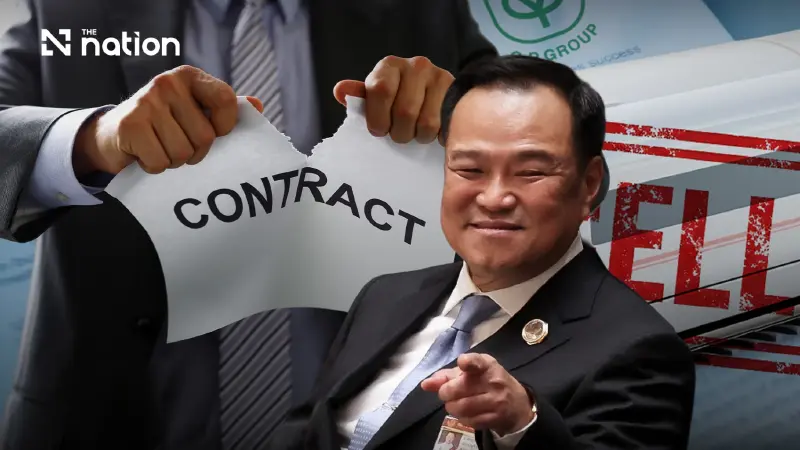


Anutin says the existing agreement must be honoured, with contract breaches potentially leading to blacklisting, seized guarantees and compensation claims
- Prime Minister Anutin Charnvirakul warned that the private contractor for the three-airport high-speed rail project cannot unilaterally terminate its contract, following reports that a CP Group company attempted to do so.
- The PM stated that a contractor abandoning a project could be blacklisted from future state contracts and face significant financial claims for damages and increased costs.
- In response, CP Group issued a statement denying it had cancelled the agreement and officially confirmed its commitment to continuing with the rail project.
PM Anutin Charnvirakul has insisted that the three-airport high-speed rail project must continue under its existing agreement, warning that a private concessionaire cannot unilaterally terminate a contract with the state.
His remarks followed reports that a company within CP Group had submitted a letter to the State Railway of Thailand seeking to end the contract for the rail link connecting Don Mueang, Suvarnabhumi and U-Tapao airports.
CP Group subsequently issued a statement denying that it had cancelled the agreement and confirming that it would continue with the project.
Speaking in Songkhla on July 10, Anutin said the government’s position was that all parties must comply with the contract, procurement regulations and their mutual obligations.
He noted that the agreement was between the State Railway of Thailand and the private operator selected to carry out the project.
Government insists contract conditions must be honoured
Asked whether the high-speed rail project remained necessary, Anutin said the scheme had already been established and any changes would require amendments to the contractual conditions.
He questioned how a company that had accepted all of the state’s requirements before becoming a contracting party could later seek to change those terms.
Allowing one agreement to be altered freely could create pressure to revise other government contracts, he said, adding that the law must remain the principal consideration.
Anutin said a private company could not simply request cancellation and expect the contract to end automatically.
He urged the public to consider the general rules governing state contracts rather than focusing on any particular company, saying such agreements generally give the state greater authority to terminate them.
Withdrawal could trigger blacklisting and financial claims
The prime minister said any termination would require acceptance by both parties and could carry serious consequences for the private operator.
A contractor that stopped work without completing its obligations could be classified as having abandoned a government project, placed on a blacklist and barred from bidding for future state contracts.
The authorities could also confiscate performance guarantees and other securities connected with the agreement.
Anutin warned that the financial consequences could extend further if the government had to hold a new tender at a higher cost.
In that case, the state could seek reimbursement for the additional expenditure from the party responsible for ending the original contract, potentially leading to a prolonged dispute.
He said the least complicated course would therefore be for all parties to fulfil the existing agreement.
Project must continue unless state terminates agreement
Asked whether the government would summon the private operator for discussions, Anutin reiterated that the project had to move forward.
Failure to proceed would constitute a breach of contract, he said.
The agreement includes staged construction requirements and specifies the percentage of work that must be completed within particular periods.
If the contractor falls short of those milestones, the state may have grounds to regard the failure as a contractual violation and terminate the agreement itself.
Anutin said he had yet to identify any provision allowing the private party to cancel the contract on its own initiative.
He warned that allowing contractors to withdraw whenever they encountered difficulties would leave unfinished structures and abandoned projects across the country.
Companies entering agreements with the Thai government must therefore be certain that they can accept and comply with all stipulated conditions, he added.
Procurement law changes target contractors abandoning projects
Anutin also said Deputy Prime Minister Pakorn Nilprapunt, who oversees legal affairs, was drafting amendments to the Public Procurement and Supplies Administration Act.
The proposed changes are intended to enable authorities to act more quickly against contractors that sign state agreements but subsequently fail to meet their obligations.
The legislation would strengthen the government’s ability to deal with companies that abandon public projects or do not complete work in line with their contracts.
CP Group’s latest statement, however, confirmed that it had not withdrawn from the three-airport high-speed rail agreement and intended to continue the project.
