
Inside Wat Phra Kaew Wang Na, a rare window into Bangkok’s royal past
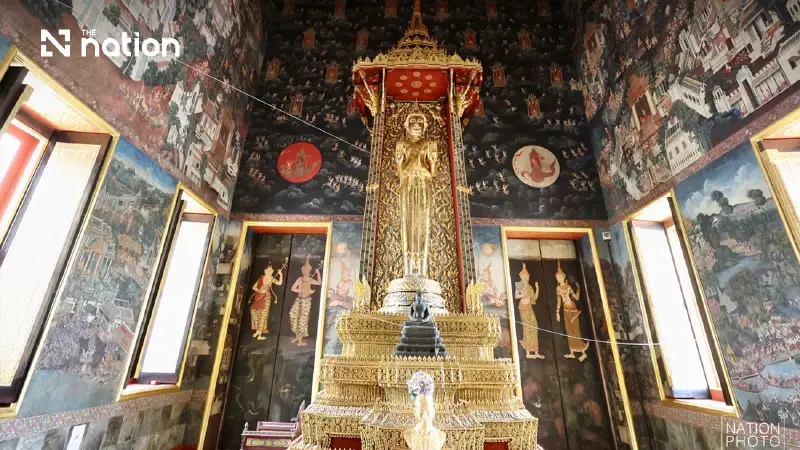


For a limited period, Wat Phra Kaew Wang Na is opening its historic ordination hall, revealing centuries of royal history, Buddhist art and remarkable murals.
- Wat Phra Kaew Wang Na, located within the grounds of the former Front Palace, is offering a rare public opening of its ordination hall from August 12 to September 20, 2026.
- The temple's history reflects generations of royal patronage, evolving from a religious retreat for royal women under King Rama I to its current form which was completed under King Mongkut (Rama IV).
- It serves as a significant historical artifact, preserving the art and architecture of the Front Palace, a powerful royal institution that has otherwise largely disappeared from modern Bangkok.
Hidden within the grounds of the former Front Palace, Wat Bowon Sathan Sutthawat, widely known as Wat Phra Kaew Wang Na, is welcoming visitors into its ordination hall from August 12 to September 20, 2026.
The special opening offers a rare opportunity to step beyond its exterior and explore a site where royal court history, Buddhist devotion and early Rattanakosin art converge.
Unlike most temples, Wat Bowon Sathan Sutthawat has no resident monks. Its location within the former Bowon Sathan Mongkhon Palace, or Front Palace, gives it an unusual status comparable in some respects to Wat Phra Si Rattana Satsadaram, the Temple of the Emerald Buddha, within the Grand Palace.

During the reign of King Rama I, Maha Sura Singhanat, ruler of the Front Palace, established a religious retreat for Luang Chi Nak Nang Maen, the mother of a principal royal consort, together with other female devotees and their attendants.
The site became known as Wat Luang Chi, reflecting its role as a place for observing religious precepts and practising meditation.
By the reign of King Rama II, the absence of suitable female devotees under royal patronage left the temple neglected. Maha Senanurak, then ruler of the Front Palace, eventually ordered its buildings to be dismantled and the grounds transformed into a garden used for keeping rabbits.

The site’s fortunes changed again under King Rama III. Maha Sakdiphonlasep, ruler of the Front Palace, dedicated the former garden to the construction of a new temple.
He named it Wat Bowon Sathan Sutthawat, creating the temple as an offering to Buddhism and in fulfilment of a vow following his military expedition to suppress the Vientiane rebellion in 1825.
The ordination hall that visitors see today also carries traces of changing royal ideas.
Its original design called for a Prasat, or spired roof, but King Rama III rejected the proposal because such a form had no precedent within the Front Palace. The design was subsequently altered to a four-sided structure, although construction remained unfinished when Maha Sakdiphonlasep died.

Work continued under Pinklao, the viceroy of Siam, who envisaged the hall as the home of the Phra Buddha Sihing image. A raised pedestal was built to support a Busabok shrine at its centre, while the walls were decorated with paintings depicting the legend of the revered Buddha image and stories of the 28 past Buddhas.
Paintings of Hindu deities appear on the rear surfaces of doors and window panels, displaying an artistic character comparable to murals at Wat Suthat Thepwararam. At the heart of the ordination hall stands the principal Buddha image in the gesture of fearlessness.
Even then, the building was not yet complete. Pinklao died in 1865 before construction and decoration had been fully finished, leaving King Mongkut, also known as King Rama IV, to order the remaining work to be completed.

The result is a temple shaped not by a single reign, but by generations of royal patronage, changing architectural ideas and enduring religious faith.
Its value lies as much in those layers of history as in the beauty of its paintings and architecture. The ordination hall preserves evidence of the Front Palace, a once-powerful royal institution whose physical presence has largely disappeared from modern Bangkok.

For visitors today, the special opening offers more than a chance to admire old murals. It provides a rare opportunity to stand inside a surviving fragment of the former royal world and encounter Bangkok’s history through the place where it unfolded.
Wat Bowon Sathan Sutthawat is open to visitors from August 12 to September 20, 2026, between 9am and 4pm.
