
CHIANG KHAN SEES THE FUTURE


Keen to sustain its tourism boom, the Isaan town keeps climate change in mind too
The picturesque town of Chiang Khan in Loei on the Mekong River is arguably one of Thailand’s most-visited destinations thanks to its natural and cultural attractions. Tourists’ fondness for the scenic beauty and simple lifestyle is evidenced by the way the pictures they post online go viral.
Less well known, however, is what Chiang Khan residents think about the rapid changes brought on by booming tourism.
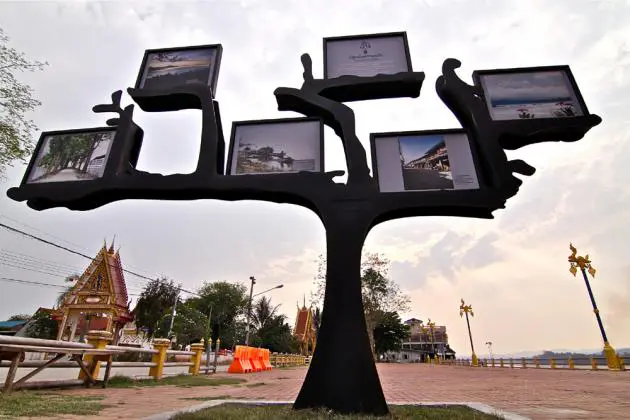
Local students recently used cameras provided by advertising agency TBWA\\Thailand to document the true “wonders” of their town for a competition that drew 289 entries. Thirty photos made it to the final round and the five best were displayed on the new “Tree of Hope” statue in Chiang Khan’s riverfront park.
“We encouraged the students to show us their favourite places, people and things,” explains TBWA\\Thailand president Chaipranin Visudhipol, who also heads the Advertising Association of Thailand.
“Besides learning their ideas, we got to see the things they deem meaningful and deserving of protection for future generations.”
Chaipranin visited Chiang Khan to announce the winners and unveil the Tree of Hope. Facebook users had picked the winners by popular vote.
The Tree took root in another community endeavour 18 months earlier. Chiang Khan was a pilot town for a “visioning exercise” in which the mayor led planners, businessmen, residents and journalists in brainstorming development paths for the emerging tourist magnet in the era of climate change.
TBWA\\Thailand, the Stockholm Environment Institute Asia Centre and the Southeast Asia Start Regional Centre hosted sessions of “foresight planning”, using techniques normally reserved for the business sector and large government agencies in developed countries.
Looking decades ahead, public officials, non-governmental organisations and citizens mapped out four potential scenarios for Chiang Khan’s future.
At best, they saw a low-carbon economy with sustainable tourism leading the way. At worse, they feared pollution and desertion, with no plans to tackle climate-related disasters.
TBWA\\Thailand launched the photo competition to continue the visioning project. “Encouraging young people to show their pride in their community would increase the chances that the town as a whole would work to preserve what they love,” says Chaipranin.
“I truly enjoyed sharing my hometown’s natural beauty through the camera lens, hoping that visitors will help us protect it so they and their friends and families can continue to experience what we have for years to come,” says Suppalap Kerdchaiyaphum, whose picture of majestic misty green mountain won first prize and Bt10,000, along with another Bt5,000 for being the Facebook favourite.
Chaipranin points out, though, that the project’s success depends on the students and others monitoring the local treasures that have been documented. Even the simple act of picking up litter at these sites helps remind everyone that it doesn’t take much to keep things special, he stresses.
“We’re proud of our young people actively roaming the town in their photo quest because it reminds us that Chiang Khan is lucky to have so much that’s worth protecting,” says Deputy Mayor Theerapong Saichan.
“Their awareness is branching out and will hopefully help spawn a canopy of preservation to maintain what we have for years come.”
