
Louvre opens new wing of Islamic art
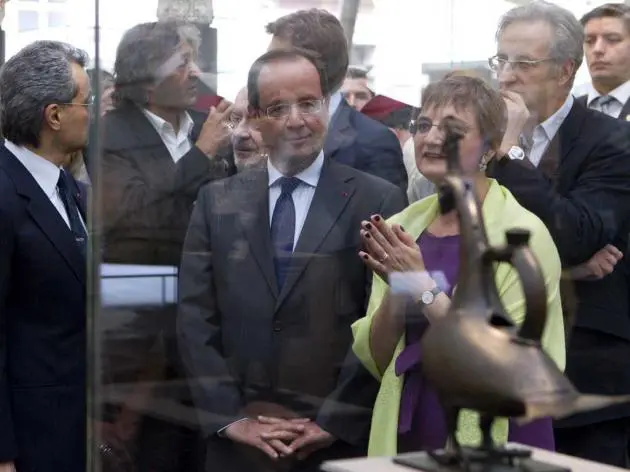


A huge new Islamic Art permanent exhibition at the Louvre in Paris is destined to cause as much of a splash when it opens to the public on Saturday, as the museum's famous glass pyramid did more than 20 years ago.
The Department of Islamic Art has been refurbished at a cost of 98.5 million euros (128 million dollars) and will cover 3,000 square metres.
“The Islamic civilisations are older, more vibrant and more tolerant than those who claim unfairly to speak in their name,” French President Francois Hollande said at the official opening earlier in the week, in a clear reference to the current uproar in many Muslim countries.
“Civilisations are not blocs that ignore each other or that clash,” the French president said.
The Louvre, like the French language itself, draws a distinction between “islam” the religion, written in French with a lower-case i, and Islam the civilisation, written with an I.
“A large part of the art of this civilisation has nothing to do with religion. Many of the objects were in fact made by non-Muslims,” says Henri Loyrette, director of the world's largest museum.
Some 3,000 artefacts will be on show, spanning 1,300 years of Islamic history over three continents. The exhibits will show the range of Islamic art, from Spain to India and from 622 up to the 19thcentury.
By contrast, the Metropolitan Museum in New York did away with its department for Islamic art in November 2011 and is now displaying art from Arabia, Turkey, Central and Southern Asia.
Architecturally, the new wing resembles variously a flying carpet, a Bedouin tent or the wings of a dragonfly. The new rooms in the Visconti Court are located under an undulating roof of steel and glass intended to give the imagination free rein.
The roof is expected to become a Louvre landmark in the same way as the glass pyramid in the museum grounds, inaugurated in 1989.
The Louvre owns one of the world’s largest collections of Islamic art. Much of it has been kept unseen for years in its storerooms.Apart from the 15,000 artefacts in its own collection, the Louvre also has access to 3,600 items from the decorative arts museum.
The Musee des Arts Decoratifs, which forms part of the Louvre complex, was unable to accommodate this part of its collection following its own recent renovation, completed in 2006.
The new Islamic rooms on two floors house treasures dating back to the very start of the Islamic empire. They include, for instance, an elaborate ivory casket from Spain with the name al-Mughira and a magnificent wooden door from the Dar Al-Khalifa, the palace of the caliph in Samarra, now in Iraq.
A stairway leads down to the lower gallery immersing the visitor in the world of the Thousand-and-One Nights. Pieces of jewellery from India set with emeralds glitter in the half-light, competing for attention with copper vessels inlaid with gold and silver from Egyptand Syria.
Beautiful ceramic mosaics from Persia provide a feast for the eyes.
The new exhibition could never have come about without generous private and state donations largely from the Muslim world.
Morocco, Kuwait, Oman and Azerbaijan put up a total of 26 million euros, while private donors, companies and foundations donated 30million. The Alwaleed Bin Talal Foundations set up by the Saudi prince contributed 17 million euros.
The French state stumped up 31 million euros, while the Louvre itself was able to find the remaining 11.5 million.
