
Contemporary dance


Play
performances from Brazil, Poland and Italy fail to ignite passions
Attending a contemporary dance performance poses something of a risk, especially to the uninitiated. Buy a ticket to see “Swan Lake” and you know what you’re going to get both in terms of story and choreography — the tragic tale of love between a prince and a cursed swan princess, as well as the black swan pas de deux with 32 fouette pirouettes.
With contemporary performances, you’re paying money to unravel the unknown and while some shows are well worth the cash, others simply fail to make the cut.
Last week, Bangkok’s 14th International Festival of Dance and Music presented three contemporary dance productions, which overall fell more into the second category.
First up was Brazil’s Quasar Dance Company, whose name means “a heavenly body with an extraordinary capacity to radiate energy”. It seems like a perfect name for a dance company, but is in reality a bit of an exaggeration for this one.
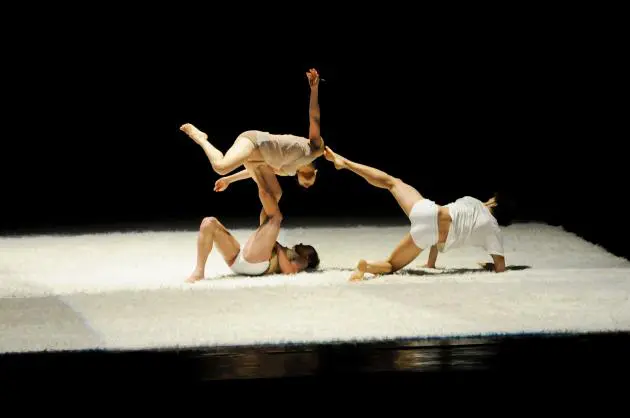
The first piece of their double-bill, “So Close”, questioned the distance between people and to what extent we should allow ourselves to get close to strangers.
The inspiration from this mental relationship ultimately materialised in the form of physical contact. Henrique Rodovalho’s choreography was composed mainly of flowing sequences of touches, turns and intertwinement, with no solos from start to end.
The movements took place on the furry carpet that covered the whole stage, causing the dust trapped in it to diffuse into the air as the dancers kicked their legs. That might not have been intentional, but it certainly made the show more visually interesting.
The second piece, “Up in the Mouth”, was a disappointment. Ambitious concepts of the law of physics, star explosions and black holes resulted in aimless choreography that felt like a lesser repetition of the first show.
“Waiting For…”, the first of two productions staged two days later by the Baltic Dance Company from Poland, was also unexceptional. Based loosely on Samuel Beckett’s masterpiece “Waiting for Godot”, the piece tried to explore the yearning for unrealised dreams but instead left the audience yearning for a quick release from mediocre moves and unpointed feet.
The performance picked up during the modern dance-theatre rendition of Stravinsky’s “The Rite of Spring”. Choreographer Isadora Weisstook the title metaphorically and explored negative gender stereotypes that become more distinct as children grow up.
The most important actions took place on a raised platform in the middle of the stage, with a cameraman circling the area and projecting his real-time, close-up footage of the female dancers’ expressions onto a large screen.
This setting served as a ring for the battle between the genders, starting with sensuous courtships that shifted into frenzied fights in which the males almost always had the upper hand. The men stripped the women down to their underwear and forcefully pulled their mouths apart to form fake smiles before ending their lives.
While the objectification of women is undoubtedly an issue of which people should be aware, it was overdone here and thus failed to impress, especially as it was conveyed through such excess props as chairs and water guns.
Spellbound Dance Company’s “The Four Seasons” was the best in this year’s contemporary dance lineup.
Based on Vivaldi’s magnum opus, the music was a surprisingly pleasing mash-up between the original score and electronic music.
The choreography, too, went beyond movements of various tempos that matched the characteristics of different seasons. It reflected the cycle of life — human growth, budding love, old age and death —on the ground, in the air and on the surface of a box-like structure that ingeniously changed from a tree to a boat and a house with little flips or turns of angles.
The dancers hid in the structure to observe the changing seasons, springing from and leaping into its hollow space. The surface also served as a textured screen on which mesmerising video art showing abstract plants made of green brushstrokes as well as real drops of water and falling leaves was projected.
The dancing was neat and of a high technical level. Although this Italian production wasn’t the most innovative, it was well thought out, well rehearsed and brought the curtain down on a week of dance on a good note.
enchantment in the woods
- The festival’s dance programme now goes classical with “Swan Lake” by Staatsballett Berlin being staged on Tuesday and Wednesday at 7.30 at the Thailand Cultural Centre.
- Tickets cost from Bt1,000 to Bt4,500 at www.ThaiTicketMajor.com.
- Find out more at www.BangkokFestivals.com.
