
RECYCLING TRADITION - AND SWANS


In France, a taste of South African contemporary dance |and the best production of 'Swan Lake' ever
Before my last day at the Biennale de la danse Lyon, which was coincidentally South Africa’s national heritage day, I had neither watched a contemporary dance from South Africa nor had any idea what it would look like. I had one evening left and needed to choose between “Swan Lake” and “Beauty Remained for Just a Moment then Returned Gently to Her Starting Position”. I picked the latter, of course.
At the entrance to Le Transbordeur, everyone was given a bottle of water. Inside, we saw a video of a man holding a sign on a sidewalk like a hitchhiker. He was looking for “beauty”.
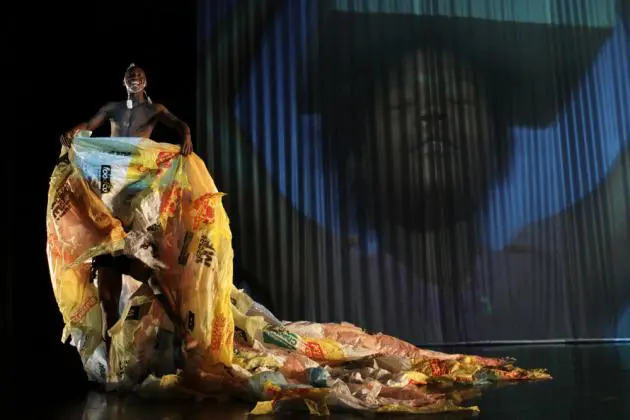
Renowned choreographer Robyn Orlin and her company, Moving into Dance Mophatong, then presented a unique blend of theatre, modern dance and traditional African dance and music, as well as a large amount of audience participation.
We were asked to drink up the water and throw the empty bottles onto the stage. The dancers then collected them into garbage bags, which later became their percussion instruments. All their costumes were made from recycled fabric and objects and deftly designed by Orlin’s counterpart in the fashion industry, Marianne Fassler.
Having been fulfilled with my last show in Lyon and discovered a new angle to view and a fresh appreciation South African contemporary culture, I enjoyed a Lyonnaise dinner with an Australian producer I met four years ago in Adelaide.
We were then joined by two Singaporean friends, from the Esplanade’s programming department, who raved about Dada Masilo’s “Swan Lake” and also mentioned that they already discussed the possibility of presenting it there in 2014. (It’s fully booked for 2013.)
Back in my hotel room, I went online and checked where “Swan Lake” would travel next – two years is too long to wait. I was lucky: It was scheduled for performances at Muse de Quai Branly in Paris a month later, and my Australian friend and I planned to be there.
In the beginning, Tchaikovsky’s music lured us into believing that this was going to be another standard version, but then we could see that all the dancers were barefoot and the male ones also wore white tutus, like their female counterparts. Shortly afterwards the dance was interrupted by an actor-dancer portraying Prince Siegfried’s father, who gave a brief and hilarious summary of the ballet, which in the end helped cutting down the performance time to only 70 minutes.
When he described the world-famous dance movements using sarcastic terms like “virility splits” and “seaweed arms”, we roared with laughter and applause.
A major twist, a queer one, was when Siegfried fell in love with the Black Swan, who was portrayed by a beautifully muscled male dancer and yet he showed extraordinary balance between strength and flexibility in their duet.
Towards the end, when Odette, performed by Masilo herself with an exemplary mix of classical ballet and traditional African dance, was heartbroken, she was joined by her fellow swans, now all in black tutus and bare-chested, men and women alike. And so, with this work, she is successfully questioning, if not defying, racial, cultural and sexual hierarchy – not only in the classical ballet but also in the contemporary society.
“Swan Lake” also made me think of the way this most popular ballet has been staged and presented here and in many countries in Asia, in a way that looks like it was frozen in time like a museum artefact from another period and country.
The way classical ballet has been taught in Thailand reflects this mentality too. Thus it’s no longer a surprise that, even though there are a significant number of children taking ballet classes, they rarely go to see contemporary dance. We have been taught to be too respectful perhaps, despite the fact that we’re known as people who love adapting and we’ve never been politically colonised by any European country.
In the end, after having watched 10 productions of “Swan Lake” by companies around the world, this “Swan Lake” became my personal favourite and I now look forward to watching more of Masilo and Orlin’s work. They both confirm that watching dance is more than shutting down the brain and experiencing beauty with the eyes and emotions. It’s a chance for each member of the audience to think of what it means to us in the world of reality when the curtain comes down.
The writer’s trip was supported by the French Embassy in Thailand, Institut Francaise and Biennale de la danse Lyon.
