
Burning up the stage
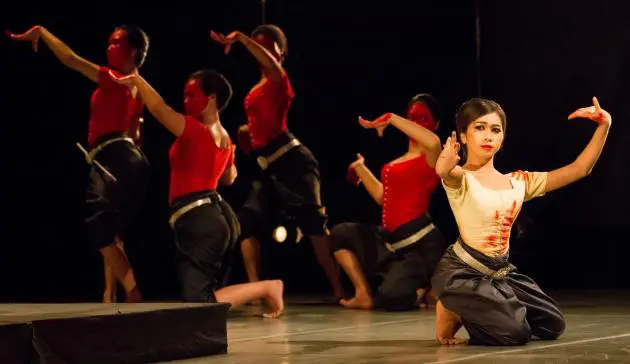


Choreographers from Cambodia, Indonesia and Thailand offer their insights on contemporary dance
Bringing down the curtain of “Our Roots Right Now”, the 10-day, 10-night research forum and festival on Thai and Southeast Asian contemporary dance and theatre at Chulalongkorn University’s Sodsai Pantoomkomol Centre for Dramatic Arts last Monday, was “Fire, Fire, Fire: Contemporary Southeast Asian Choreography”. It featured three different versions of Sita’s trial by fire, an episode of the “Ramayana”, by three of the region’s leading choreographers: Sophiline Cheam Shapiro, Eko Supriyanto and Pichet Klunchun and their companies, Khmer Arts, Solo Dance Studio and Pichet Klunchun Dance Company respectively.
“Fire, Fire, Fire” premiered in Phnom Penh on January 24 with support from the Goethe Institut’s Tanzconnexions project and over the past week has since been staged in Jakarta and Solo.
In between their dress rehearsals in the morning and afternoon, the three choreographers shared their insights with students and professionals. In Shapiro’s “Broken Angels” workshop, she showed how to infuse feeling with the highly codified and rigid form of classical Cambodian dance. In “Flow, Slow, Spiral”, Supriyanto explored flow, slow and spiral movements in contemporary dance based on Javanese court dance in which he was trained. In his masterclass, Pichet put the processes of creating dance into three stages – “Picture, Posture, Life.”
In the evening, the full-house audience witnessed our multi-faceted Southeast Asia through three 20-minute dance pieces performed continuously without an intermission. Shapiro’s work was more literary than the other two and didn’t venture as far from the tradition. It was also sumptuously beautiful, fittingly slotted as the opener of the triple bill.
Pichet played with the image of fire, and the movements looked like those of western modern dance yet showed traces and the philosophy of classical Thai roots. It seemed that he was also trying to disappoint some audience members by not giving them what they wanted – the exotic images of Thailand. The most riveting of the three, Supriyanto worked on the notion of confrontation and showed how various traditions have been blended and processed into a unique contemporary dance vocabulary.
At the post-show discussion, which lasted as long as the performance itself, the three choreographers were joined onstage by Hong Kong’s experimental art pioneer Danny Yung. Shapiro explained the development of this unique project over the past three years, saying that a production had not originally been planned, only a sharing of knowledge and ideas among the members of the three companies through workshops.
Curious about the collaboration, Yung asked why each choreographer did not try working with the dancers of the other two companies and why there the show didn’t feature a fourth part – one they had created together. They didn’t give a direct answer, and I assume that the reason is either they didn’t have enough time or that the dancers were still confined to their training and artistic director, or master. That true collaboration could perhaps be the next phase of development, once they become reacquainted with one another.
Pichet warned the audience that the three troupes are not representative of their countries, but in fact are trouble makers, because of what they are doing to their dance and theatre traditions. He also noted that the differences in their three choreographic pieces show how time has progressed differently in each country, and this also causes the contemporariness to vary, at least to a certain extent.
Nonetheless, this project serves a possible model for the development of contemporary dance in the region though we still have a long way to go.
I was recently at a school’s homecom?ing event whose slogan managed to sneak in the word “Asean”. On stage was what I’d call a hodgepodge of traditional dance from various Asean countries yet what the audience really enjoyed that evening was, inevitably, the Gangnam dance. This shows that we only
care about our neighbours’ culture on the surface level. That’s not what it takes to be part of the AEC.
TRIPTYCH OF STYLE
For more on the three dance troupes of “Fire, Fire, Fire” visit, www.Khmer?Arts.org, www.SoloDanceStudio.org, and www.PKLifeWork.com.
More contemporary dance will be pre?sented in the Goethe Institut’s Tanzconnexions with 18 Monkeys Dance Theatre’s “Lieber Adzio” on March 16 and 17 and Total Brutal’s “Dancing to the End” on March 23 and 24.
For more details, visit visit www.Goethe.de/Tanzconnexions.
