
'Otello' Finds its Life in Death
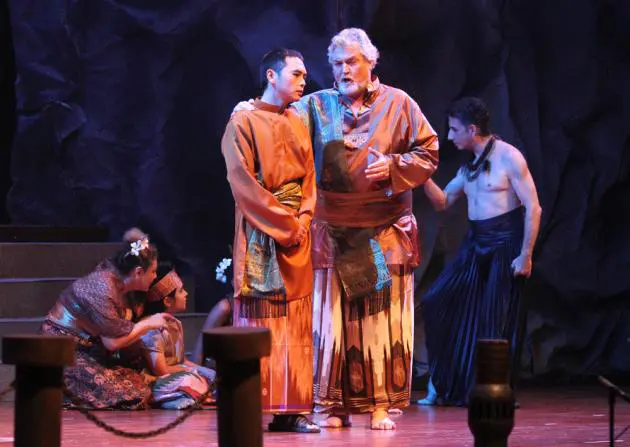


The Siam Philharmonic rescues an opera dulled by wooden acting
The fourth act of Opera Siam’s “Otello” last Thursday night at the Thailand Cultural Centre was magnificent. The superstars, however, were the orchestra’s low wind instruments, sounding sensually cool as they prepared us for the tragic finale of Verdi’s operatic telling of Shakespeare’s story. Jealous Otello, misled by the evil and equally jealous Iago to believe his wife Desdemona has been unfaithful, kills her – and then kisses her dead body.
For this act, the cast came together with strength. Soprano Nancy Yuen was rapturous in her grief, her singing of “Hail Mary” affecting, her death acted out with ghostly vocal sounds as Desdemona protests her innocence.
Tenor Jeffrey Springer as Otello finally brought some subtlety to his role, so that we came to pity as well as hate his character. His kisses expressed real love and loss, and his singing expressed pain and not only angry dementia.
Somtow Sucharitkul’s extraordinary orchestra completed the drama. The feeling of stillness as wind instruments danced for us was profound; the trumpets as Otello tells Desdemona to pray were fateful; the ensemble brought home Otello’s pain as he realises his horrific mistake, stabs himself and, before dying, plants a final lurid kiss on his already lifeless wife.
The first three acts were, however, at best uneven. Javier Agullo as Cassio, wrongly accused of being in love with Desdemona, was the one consistently wonderful singer. He is a real Verdian lyric tenor, with a sweet and endlessly expressive voice, and gave pleasure every time he appeared onstage.
Lyricism is necessary for the other male roles as well. Otello should not be portrayed simply as a covetous murderer, but as someone deeply in love with his wife and tortured by doubt as well as by the resolve to do what he has to do.
Springer’s voice, though strong and clear, lacked beauty, and his characterisation was for the most part lacking in subtlety. He was good at being a brute, flinging Desdemona to the floor in rage. But he made little of the fact that Otello is an outsider, a Muslim raised to high office, and missed far too many chances to make the audience think about his character’s predicament.
Phillip Joll also had a clear, strong voice, but scored low in vocal expression. Both Springer and Joll were often wooden and obvious in their acting, in a production that was far too static. Yuen sang sweetly throughout, but her voice lacked power and her Desdemona frankly only really came to life as she was about to die.
Emanuella Barazia did give character to the smaller part of Emilia. Ralph Mcdonald, however, was cast well beyond his capabilities in another small role, Lodovico.
Somtow added a rarely performed dance to Act III, but it became clear why it is generally left out. It broke the continuity, and the choreography and dancing was at best mediocre.
The choral performance was adequate and at times better than that. It was the Siam Philharmonic that was the evening’s saving grace, underlining Somtow’s great achievement in building world-class orchestral forces in Thailand. During the dryer sections of stage action, it was possible to just close one’s eyes and allow the music to tell the story.
The brass was blazing, the percussion driving, the winds beguiling and played with such accurate virtuosity as well as pathos. And the strings were crisp, clean and showed that Somtow knows how to build classicism into a romantic opera. Orchestral brilliance means that any Somtow evening is going to be illuminating, even if other elements go astray.
But more careful attention to casting and dramatisation next time will ensure that the all-round excellence of so many of other Somtow productions is once more achieved.
