
A bell rings in paradise


Play
And another day starts at Bali's Green School, where kids learn to respect their environment and shoulder responsibility for its preservation
As in any other school around the world, students at the Green School in Bali are taught the rigours of mathematics, science, languages and other general subjects. The difference: they’re also learning to grow rice paddies. And yes, there’s a mud-wrestling pit here too.
The school was founded in 2006 by John Hardy, a former jeweller, and his partner Cynthia. The idea for a school based on ecological concepts first struck Hardy when he watched Al Gore’s documentary on global warming, “An Inconvenient Truth”.
The curriculum, besides other subjects, focuses on instilling an awareness of their environment in students and teaching them sustainable and self-reliant ways of living.
Located in the secluded Sibang Kaja forest in the centre of the island, the school is a striking site – both in terms of its looks and its philosophy.
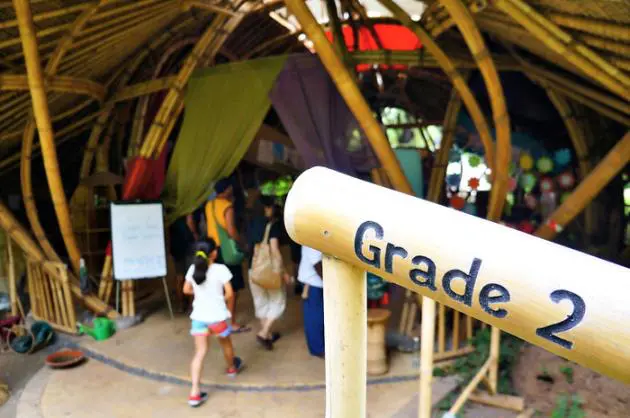
The complex’s distinctive buildings have all been constructed using sustainable natural materials like bamboo, and the premises are chock full of greenery – trees, plants, flowers everywhere you look. Among its most quirky features, aside from the wrestling pit where we saw several students playing, is a healing circle, featuring a large, brown crystal from Brazil, as well as a massive musical instrument crafted out of bamboo pillars and strings that emanates soothing sounds when played.
As impressive as the structure itself is, the school’s real achievements are seen in its unique teaching methods, disseminated to the almost 300 students from over 45 countries who are presently enrolled here.
“We’re not trying to be just another hippie school in the jungle,” says Ben Macrory, head of communications at the school. “It’s not like we neglect the traditional curriculum … we want our kids to be able to compete with students from any other school when they leave.”
Macrory explains that it is the emphasis on respect, humility and appreciation of all forms of life that sets the Green School apart from its more conventional counterparts in the education system.
Indeed, students are kept busy with a number of creative projects that have been crafted to help them understand the significance of preserving natural resources and wildlife. The “pet project”, for instance, assigns to them a particular animal – whether a rabbit or the rare Bali Starling – to take care of, teaching them responsibility for animals.
Each classroom also has its own garden to cultivate, and students grow rice in paddies that are harvested once in a while.
“The idea behind this particular project is to take students through the rice-growing process,” Macrory says. “It’s meant to show them where their food comes from, and to inspire respect for the produce they consume on a daily basis.”
The school also boasts energy projects; the site has been fitted with about 108 solar panels, all of which work to provide 80 per cent of the school’s total electricity needs. A micro-hydropower system is also in the offing. “Hopefully, we can become completely self-sufficient and go off the grid once that comes about,” Macrory says. “We could even share our surpluses with the locals at some point.”
Besides the school’s main buildings, Hardy also built lodgings on the nine-hectare plot, creating a village of sorts that is currently managed by PT Bamboo Pure. Visitors are welcome to tour the premises to see how the school functions, and green camp programmes are often held for those between six and 18 years of age.
Its remarkable efforts won it the Greenest School on Earth Award in 2012, bestowed by the Centre for Green Schools at the US Green Building Council. Forging ahead as it has in nurturing youngsters who are respectful, responsible and far-sighted with regards to the environment and other fellow beings, the school is a beacon of hope in these desperate times, and a model communities around the world should certainly consider replicating.
