
Heavyweight of history


Play
Nanjing, China's former capital, has a rich past - and not all of it bloody
The past jostles with the present for your attention in Nanjing, China’s former capital and now administrative centre of Jiangsu province. The city sits on the spot where the Yangtze River and the railway from Beijing meet, a position that helped it become a commercial and political hub – and a crossroads of world history.
We arrive late Friday, pop out of our hostel to admire the surroundings, and immediately get swept up in a horde of people. Surely this human deluge is either fleeing a fire or mobbing a celebrity? The answer is soon apparent. We are staying quite literally around the corner from Nanjing’s famous Fuzimiao area.
Here, the Song Dynasty (960-1279) Confucius temple that gives the area its name plays stately host to the crowds. And then there is the Qinhuai River – pretty by day but gorgeous at night when the water comes alive with reflected neon.
There are glitzy shops and restaurants that cater to tourists and alleys containing numerous stalls where you can buy everything from snacks to pets – preferably not at the same place.
I am delighted to discover that stinky tofu is a local speciality, my travel companion considerably less so.
The next morning, we rise early and head to the city walls, which are more than 600 years old. Nanjing’s south gate is known as the “Gate of China”, and the gate complex contains a small archery range where we establish the generation and gender gaps between English legend Robin Hood and “The Hunger Games’ Katniss Everdeen.
The walls rise to form an elevated plaza, a favourite meeting place for families with young children. Various games are played with various degrees of passion, and panoramic views of the city are garnished by brilliant blue skies and more than a few kites.
From here we trek north, detouring for a quick walk around the rather pretty Mochou Lake before heading west to the Memorial Hall of the Victims of the Nanjing Massacre.
In 1937, the Japanese army occupied Nanjing and began six weeks of destruction, pillage, rape and slaughter. At that time, more than 300,000 people were killed, and the memorial is a stark reminder of that loss.
The pyramidal structure looms over the surrounding buildings, as does the grief-contorted statue outside it. The exterior is minimalist. Small statues, commemorating the fallen and those who fled, keep watch beside a long, quiet pool.
Inside, the aesthetic is similar. There is a giant cross standing over paths that cut through gravel, leading to walls bearing the names of those who fell to Japanese cruelty. There are historical documents and films, but the simple, powerful emptiness stands as a silent tribute to the trauma the city endured.
The sun comes out the next day, timing its appearance to perfection as we head for Purple Mountain. Known in Mandarin as Zijinshan, the site is a glorious hodgepodge of parks, paths and ancient tombs that would take days to fully explore.
We initially have our hearts set on a cable-car ride to the peak, but we soon get distracted by the mausoleum of Sun Yat-sen. Sun, a revered revolutionary leader who played a pivotal role in overthrowing the imperial rule of the Qing Dynasty in 1911, wished to be buried in Nanjing. Today, thousands of visitors make a pilgrimage to his tomb each day.
The mausoleum sparkles in the sunlight. Climbing the 392 stone steps involves dodging plenty of people looking through the viewfinder of a camera. But it’s worth it once you soak in the view, as serene as the statue of Sun that greets you at the top.
For lunch, my companion has heart set on one thing and one thing only: duck-blood noodles. These are vacuumed up by millions of Nanjingers every morning. The broth is tasty and the texture of the duck blood is somewhat unique. Even better, after a brief quest I happen upon more stinky tofu.
Sated, we next head to the Linggu Temple and its trademark Beamless Hall – as the name suggests, no trees were harmed in the construction of this brick-and-stone edifice. Wandering around the paths takes us to the Linggu Pagoda, which peeks through the trees as you walk toward it.
Upon entering, we spot insects flitting around - closer inspection reveals an abundance of ladybirds. They perch on the banister of the spiral staircase that leads to the top, and a woman climbing up ahead of us confides that they are reincarnated souls that have come back to the pagoda. We nod, and watch where we put our feet.
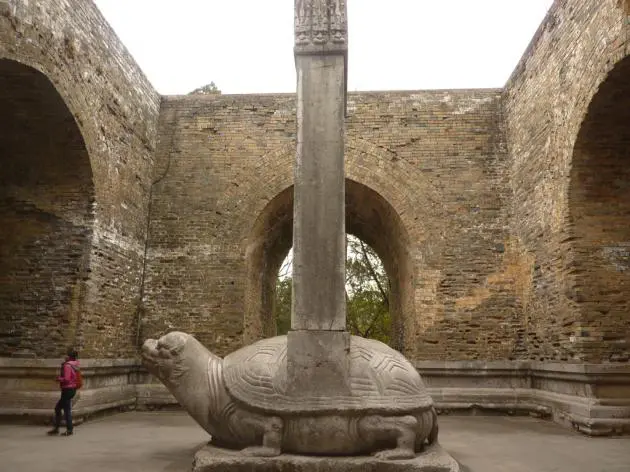
Next, we check out the Zhongshanling Bandstand, an amphitheatre with an impressive stone stage that is hosting the even more impressive warbling of any Nanjinger who deigns to pick up the microphone. Then, as dusk gathers, we head to the Ming Dynasty (1368-1644) Xiaoling Tomb.
The tomb itself, about 800 years old, has not been explored. But the same cannot be said of the lovely network of paths and scenic spots that surround the structure.
On our way out, we are very excited by the “spirit path”, along which various animals line up on either side. We interrupt hordes of amateur photographers trying to take pictures of stone camels, elephants and lions in the gathering dusk.
Tired, we head to the city’s 1912 bar district for sustenance and spirits. The hours before our flight back to Beijing are spent playing cards. To top things off, there is a vendor at the district’s entrance doing a roaring trade in stinky tofu. We partake, and for once we are in agreement – it is the best we have sampled on the trip.
