
Incredible shrinking Bangkok


Play
The capital at 1:100 scale is among the wonders to behold at the Thailand Creative and Design Centre
Bangkok has earned its place in the tiny, perfect paper world of Japanese artist Naoki Terada, where Tokyo, New York and Amsterdam had been the only sizeably populated places until now.
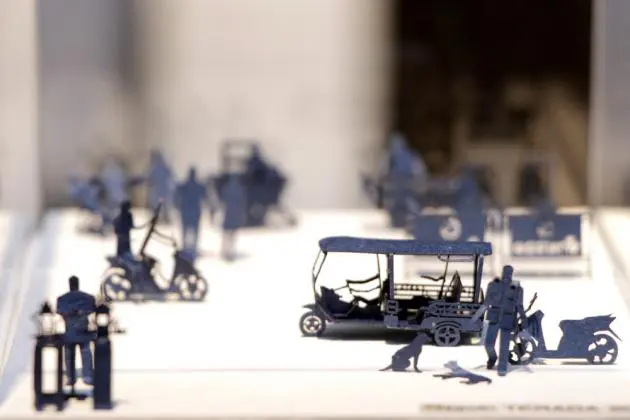
In “The Life of Terada Mokei”, at the Thailand Creative and Design Centre, the smallness of the disarmingly simple renderings creates a breathtaking big picture. He makes 1:100 scale models from laser-cut paper. People, animals, trees, streets, vehicles and buildings pop up from single sheets. Mokei is “model” in Japanese.
There are 18 sets of miniature models in all, displayed in glass boxes. You can admire scenes from everyday life in Tokyo – ramen noodle stalls on the sidewalk, cherry trees in blossom – and New York, with a subway station, a lively open-air cafe and a romantic wedding underway in a chapel.
Now, for the sixth exhibition in the Meets Project in Asia series launched last year by Japanese designer Satoshi Takiguchi for artists to exchange ideas and show their work abroad, there are Bangkok vignettes. Terada spent four days sizing up the city and decided to depict a tuk-tuk, a motorcycle-taxi driver with a coterie of dogs, and a man praying at a spirit house. There’s a street vendor holding a pineapple and a noodle pushcart with stools for the customers.
The models, seeming a million times smaller than the real things, are utterly simple, with no fine details, but Terada believes that when models replace reality, they too assume the essence of reality. They are the stuff of dreams – with the potential to come vibrantly true.
“The 1:100 scale is the one most commonly used in Japan,” says the founder of Terada Design Architects. “Viewing a small model is like viewing the real thing from a distance. This is like origami to which you can attach your own feelings.”
Architects rely on such models, of course, to help them and their clients visualise different designs for a building, and it’s common to enhance the models with miniature people and landscaping. Terada made the models in 2011 for his firm. The first of his “1/100 Architectural Model Accessories Series” involved houses and offices, but they were lively with people, pets, furniture and computers atop workstations.
“When I unveiled the fourth in the series – a zoo – there was a lot of good response, and not just from architects,” says Terada. He sells kits for others to try their hand at assembling the models. “People loved the simple forms of the animals, like elephants, deer, squirrels, swans and cranes. They wanted to build them themselves and explore their own imagination.”
The “Cities of the World” series, capturing vibrant characteristics of Tokyo, New York and Amsterdam, brought critical acclaim.
Viewers marvelled as they spotted the tiny vending machines of the Japanese capital, and even a guardrail around the gingko trees. The miniature New York has skateboarders, vendors selling hotdogs and pretzels and a policeman on horseback. His Lilliputian Amsterdam has bicycles – lots of bicycles.
“We pass mailboxes and trash bins around the city every day, but we rarely notice them,” Terada points out. “I have to do this deconstruction to get at the essence of the thing.”
Part of Bangkok’s essence is its unchecked sprawl, so it’s fitting that pieces of the shrunken city can be found beyond the main lobby exhibition. Members of the TCDC’s library will find several icons there, as well.
“I portray Bangkok through the eyes of a foreigner, a stranger,” Terada says. “On my first day I walked around without a camera – I wanted to see the city through my eyes, not a viewfinder.
“The second day I started photographing things that attracted me and looked at them from long distance to get the right proportions. And over the next days I took measurements of the actual size of objects and observed their functions. The distortion of form can’t be done without the full-scale size.”
He struggled a bit to scale down a tuk-tuk “because its shape is rather
complicated. I felt pressured to do it, though, because it’s the most famous symbol of Bangkok, but I had limited time.”
Next he executed 2D drawings of all his subjects and sent them to a factory to be laser-cut in paper. That took two or three tries before the models were complete.
“South Korea and Taiwan might share some things in common with Japan, but Bangkok is totally different,” Terada says. “In Japan people normally eat dinner at home, but Thais tend to enjoy eating out – that’s why Bangkok’s street food is so vibrant and interesting.”
Each model set has three tones, with black and white predominating and a third colour chosen according to the context.
“I chose red for New York because it’s known as ‘the Big Apple’, and green is the official colour of Tokyo. Orange is associated with Amsterdam. I took a lot of time coming up with a suitable colour for Bangkok – I certainly didn’t want my work to suggest either side of the political conflict, so red and yellow were out. Finally I decided to use blue because it’s one of the colours of the Thai flag.”
Terada acknowledges that the model kits available for each city set could be far more complicated and intricate, but he prefers to keep them simple and easy so anyone can enjoy assembling them.
“There are two kinds of people who buy my models,” he says. The first think it’s challenging and exciting to assemble all these tiny things into a scenario. The second – the majority – just enjoys envisioning the parts unassembled. They’re happy to just look at the blueprint and imagine the potential!
“Well, if it makes you happy just to hold the package, that makes me happy as well.”
MAGNIFY-CENT
>>> “The Life of Terada Mokei” runs until August 11 at the Thailand Creative and Design Centre on the sixth floor of the Emporium.
>>> It’s open daily except Monday from 10.30am to 9pm. Admission is free.
>>> The Terada Mokei model cities sell for Bt700 each in the centre’s shop.
>>> Find out more at (02) 664 8448, extension 213, 214, or visit www.TCDC.or.th.
