
Jewels as light as a feather


Whither the kingfisher, whose plumes the Chinese once regarded as more valuable than gold?
Think gold is precious? If you listen to Xiao Guang-chun, the shimmering metal is almost nothing compared to another of nature’s treasures – this one commands a much more lustrous shine, a shine charged with an irrepressible, time-transcending life force.
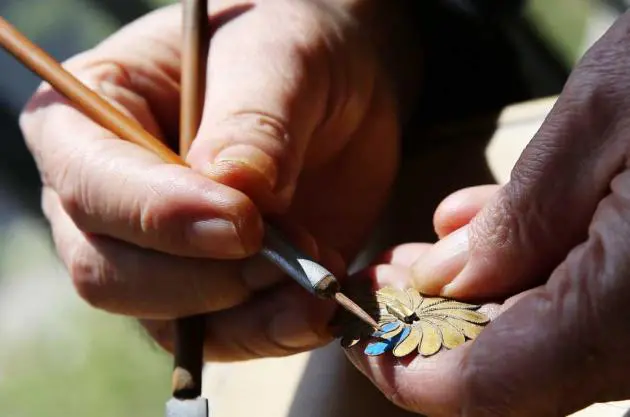
It is the shine of kingfisher feather, the feather of a small, jewel-toned bird that Xiao has been applying tirelessly, for the past four decades, on the surfaces of antique golden accessories, in an effort to resuscitate their time-worn beauty and charm.
“Aesthetically, our ancestors placed the kingfisher feather way ahead of gold,” says Xiao, pointing to the fact that the latter had been reduced to a mere “base” status in almost all head accessories made for upper-class court ladies during China’s dynastic periods.
“Despite gold being valued as the most precious metal – and a form of currency – at that time, in creating jewellery, artisans routinely covered the entire surfaces of their gold-wrought designs with the feather, leaving only golden fringes to set off and accentuate the plume’s iridescent blue hue.
“These days the colour is sometimes referred to as ‘Turkish blue’, after Turkish turquoise, I suppose. But in my view it’s a shade of its own, indefinable by any other worldly thing,” says Xiao. “Mother Nature has only this one tube of paint and she lavishes it on the wings of this lucky little bird we call kingfisher.”
But there’s one thing that could, hopefully, do justice to the beauty of the feather. It’s the name assigned to Xiao’s art.
“People call the process dian cui, meaning ‘a dipping of blue’,” he says. “It so perfectly captures the silken texture of the plume, which, under sunlight, seems to melt into a reflective and miraculous pool of indigo.”
Not only that, the very term also hints at a dian cui master’s light, delicate touch when letting the colour flow onto the golden surfaces, one piece of feather at a time. It’s lightness that’s rooted in decades of practice, and rendered possible by a calm state of mind. “The amount of patience he’s shown seems to belong only to a woman, not a man,” says Li Dafen, Xiao’s wife of nearly 40 years.
Like all artisans who have grown up knowing no god other than the god of his own calling, the 63-year-old Xiao talks fervently about his skill, which is deceptively simple yet punishingly complicated and time-consuming.
“To make sure the feathers stay there firmly and smoothly, for hopefully a hundred years or two, you have to go through a process dictated by strict rules,” he says. It’s also a process filled with diligently guarded trade secrets. Xiao’s late father passed the skills on to him, exclusively.
“My father personally embodied for me the dying art. And he taught me everything there is to know about it, at a time when the possession of such rare skills could lead to persecution,” Xiao says. He is talking about the Cultural Revolution (1966-76), during which everything luxurious was denounced as “immoral”.
“My father, who had been doing dian cui since he was 12, was barred from working. In retrospect, what was the greatest pathos for him was a stroke of luck for me since, for the first time, he truly opened up and revealed for me a world behind all the beauty and glitter that met the eye.”
When the social chaos eventually came to an end, Xiao became a master in his own right. His reputation spread in the following decades, to the point where he found no need to hawk his trade.
“They all came to me – collectors from as near as Beijing and as far as Hong Kong, Taiwan and Europe. I once repaired for a Hong Kong client a rare Qing Dynasty hairpin whose feathered surface was largely damaged because of age and lack of proper care. The owner later sold it to the British Museum in London, a decision he would come to regret gravely.”
Over time, two different tendencies have coalesced within the same person: One demands the beauty of his art to be seen and appreciated, by as many people as possible; the other wants to hide it, at least the creation of it, completely from public view.
For the past two years, failing eyesight has largely prevented Xiao from working. And it was not before much persuasion and coaxing that his only daughter reluctantly agreed to learn his art. He also asked his son and daughter-in-law, but neither showed any interest.
So, what’s next? Will there be one day when dian cui will be lost forever, like many age-old techniques that have suffered the same fate? “That’s beyond my answering,” Xiao says.
The exact time dian cui originated is disputed, but the decorative method, extremely popular among ladies from the aristocratic class, reached its zenith during the reign of Qing Dynasty Emperor Qianlong from 1736 to 1796.
The reason the kingfisher is preferred over any other bird is because its feather can retain its colour and lustre for decades, even centuries. This has proven to be both dian cui’s doing and undoing, especially at a time when the avian species has become a rarity, just like the men who practise this ancient craft.
