
Chips off the Chinese block


Play
A new exhibition of Qing dynasty porcelains relates the closer relationship between the two countries
WE DON’T USUALLY think of ceramics as great storytellers but the chipped porcelain, cracked teapots and shards of pottery on show at Museum Siam speak volumes about the centuries-long relationship between China and Thailand.
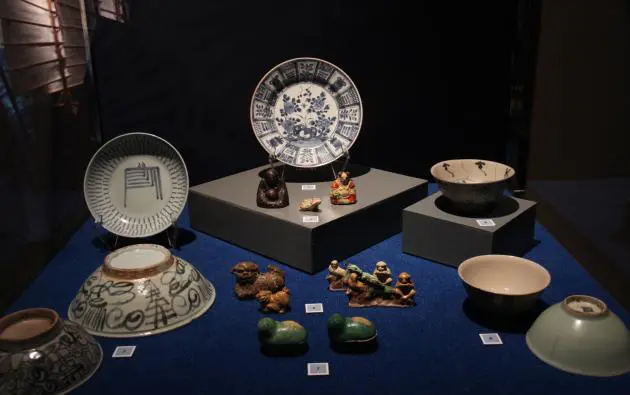
Organised by the National Discovery Museum Institute (NDMI) and Southeast Asian Ceramics Museum (SEACM) of Bangkok University, the exhibition, “Qing Export Porcelain in the Kingdom of Siam during the Arrival of Chinese Junks”, paints a fascinating portrait of the late Ayutthaya period, when Chinese junks and traders first arrived in Siam.
“This exhibition shows the porcelains shipped by China to Siam during the late Ayutthaya period and the early Rattanakosin era,” says Dr Pariwat Thammapreechakorn, director of the Southeast Asian Ceramics Museum.
“These historical pieces were produced between the Kangxi and Daokuang empires or, in Thai terms, between the reigns of King Prasat Thong and King Rama III.”
The exhibition is divided into three zones: exported Qing pottery, Chinese Junks and a video presentation that introduces the locations of the wrecked ships during the 100 years stretching from 2300 BE (1757).
“Chinese junks were sailing to many countries in South China Sea long before Ayutthaya era. Archaeologists found many Chinese porcelains from the Tang Dynasty in the former Dvaravati and Srivijaya kingdoms,” says Pimprapai Pisanbutr, a descendant of a Chinese junk trader and the author of “Krabueng Thuay Kala Tak” (“Chipped Porcelain”), which looks at the history of Chinese porcelain in Thailand as well as old Chinese families in Thailand and their culture.
From Ayutthaya until early Rattanakosin, Thailand had to send a tribute to the Chinese court to ask for trading approval. China would then in turn send a tribute back to the Siamese court. High quality porcelain was also included in the tribute to Thailand, as the Chinese considered that fine porcelains were as valuable as fine jewels.
“In the old days, Thailand would send a tribute to officers at Guangdong, a province on the South China Sea coast of China, and those officers would forward the tribute to the royal court in Beijing,” said Pimprapai.
While the angry sea, unpredictable monsoon and hidden reefs in the South China Sea often proved too dangerous for sailors, the traders from China had no compunction about risking life and limb. They were skilled mariners and very knowledgeable about the monsoon. The three masted Chinese junks setting out for the southern sea would weigh anchor around the lunar New Year and reach their destination three or four weeks later, returning after the change of the monsoon winds in early June.
These vessels loaded with tea, silks and paintings from China relied very much on their stashes of porcelain to make it to the Siamese shores.
“Chinese porcelains were not only popular goods, as back then China was the only country who knew how to make porcelain, but were of vital importance to the junks because they were used as ballast, Pimprapai says.
“Silk and tea were too light to provide the desired stability so the traders usually loaded porcelain ware in the bowels of the ships, both to provide stability to the vessels and because they were impervious to water, unlike the more expensive tea and silk stored above. When they reached Thailand, they would sell all the porcelain ware and load goods like rice and spices from Siam to take back to China.
“When the royal court of Siam ordered porcelain from China, they would give the designs and patterns to the merchants. The porcelains for Siamese court came from Jingdezhen, which was considered the Porcelain Capital of China. The porcelain bowls with lids are examples of Siamese design. We’ve also found Thep-phanom, the traditional Thai pattern that portrays a god pressing his hands together at the chest level in the sign of respect, on ancient tableware from Ayutthaya era. The patterns on shards unearthed in the old city are also similar to the patterns on the temples in the Ayutthaya period,” says Pimprapai.
After the Second Fall of Ayutthaya in 1767, Taksin the Great established Thonburi as the new capital on the banks of the Chao Phraya River. The new king tried to foster a relationship with Qianlong, emperor of the Qing dynasty, but he refused to recognise King Taksin as the legitimate ruler of Siam. It wasn’t until 1777 that Qianlong finally accepted King Taksin and allowed trade between the two countries to resume.
Trading with China brought money and labour, with the coolies helping to build the kingdom in Thonburi and Rattanakosin.
“The Qing dynasty was greatly weakened during the early Rattanakosin period and many Chinese left the country to seek better lives. Five main ethnic groups from southern China migrated to Thailand; Tae Chiew from Chaozhou, Guandong or Cantonese from Guangzhou, Fujian or Hokkien from Quanzhou and Zhangzhou, Kejia or Hakka from many parts in southern China and Hainan from the northern part of Hainan island,” says Professor Supang Chantavanich, director of Asian Research for Migration at Chulalongkorn University’s Institute of Asian Studies.
“The new migrants came from all walks of life, not necessarily from the merchant class as had been usual up until then. The migrants were willing to take on any kind of work, as long as their earnings could support them and their family members back in China.”
King Rama IV finally stopped sending tributes because of the political instability in China. With stocks scarce, the Chinese migrants and Thais started to produce the once-imported goods in country, assimilating their cultures, artisanal skills and beliefs and turning the trader/buyer relationship into a unique kinship just like fine Chinese porcelain with Siamese design.
STORIES IN THE SHARDS
>>The “Qing Export Porcelain in the Kingdom of Siam during the Arrival of Chinese Junks” continues through September 30 at Museum Siam,
>>> It’s open daily from 10am to 6pm. Admission is free.
>>> Find out more by calling (02) 225 2777 extension 400 or visit www.MuseumSiam.org and the “museumsiamfan” page at Facebook.
