
They bury their bicycles


Play
Japanese cyclists park their wheels at automated underground facilities
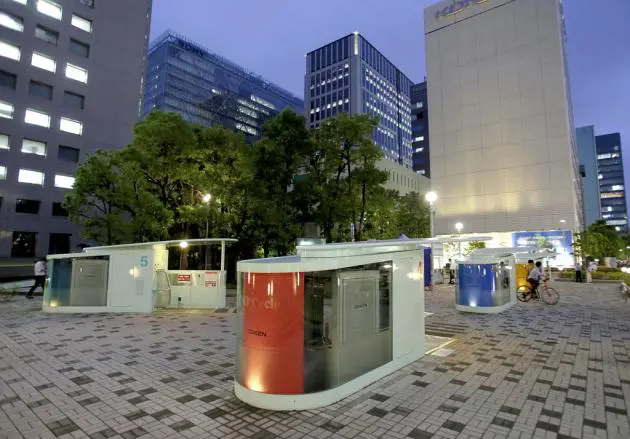
Five small booths stand in a plaza in Konan Hoshi no Koen Park in Tokyo’s Minato Ward. These modest-looking structures are the gateway to a surprisingly large underground realm.
Beneath each booth is a deep cylindrical space housing a mechanised bicycle-storage device. The five sites can accommodate about 1,000 bicycles.
At the entrance to each booth is a platform where a cyclist can place his or her bicycle. A door automatically opens and the bicycle is quickly taken out of sight. To retrieve it, the user waves a card with an integrated-circuit chip over a sensor. The bike is whisked up to ground level in 13 seconds.
The service is available from 4.30am to 1.30am. The fee is ¥1,800 (Bt560) per month.
The system was first put into use in 1998 by Giken Seisakusho, a construction machinery manufacturer whose motto is “Culture on the ground, functions underground”.
Including those under construction, there are 43 such facilities at 16 locations across the nation. The facility in Konan Hoshi no Koen park was completed in 2010. As a result, illegally parked bicycles have mostly disappeared from the area.
Shotaro Yano, leader of the firm’s underground development section, emphasises the advantage of its construction method. “Steel boards are inserted into the ground to create a cylindrical shape, and the soil inside is then removed. We can do this in only two months. Since soil pressure is evenly distributed [thanks to the cylindrical shape], the parking facility is reasonably earthquake-resistant. And since a carrier device is placed in the centre, the distance the bikes have to be moved is minimised.”
Etsuko Kanda, 60, whose home is a 10-minute bike ride from the park, commutes to work after parking at this facility. “I can park my bicycle literally in an instant,” she says. “It’s very easy – I don’t have to push my bike up and down ramps. And there’s no risk of having the bicycle stolen or being damaged.”
