
Magic in the thread


Play
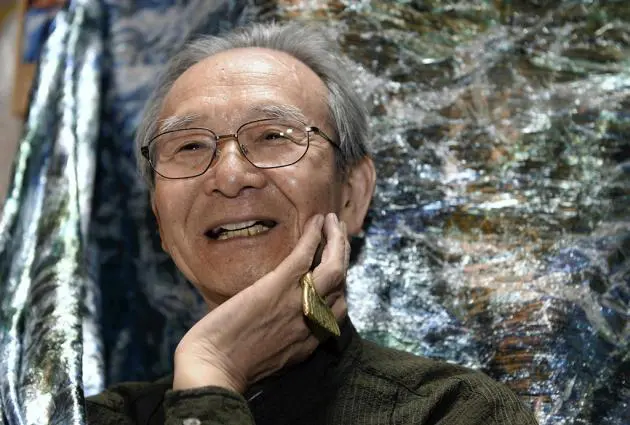
Junichi Arai blends traditions and technology in his creation of textiles
Touching one of Junichi Arai's fabrics, I realise it’s outstanding not only for its design, which was created using traditional tie-dyeing techniques, but also for its intricate pattern of colours and laces. The piece I was handling even gave off an iridescent glow in the light. But what makes it even more remarkable is that this innovative metallic cloth with translucence was created by the artist about a half century ago.
Since the start of his career, Arai’s textiles have wowed the fashion industry. Many of his creations have inspired internationally renowned Japanese designers such as Kansai Yamamoto, Issei Miyake and Rei Kawakubo. He also makes stage costumes for singer Tokiko Kato.
“I thought nobody except me would want to do this kind of work,” says the 81-year-old master with a gentle smile. “It’s a very primitive form of labour.”
An exhibition showcasing his 60-year career is being held at the Ashikaga Museum of Art in Ashikaga until September 1. About 60 works are on display, including Nuno me Gara (patterned fabric), a jacquard fabric that is housed at a British museum, the Mangekyo (kaleidoscope) series with its glossy metallic beauty, and a large piece shaped like a whirlpool. The exhibition will also visit the Kuma Museum of Art in Kumakogen from September 14.
Arai describes himself as a “textile planner”. He has already given many solo exhibitions in Japan and abroad, and due to his achievements, Arai was awarded an honorary doctorate by the Royal College of Art in London in 2011.
The artist was born in 1932 as the eldest son of a weaver family in Kiryu, an area that is home to the traditional fabric weaving industry. He became passionate about literature and performing arts while in high school. Although he dreamed of attending university, the arrival of Typhoon Kathleen in 1947 in the Kanto region, where his hometown is located, forced a change of plans.
“The machines at the factory [for my family business] were flooded. It caused huge damage,” he says. “So I had to give up on going to university and acting on the stage.”
After graduating from high school, Arai began training under experienced workers at a textile factory run by a relative. Once he embarked on the work, he was immediately captivated by it and wanted to learn every detail, such as the materials used for threads. It was as if he was searching for answers to puzzles of geometry, a subject he excelled at in school.
A turning point in his education occurred in the mid-1950s, when he was learning dyeing and fabric weaving from workers in Kyoto. One day, he found gasified aluminium that was attached to threads to make them gold and silver had begun melting sporadically.
“It was a failure from a manufacturers’ perspective,” Arai recalls. “But it made me rather interested in what chemicals I could use to uniformly melt the aluminium how I liked.”
In pursuit of an answer, he began experimenting with various materials at Gunma University’s research facility. After eight years of study there, he came up with an original method to melt aluminium on woven gold and silver threads that were made from processed polyester films in a visually pleasing way. This method was key in creating the glossy, attractive texture of the fabric I was touching at the start of this story.
Arai manufactured a sample of a product intended for commercial sale using a central governmental subsidy. Orders for the product started flooding in from overseas, even from countries in the Middle East. However, manufacturing the textile turned out to be very difficult.
“Printing companies were reluctant to make it. We managed to produce it, but the quality was unstable,” he says. “It didn’t pass the laboratory check for exports and was a huge financial loss.”
While seeking a fresh approach to textile manufacturing, Arai happened to visit Mexico in 1969. This trip became another milestone in his career.
He went to Mexico as a representative of a large apparel manufacturer to deal with complaints about its products. Arai fell in love with the richness of locally dyed and woven ethnic clothing and the delicate textures of the natural materials used in making the garments.
“Spinning, intertwined threads – it’s superb handicraft work,” he says. “None of their products were the same.”
In the late 1970s, Arai was a pioneer in introducing computers to manufacture fabrics with simple, beautiful patterns and the appealing textures of ethnic clothing worldwide. He used jacquard fabrics for the purpose, which use highly twisted strings of thread.
“Looking back on my career, I realise the superb work of craftspeople in Kiryu was the most impressive of all,” Arai says. “As the ancient Indian philosophy goes, weaving the warp and weft is just like living life.”
