
Odyssey in the deep


Play
British science fiction author Arthur C Clarke's favourite place was a Sri Lankan beach
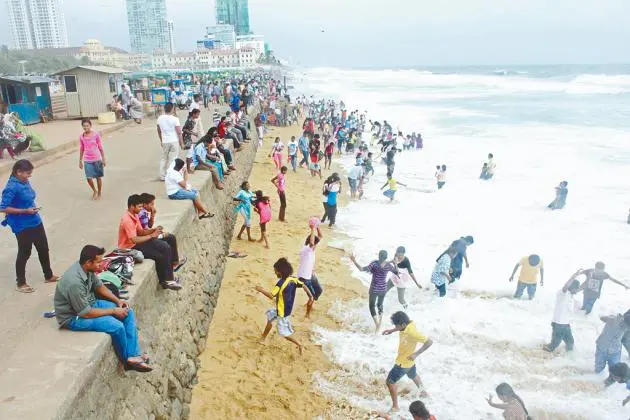
The beach along the Galle Face Green promenade facing the Indian Ocean in Colombo, the largest city and commercial capital of Sri Lanka, is crowded with local people most weekends. Families and couples enjoy the water at the beach, where strong winds from the ocean often ruffle the surface of the water.
Arthur C Clarke, the giant of British science fiction, fell in love with this sea. He moved to Sri Lanka and made Colombo his last home, living in a white house in Cinnamon Gardens, an exclusive residential district two kilometres from the beach, for nearly 40 years.
The family of one of Clarke's friends is living in the house now. The study on the second floor has not changed since Clarke died in March 2008 at age 90, according to his friend. A white Apple computer sits on the desk and the bookshelves are filled with Clarke's own books, including some translated into Japanese, and books related to space.
Remembering conversations with Clarke, his secretary, Dottie Weerasuriya, 70, says with a smile that he often said that the sea in Sri Lanka was the best place to simulate being in space. “Clarke was an insatiably curious man, like a mischievous boy,” she adds.
Clarke was born to a farming family in Minehead, Somerset, in southwestern Britain. While serving in the Royal Air Force as a technical officer during World War II, he was involved in developing radar and proposed a geostationary satellite communications system. He started writing in earnest in 1946, and ultimately produced more than 80 works of science fiction, including “Childhood’s End” and “The Fountains of Paradise”.
Clarke, who made his debut as a writer in Britain in 1956, moved to Sri Lanka shortly after the country became independent from Britain, mainly to pursue his interest in scuba diving. The years he concentrated on diving were also a rich time for his writing.
Works written in those days include “A Fall of Moondust”, which depicted the world of the moon’s surface before Apollo 11 actually landed on the moon and “2001: A Space Odyssey”, which was made into a film in 1968 by director Stanley Kubrick. Many of Clarke's descriptions of beautiful scenes in outer space may have been inspired by his experiences underwater.
Astronomical observation had been Clarke’s hobby since childhood. Based on his abundant scientific knowledge, Clarke wrote a number of books that seemed to foretell the future world. These works fascinated not only science fiction fans around the world but also politicians in Sri Lanka, who were concerned about the country’s future.
A 59-year-old information technology specialist who was close to Clarke said a certain politician actually approached Clarke for advice, but Clarke apparently declined to give it.
Sri Lanka was trapped in a civil war from the late 1970s as conflicts between Buddhist majority Sinhalese and Hindu minority Tamils intensified. Clarke criticised the civil war in a roundabout way, saying the money used for the war should be applied to more useful purposes.
In his later years, Clarke was confined to a wheelchair as his leg muscles deteriorated due to polio he suffered in the early 1960s. However, he still went to the beach every Sunday and would spend hours in meditation watching the sea, according to Weerasuriya.
Many people visited him in his study. Clarke sometimes invited passing children in and enjoyed their surprise at a dinosaur model that he moved by remote control.
Sri Lanka's civil war ended a year after Clarke died, and the number of visitors to the island of everlasting summer is increasing every year. The main tourist attraction is of course the sea that he so loved.
