
Averse to rain, Germans camp indoors


Play
Caravans that ramble no more offer an alternative to unreasonable weather
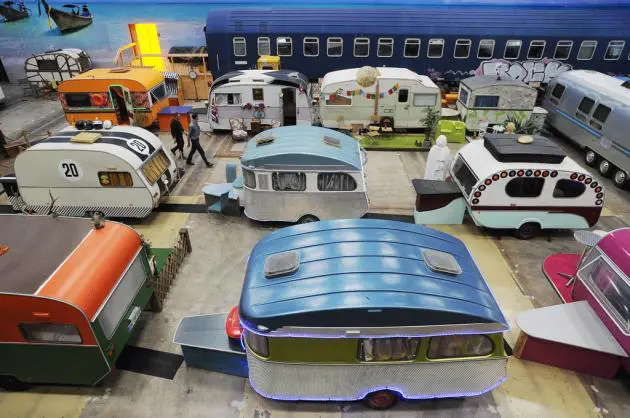
The 15 caravans dating back to the 1950s and ’60s have names like Big Ben, the Hunting Lodge and Rockabilly. Their travelling days over, they stand parked in an old warehouse in Bonn, Germany.
Indoor camping is the idea – low prices and the freedom of your own home-away-from-home without having to endure the vagaries of the German summertime weather.
Among the collection at his BaseCamp, Bonn hotelier Michael Schloesser has four Airstream models – the celebrated US-made travel trailers with their characteristic sleek shape in gleaming aluminium.
He is not alone with his idea. The Huettenpalast (Hut Palace) in Berlin has a similar concept, offering its guests accommodation in caravans and small wooden huts set up in an old factory.
The main advantage is a permanent roof, since summer holidays in northern European are seldom rain-free. These indoor campers stay dry while still being able to sleep out of doors, so to speak.
The Bonn indoor-camping site covers some 1,600 square metres and counts school groups among its customers. Schloesser has also acquired two old railway carriages, one of them a sleeper and the other with reclining chairs.
Guests seeking something more intimate can opt for an old Trabant, the icon of East German communist motoring technology, complete with a two-person tent on the roof. Also on offer are models from Volkswagen and Citroen.
“Collecting all these old vehicles wasn’t that easy,” Schloesser says. He finally found many of them at an auction in the Netherlands, engaging the services of a film-set maker to turn them into acceptable accommodation units.
Much of the decor comes from Berlin’s well-stocked flea markets. Rockabilly is covered on the outside with vinyl seven singles, while the Drag Queen is in bright colours with a great deal of plush and chintz.
In front of each of the vehicles is a garden with places to sit in the appropriate theme. The Hunting Lodge has a boar’s head and deer antlers mounted on the outside, above a sofa covered with animal skins.
Schloesser has also had a gallery measuring 170 square metres installed in the hall to provide a kitchen and seating for breakfast with a panoramic view out over the entire hall and its walls decorated in the theme of a South Pacific holiday.
The reception desk is open 24 hours a day, and the campsite is monitored by closed-circuit television. Apart from the usual ablution facilities, there are lockers fitted with sockets for charging mobile phones and the like, and outside is an old US school bus in traditional yellow serving fries, burgers and sausages.
Unlike the average big-city campsite in the suburbs, BaseCamp is in the heart of Bonn, within easy walking distance of the museums and the old West German government quarter.
Huettenpalast is in the middle of the trendy area that straddles the Berlin boroughs of Kreuzberg and Neukoelln to the southeast of the city centre.
The prices reflect the changed status of the cities.
In the sleepy former West German capital, a bed in the sleeper carriage is to be had for as little as 22 euros (Bt920), rising to 128 euros (Bt5,300) for one of the Airstreams, while in trendy Berlin, single accommodation starts at 55 euros.
