
Anatomy in 3-D


Play
Does the future of health technology lie in printing spare parts for the body?
It may sound like something from a science fiction movie but Peking University Third Hospital’s announcement that its new 3-D printed orthopaedic implants have produced good results in clinical trials is very much a reality.
Scientists in a few countries, such as the US, have used 3-D printing, a process of laying down successive layers of material in different shapes to make a three-dimensional solid object, according to a digital model.
The 3-D objects are used in three ways: for surgery simulation, to produce lifesaving medical implants and artificial body parts, and to create living tissues and organs for drug testing.
“We started the clinical trial to test those implants last year, and all the patients participating in the trial are recovering well,” says Liu Zhongjun, director of the hospital’s orthopaedic department.
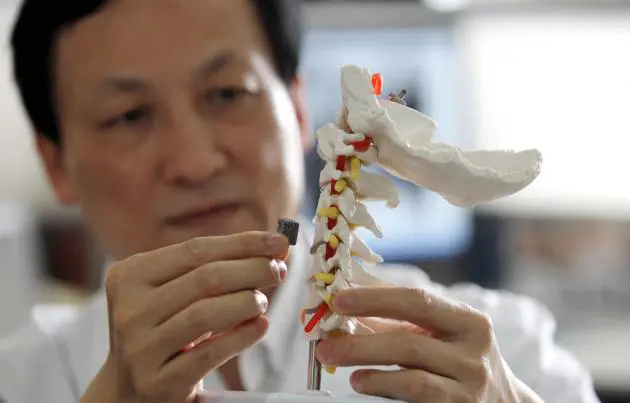
Cooperating with a Beijing medical device company that owns an imported 3-D printer, the hospital has produced dozens of hip replacements and artificial vertebral bodies. To date, more than 50 volunteer patients have tried the implants.
The test is the first time that 3-D printed artificial vertebral bodies have been used in human bodies in the medical world, although artificial vertebral bodies have been used in orthopaedic surgeries for years, Liu says.
The material is nothing new. The hospital uses titanium powder to print, a special metal that has been applied to make body implants for decades.
But the shapes of the 3-D products are very different from traditional ones, in a positive sense, Liu says.
Orthopaedic implants are widely used for patients suffering from bone damage caused by injuries or diseases. They are inserted into joints and bones to restore normal functions, such as spine implants to help anchor the spine.
But because of the limits of traditional manufacturing methods, the shapes of orthopaedic implants are usually geometric patterns, and as a result, they cannot attach to bones firmly without additional cement, screws and fixing plates.
The 3-D printing, instead, is able to print titanium powder into any shapes, as long as the computer that controls the printer has a digital model to follow.
“The 3-D printed orthopaedic implants can match better with bones around them than traditional ones,” Liu explains.
Besides, the tiny pores of the new implants, another feature of the 3-D device, enable bones to grow into the implants, Liu adds.
Liu’s team launched the programme in 2009. The hospital provided designing know-how, and the medical device company digitalised the design.
In mid-2010, they started trials on sheep, and in 2012, the team got permission from health authorities for human trials.
A woman surnamed Huang, became the first patient for the clinical trial.
The 54-year-old Beijing resident had suffered from severe dizziness and stiffness in limbs caused by cervical spondylosis, a degenerative condition of the cervical spine.
In September 2012, Huang heard about 3-D printing, and decided to use the new 3-D printed artificial vertebral bodies.
Within a few days after the surgery, Huan’'s symptoms disappeared. Her quarterly checks have shown positive recovery results.
Lyu Chao, 32, is the latest patient to benefit from the technology.
Before his surgery in July, his fingers, knees and lower legs often felt numb, and he could not walk or run fast.
Lyu is the 20th volunteer. The hospital plans to have at least 22 volunteers before they apply to health authorities for clinical use, according to Liu Zhongjun, director of the clinical trial programme.
“Producing medical devices through 3-D printing saves time and materials, and thus the cost will be lower than traditional methods,” says Liu.
It also has the potential to custom-print medical implants, and create living organs for transplants, he adds.
Qi Xiangdong, a senior cosmetic surgeon with General Hospital of Guangzhou Military Command, says Chinese hospitals have been trying to make use of 3-D printing since 2002.
Many have applied the technology to create lifelike organ models so that doctors can simulate surgery procedures and pre-plan for complicated surgeries to enhance safety and efficiency, says Qi, who’s a member of the standing committee of Digital Medicine Association under the Chinese Medical Association.
In 2008, doctors in Qi’s hospital successfully made a 3-D printing digital model for the upper part of a cervical vertebra, and hospitals in Shanghai have been using 3-D printing to help design cosmetic implants for several years, Qi says.
But to make models for surgery simulation and preparation is different from creating living tissues and organs.
“It is great that more Chinese hospitals manage to develop 3-D technology-related medical solutions for patients,” Qi says. “With the technology, doctors can provide better treatment to patients.”
In 2002 CT and MRI data was used to 3-D print anatomical models of conjoined twins from Egypt in the United States, to plan for the separation surgery.
The surgery succeeded in 2003, and the twins lived six years.
In 2011, researchers in Belgium and the Netherlands created and implanted an entire 3-D printed lower jaw for an 83-year-old woman. It was the world’s first complete 3-D printed implant.
In 2012, specialists in the US created an airway device with a 3-D laser printer with approval from the US Food and Drug Administration, and saved a baby boy, whose birth defect had caused his throat’s airway to collapse frequently.
In February 2013, scientists at Cornell University announced it had used 3-D printing to create an artificial ear for treating ear deformity.
In March, US doctors used 3-D printed artificial skull bones, and replaced 75 percent of a patient’s skullcap that had been severely damaged, with approval from the FDA.
In April, scientists in the US managed to create mini versions of a liver using a 3-D printer. They built up layers of liver cells, including cells from the lining of blood vessels to nourish the liver cells with nutrients and oxygen.
