
Stepping out for happiness


Play
A German dancing school employs the magic of music to help dementia sufferers
Johannes is 76, and suffering from an advanced stage of dementia. But he’s always in a good mood when he can once again head off to his dancing classes. Although he has lost almost all his memory, he can still remember the old dance steps.
Astonishingly, he can still recite the lyrics of a 1970s German pop song, “Schmidtchen Schleicher”, and other pop song hits from back then.
When the Stallnig-Nierhaus dance school in Cologne has its programme "Let’s dance again - dancing for people with and without dementia," Johannes is always there, accompanied by a volunteer female escort.
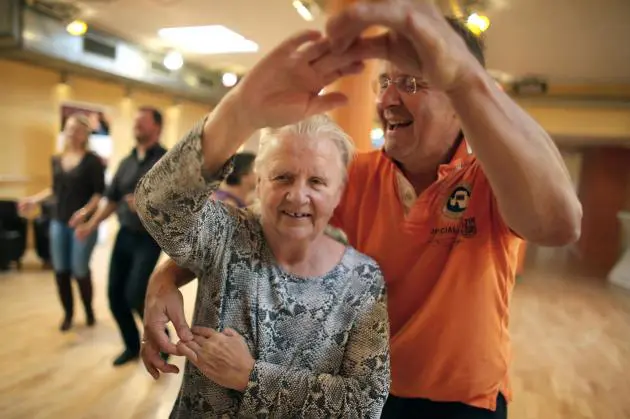
Up to 50 others between the ages of 60 and 97 are out on the dance floor, some suffering dementia, the others relatives or orderlies from nursing homes. Despite the disabilities and impairments, the mood is good and everyone is beaming and having a good time.
It’s an initiative that is unique in all of Germany, one now being watched by other cities and even by other countries. The idea came from Stefan Kleinstueck of Cologne’s centre for dementia services.
“Many of our dementia sufferers used to attend dance school many years ago,” he notes. “When we turn on the music here and go through the first steps and make inviting gestures, they immediately join in.”
Kleinstueck, who is also a social worker, orderly, and chairman of the Alzheimer Society of the state of North Rhine Westfalia, adds: “Sometimes you really notice where something seems to go ‘click’, and the dance steps work.
“Even their partners are astonished at what slumbering mental resources can be brought forth again.”
Hans-Georg Stallnig opened his dance school a few years ago on the occasion of World Alzheimers Day. “We play a lot of hit songs, evergreens. But we’ll also dance to hip-hop,” the dancing instructor says.
“It is fantastic what music can still reach, though the mind is gone”
Music speaks to the emotions and can sometimes trigger long-forgotten memories. Dance steps and movements from back in the days of youth once again can emerge from the long-term memory areas of the brain.
Kleinstueck notes that attempts are made in nursing homes or in community centres to try to motivate dementia sufferers with music and movement, but usually without success. “You really do need professionals.
“It’s not enough to simply put on some records or grind out a tune on a piano. You’ll get maybe two couples out on the floor while everyone else sits staring into their coffee cups,” he says, insisting that people trained in leading and motivation are necessary.
And, they should have a trained eye for knowing what is achievable despite physical and mental impairments, and for how to give the elderly a sense of safety and trust.
“I always need somebody to hold onto,” a grey-haired woman whispers to him on the dance floor. Kleinstueck replies: “That’s what I’m here for.” Then the couple heads to the dance floor.
Some participants take only some tentative careful steps, but others temperamentally get into the swing of things, while yet others simply enjoy standing in a group, holding hands and rocking to the music.
Stallnig performs the dance movements, for say a cha-cha-cha, but also for simply stamping the feet. The mood immediately brightens.
To one popular tune a polonaise develops spontaneously. A lot of thought is given to the selection of the music.
Eva, 69, though she has lost much of her speaking capability, is still able to sing along on the chorus of a number of the songs.
Professor Gereon Fink, director of Cologne University’s neurology clinic, says the dancing and music makes “a great deal of sense” as it stimulates physical and mental activity while at the same time achieving a positive emotional effect.
“The combination of music and movement can trigger a maximum amount of stimulation with some Alzheimers patients," he says.
For relatives the dances are additionally some relief, bringing them into contact with others facing the same situation.
In Germany more than 1 million people suffer from age-related dementia, the most frequent form of which is Alzheimer’s disease. By the year 2050 the numbers are projected to rise to almost 3 million.
With an early diagnosis of Alzheimer’s a person can now be given medications that can slow down the deterioration process. But there is no cure.
The Cologne dance school initiative is gaining attention.
“We have talked at congresses and go to other dance schools and provide training. And there have been queries from abroad,” Kleinstueck says. The first partners have been found in other cities.
“I have a vision that one day a dancing school will offer this in every city and region, within a network which has experience in dealing with dementia sufferers.”
The aim is community, closeness, and joy of living.
