
The horror of Hora


Play
Life after death beckons for worshippers at a Czech church - even if it's only as decor
Wannabe zombies and ghouls everywhere got to cackle with glee on Thursday night, when they stalked their neighbourhoods for Halloween.
But would it still be a laughing matter if you were faced with grim reminders of death weekly – or even daily? Could anything be more macabre than entering a place of worship only to be faced with human skulls and bones at every turn?
Welcome to Kutna Hora, an hour’s train ride east from Prague, where Halloween is for real all year round.
Pushing open the Cemetery Church of All Saints’ creaky door, I find myself pitched into a mass grave, albeit more tastefully decorated than most. A huge chandelier made of skulls and femurs dangles above me, while the hollow-eyed heads of former parishioners grin from pyramid displays topped by cute, fleshy cherubs. Shock and awe is my first reaction in this overcrowded house of the dead. But the current worshippers seem unperturbed – as if their surroundings were no more unusual than the stained glass windows and statues of saints that normally decorate a church.
The story behind this public boneyard, however, is an interesting one.
Kutna Hora was founded in the 14th century on the profits from local silver mines. But following quickly on the tail of the silver rush was a catastrophic plague,which claimed thousands of lives in 1318.
Most of the dead were buried in a cemetery 2 kilometres outside town. Supposedly consecrated by soil brought back by a monk from Jerusalem, this place has been the burial ground of choice since mediaeval times and is thought to house the remains of more than 40,000 people.
As well as victims of the 1318 plague, the graves contain the remains of thousands killed during the Hussite Wars in the early 15th century.
When a 19th-century architect named Santini was tasked with rebuilding the cemetery’s church, after it was burnt down by enemies of the town, he noticed that the crypt was overflowing with human bones.
Perhaps lacking other, more tradtional, sources of decor, he saw an opportunity.
Employing the services of a talented local woodcarver named Frantisek Rint, Santini got busy with creating one of the most macabre religious buildings in Europe.
With no qualms whatsoever about handling human skulls and bones, the ingenious woodcarver created plans for a massive chandelier, large urns and pyramidal stands. His ghoulish creative flair also extended to decorating the arches and window-sills of the church.
Rint festooned them with strings of skulls and bones like bunting. But his masterpiece was undoubtedly the chandelier, an awe-inspiring sight composed of every bone found in the human body.
Grateful to be entrusted with such an important commission, he fabricated with bones the coat of arms of his employers, the local Schwarzenberg noble family. He also added his own signature to the work, spelling out his name in bones on one of the walls. Bizarre as it may seem, this ossuary and chapel are a lasting testimony of this craftsman’s remarkable ingenuity and skill.
From the outside, the building – more commonly known now as the Sedlec Ossuary – looks just like an ordinary church, surrounded by a well-tended cemetery brightened here and there with flowers. Its chapel is still used for Roman Catholic services.
One can only surmise that the congregation has, over the years, grown used to worshipping amid a crowd of skeletons. No doubt it serves as a sombre reminder of mortality and a warning not to stray from the path of God and heaven.
However, visitors on a day-trip to Kutna Hora might be glad to know that this picturesque mediaeval town has more to offer than Sedlec’s horrors. With a history stretching back to the 14th century, there are quite a few beautiful and historical buildings worth visiting here.
The old heart of the town has earned Unesco World Heritage status for its numerous churches, monuments, town hall, townhouses and shops built in the Baroque style.
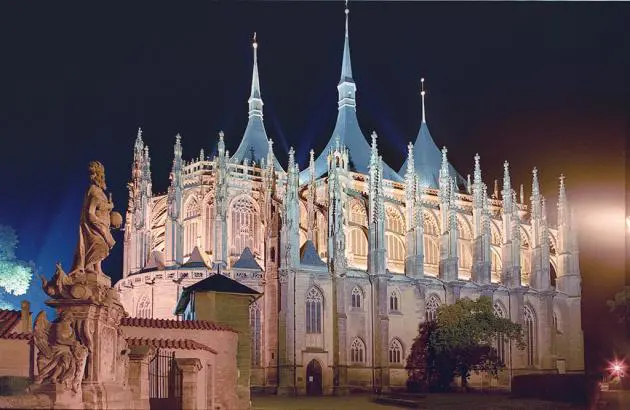
One of its architectural stars is the 15th-century gothic Cathedral of St Barbara, with its three unique tapering spires jutting up into the sky and easily towering over the rest of the town. The interior of this cathedral is spacious and vast, with high vaulted ceilings displaying the coats of arms of local aristocrats.
Ornately decorated altars, tall stained-glass windows and storied chapels are the rich reward for any visitor. Faded frescoes on one of the walls depict silversmiths at work and offer a window on the daily life of townsfolk during the mediaeval era.
The narrow gravel road that connects the cathedral to the town centre offers a superb view of the surrounding countryside and the valley below. Stationed at intervals along the road are 13 stone sculptures of saints .
Though Kutna Hora makes an interesting detour on a visit to nearby Prague, it doesn’t attract busloads of tourists. This means there are no crowds at Sedlec Ossuary, where you can indulge your curiosity in peace and quiet, perhaps by reaching out to pat a skull, or even inserting a finger through an eye socket.
So what if you feel a cold chill running down your spine? A holiday, just like Halloween, should be fun, right?
