
Georgia on my mind


Translations and adaptations dominate the recent Georgian Showcase at the Tbilisi Festival
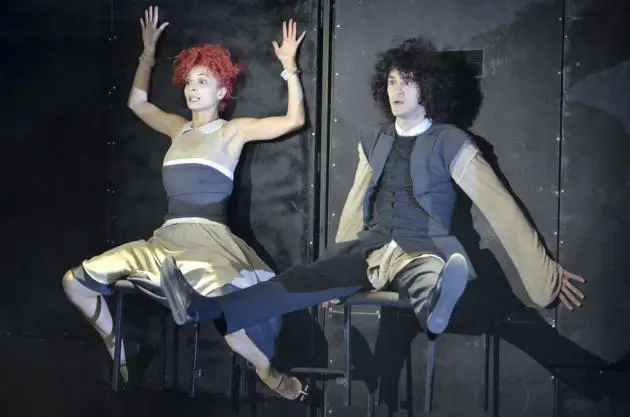
The temperature outside may have been hovering around 10 degrees Celsius but there was plenty of warmth inside Vaso Abashidze’s Music and Drama State Theatre, most of it generated by the resident company’s refreshingly new interpretation of Shakespeare’s “A Midsummer Night’s Dream”. Staged by the theatre’s artistic director David Doiashvili, it was so full of delightful surprises that I almost forgot that the energetic cast was speaking Georgian and that the English surtitles were too small for me to read.
Doiashvili, whose previous production of “Macbeth” also earned much praise, successfully merged the three storylines and linked the three sets of characters. Some of his interpretations were so sexually charged that it was hard not to laugh. For example, Lysander didn’t know how to “do it” with his love Hermia in the woods so it was Demetrius who actually “did it” first with her.
This is the kind of Shakespearean production that can draw young people and inspire them to watch and to read more of his plays. It is also equally attractive to those who may feel they’ve seen more than enough versions already and proves that Shakespeare is indeed a contemporary playwright and that his plays are, first and foremost, entertainment.
I was in Georgia last month along with an international cohort of theatre producers, presenters and journalists for the annual Tbilisi International Festival of Theatre’s Georgian Showcase and we enjoyed a great deal of exciting theatre over the four days that followed.
They included a production by Fingers Theatre’s of “The Wall” at the small stage of Kote Marjanishvili State Drama. Inspired by Pink Floyd’s seminal concert, director Beso Kupreishvili narrated a tale of “love conquering all in a desperate cry for freedom” through finger puppets.
On the following day at the same venue, the Mtsire Ptskala Puppet Opera Theatre showed how to introduce young minds to opera in an amusing production of Rossini’s “The Barber of Seville”.
Among the other noteworthy staging of plays translated into Georgian were seasoned director Temur Chkheidze’s memorable production of “The Gronholm Method” by contemporary Spanish playwright Jordi Galseran at the main stage of the Marjanishvili in which all four actors lived up to the play’s psychological complexity and the satire on the corporate world was delivered to the audience loud and clear. Equally as entertaining was veteran Robert Sturua’s production of “Master Class”, which was so by the book that I was reminded of my experience watching the original Broadway production 18 years ago.
Younger directors also enjoyed a strong presence. David Papava-Gurji’s appealing production of “Fireface” by German playwright Marius von Mayenburg delivered its original message on contemporary European family problems. Michael Charkviani’s deft staging of Reiner Werner Fassbinder’s “Katzelmacher” was unforgettable and proved not only that xenophobia is as alive now as in the 1960s but also made the audience forget that they were watching in a historic playhouse.
With dance and circus are now an integral part of theatre festivals, the State Ballet of Georgia’s triple-bill was a showcase of the talents of his many young dancers. I had been looking forward to watching “Sahalobeli“, an original work based on Georgian folk melodies and music, but was disappointed that the most of the choreography hadn’t been set free from classical ballet. To facilitate their nouveau cirque productions, an independent troupe Kakha Bakuradze’s Movement Theatre built their own performance tent in a park where the audience enjoyed a good mix of acrobatic and dramatic skills in “Gamma”.
While I hadn’t managed to learn even one Georgian phrase by the end of the four-day, four-night programme, I did return home with a happy awareness of the immense amount and unpredictable variety of theatrical creativity in this small state. I’m also sure some of these productions will soon be invited to festivals in many other corners of the world, proof once again that international arts festival supported by the local government and the private sector must always present local works.
I’m looking forward too to watching more new Georgian plays, instead of translations and adaptations.
Tempted by Tbilisi
For more, visit www.TbilisiInternational.com and “Tbilisi International” in Facebook.
The writer’s trip was supported by Tbilisi International Festival of Theatre and International Association of Theatre Critics - Georgia Section.
