
Painting a city's pain


Play
Youngsters in Port Said portray their feelings about Egypt's trouble
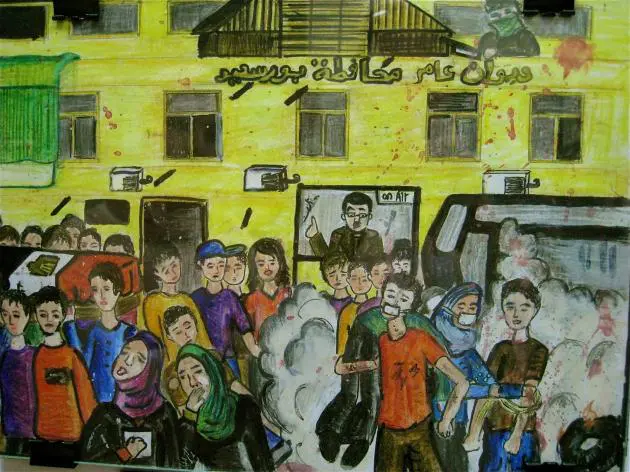
The first-prize winner of the Port Said children’s painting competition is brightly coloured, but it’s not typical child subject: a line of mourners escorting a slain demonstrator’s coffin, draped in an Egyptian flag, through clouds of police tear gas.
“My family was worried about me but I always went to the demonstrations anyway, because I felt that something must be done against the injustice,” says the artist, 15-year-old Amal Yahya el-Fakiri.
She wears a red headscarf and her dental braces glint in the sunlight as she smiles.
Like their compatriots in Cairo and Alexandria, the inhabitants of Port Said, at the northern end of the Suez Canal, have endured continual street protests, petrol shortages and long queues at state-owned bakeries in the past few years.
They saw mass protests that swept long-time president Hosni Mubarak from power in February 2011, mass protests against the military council that then took over, and mass protests leading to the army’s ouster in July 2013 of Islamist president Mohammed Morsi.
And they still have not recovered from football riots at Port Said stadium that killed 74 people in February 2012.
Recent history has not been kind to Port Said. The city was the target of an invasion by British, French and Israeli troops during the Suez Crisis in 1956, sparked by then-president Gamal Abdel Nasser’s nationalisation of the Suez Canal.
While rummaging not long ago in boxes left by his deceased parents, both art teachers, Cairo architect Tarek Labib found old photographs of children’s paintings, colourful but grim.
They depicted corpses, burning houses and paratroopers in descent. Labib did some research and learned that his parents had organised an art workshop for Port Said children immediately after the Suez Crisis as a kind of therapy to exorcise oppressive memories.
This was the inspiration for a competition in which Port Said children and adolescents were encouraged to paint pictures about their lives in the city during the past few years.
The pictures submitted by the 31 participants are also colourful but grim. They show football fans lying in pools of blood, anti-Morsi protests and impoverished people queuing up for subsidised bread.
One of the participants was a 13-year-old girl named Shahed whose grandmother took part in the Port Said art workshop after the Suez Crisis, all those years ago.
Now 69 and a retired art teacher, Hoda al-Bani had painted a sobbing mother holding a bleeding child with two faceless soldiers standing behind her.
Al-Bani proudly displayed a black-and-white photograph of herself and the other children at an exhibition of their paintings in 1957.
In addition to Port Said, the paintings were exhibited in Cairo and several European cities at the time. Then they were stored at the Egyptian embassy in Rome.
The old and new paintings were brought together this month for an exhibition titled “The Children of Port Said 1956/2013”.
It was organised by Labib, the Ganna Gallery and the quarterly Egyptian culture magazine al-Rawi.
Many people in Port Said accuse the police of collusion in the bloodbath. The riots led to a suspension of matches in Egypt’s top football league.
“Police normally even looked into our sandwiches at the stadium entrance before matches to make sure no one was smuggling in weapons,” said al-Borollosy, an al-Masry fan. “On that day, though, there were no checks at all.
“And the door behind the fan block of the visiting side was blocked, so the al-Ahly ultras had no escape.”
Renewed violence flared repeatedly during the subsequent trial.
In Cairo in March 2012, al-Ahly fans torched two police buildings and Egypt’s Football Association headquarters. In Port Said in January, 32 people were killed during protests after 21 al-Masry fans were sentenced to death by hanging.
And clashes broke out in Port Said last March when some of the al-Masry convicts were moved from the city’s prison.
Outsiders seem to be avoiding Port Said. There are hardly any foreigners in the city, and even cars with Cairo number plates are rare. “Our city has a bad reputation now,” remarks Fatma Fathi, who helped organise the painting competition.
Port Said’s inhabitants hope their city will quiet down. They hope that top-league football matches soon resume.
And they hope that their children start painting childish things again.
