
Licensed to roll


Play
Germany's elderly get rollator driving lessons
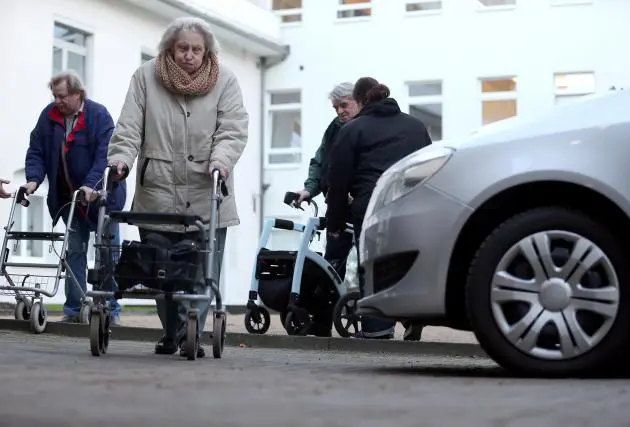
White-haired Leopoldine Schneider is pretty quick for an 87-year-old as she takes a sharp 90-degree turn through the slalom course.
“Don’t forget to breathe deeply,” says Julia Schnitzler.
A caregiver, Schnitzler helps run a rollator-driving class at Cologne’s St Hildegardis hospital. As at every driving school, there are a couple of frisky trainees who regularly exceed the recommended speed limit.
The hospital has offered the course in how to operate wheeled walkers for the past two years. Similar courses are provided elsewhere in Germany too.
Rollators, which have tyres, bicycle-style brakes, luggage baskets and seats to rest on, have spread in European countries since 1990, having taken over from the simpler walkers such as Zimmer frames that used to be used by elderly pedestrians and neurally impaired patients.
Larsen Lechler, the head of the therapy centre, goes through the most common mistakes in the theory section of the course.
The biggest issues he addresses are setting the adjustable handles too high or walking with poor posture - mainly a rounded back. Another problem is overloading the rollator with shopping bags.
After that, policewoman |Natalie Kohn comes in to explain the blind spot, the place where a truck driver cannot see you in the side mirror before a turn, and |recommends to the participants to not take any chances out on the roads.
“As the disadvantaged participant in traffic, you should behave in a defensive manner,” says Kohn.
Then the attendees go through the practical portion of the course.
Schneider has only had her rollator for three weeks.
“I’m struggling to figure this out,” she complains. “The front wheels are always waggling.”
Heinrich Schinke is about to spend his first winter with a walker after suffering a stroke.
“I still want to check out a few tricks,” says the 70-year-old.
Lechler meanwhile takes a look at Schneider, asking: “Is that correct where the bag is hanging?”
Lechler explains her handbag shouldn’t hang between the handles because it’s in the way of her knees.
“It’s better on the front!” urges Lechler.
Schneider turns down that suggestion at first, countering: “Then anybody could grab it from me there.”
The next step is a bit of rollator aerobics - to loosen up.
The participants stand between the wheels, lift their legs and shift their weight to train their sense of balance.
Then it’s time to head out onto the track.
“Don’t rush,” says Schnitzler time and again.
“Not so fast! Slow, slow! The brakes are not there for decoration! We have all the time in the world.”
Schneider wants to practice going up kerbs.
“No problem. Let’s do it!” says Schnitzler, pleased at her show of initiative. “And while we’re at it, we’ll try out what to do when the wheels get stuck in a groove too.”
During one break, the attendees compare the various models of walkers.
“What did you pay for that one?” Schneider asks Schinke.
“I paid 760 euros (Bt34,000),” replies Schinke proudly. “It’s not a supermarket cheapie.”
The industry says Germans who initially buy no-frills rollators often shift up to full-featured models once they understand the benefits.
The last drill of the course is walking on hills. It’s especially difficult to maintain control when you go downhill.
“Pull the brakes, Mrs. Schneider. Concentrate! Very good! Bravo!” says Lechler.
Once the group gets back, Schneider needs to relax.
“That was pretty exhausting,” she admits. “I still have to practice the kerbsides at home.”
Lechler offers up a smile and says: “It really is kind of like a driving course. It takes a bit of practice to use the walkers.” Then Lechler announces to the participants: “You have received enough training in theory and practical use that I giving you all a rollator driver’s licence.”
It’s just a piece of paper, but it symbolises progress.
Lechler adds one more comment before finishing.
“I can assure you of one thing. Regardless of how you act in traffic, the police can never confiscate your keys to one of these.”
