
Ready for the crunch?


Play
If you're eager for something new to tickle your palate, check out Micronutris' gourmet crickets
The lord over millions upon millions of insects could, from the looks of him, also be a bar manager. Jeans, white shirt, dress jacket with a handkerchief folded into the breast pocket. As 31-year-old Cedric Auriol welcomes guests with a smile to his empire near Toulouse in southern France, he’s all charm.
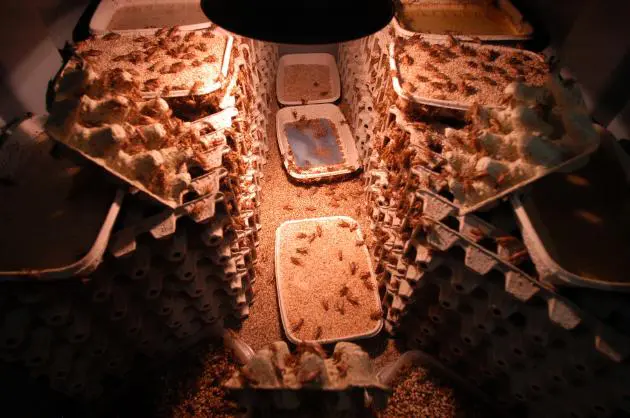
In a nondescript-looking hall, he and a small team of helpers are breeding crickets and meal worms.
But if you’re thinking that his products are meant as fishing bait or pet food, you couldn’t be more wrong. Auriol raises his insects entirely for human consumption. By his own account, he’s the first in Europe to do so.
“I am convinced that this will become part of our nutrition in the future,” he says, while praising the high nutritional value and the climate-friendly production methods.
Asked about why many Europeans feel nauseated by the mere idea, he shrugs: “Completely unfounded.” A bit like nuts, a bit spicy – that’s what his dried insects taste like. Besides “pure insects”, he also offers sweets and biscuits made from insect ingredients.
Auriol said he got the idea from the United Nations Food and Agricultural Organisation (FAO).
By coincidence, a copy of a study of the problems expected from the global population boom fell into the Frenchman’s hands. One of the solutions was termed “entomophagie,” or human consumption of insects.
“Up till then I had never eaten a cricket or mealworm,” he says. “But I was curious.” Auriol quickly launched a project. He visited small-scale producers in Asia and then got started, beginning with crickets and mealworms because they are easy to raise.
Today, around two tons of insects are now hopping, crawling and wriggling in his production hall.
How many creatures? “It’s still a figure in the millions,” says Auriol. “By the end of next year it should be more than a billion.”
Compared to an egg-laying battery, Auriol’s hall is a pleasant place. The crickets grow in roomy boxes, while being able to take refuge in egg cartons piled up like tiny skyscrapers. The mealworms are found in somewhat more grim-looking black plastic boxes filled with straw, and in a room with high humidity.
The insects feed on wheat flour, barley, fruit and vegetables – all from organic farming.
“That makes it easier for many consumers to try one out,” Auriol says. At the moment, many of his customers are insect freaks or adventurous diners.
The boot-camp image could, however, be quickly shed. For this, Auriol has found David Faure as a partner, a young man who loves to experiment in his gourmet restaurant, Aphrodite, in Nice. He is the first Michelin-star-ranked chef to offer insect dishes on his menu.
Faure uses mealworms in a pease pudding and garnishes a foie gras with crispy crickets.
Or the creatures are ground into powder to be sprinkled on codfish or in whiskey balls.
“It was always a major aim of mine to surprise and astonish people with new food items and new methods,” Faure says. In using these “funny tiny beasts,” however, it is not about making headlines but about opening new worlds for the taste buds.
Faure reports that for years he had wanted to develop an insect menu. But with imported animals he could never really keep watch over whether they met European hygiene standards. The solution only came along with the start-up of Auriol’s company, Micronutris.
Now a tense wait is going on to see whether Faure will be keeping his Michelin star, what with insects on his menu.
The decision will be announced in March.
“It’s clear that David is worried about his image,” Auriol says.
The risk is naturally much greater for a French chef than, for example, Mexicans who offer tapas with insects. On the other hand, there are plenty of new guests heading to Faure’s restaurant to try out his “Alternative Food” menu, which costs just 59 euros (Bt2,600).
Inspiration for the insect dishes came from beyond Europe. There are more species among insects than in any other class of fauna and they enhance the nourishment of around 2 billion people, the FAO estimates.
In major cities like Kinshasa or Bangkok, tons of insects are consumed each year. “They are nutritious, with high levels of protein, fat and mineral nutrients,” FAO experts say.
Auriol says that the just-completed Christmas season was outstanding. His cricket candies and gourmet packets were sold out many days before the holiday. But it is going to take some time before the insect business will be really rewarding for him.
Auriol estimates that the production of one kilogram of insects costs about seven times as much as growing a kilogram of meat. As a result, he charges 12.50 euros for 40 dried crickets.
In the future, the emphasis will be on manufacturing powders and pastes, to be used for example in biscuits or cereal bars.
The lord of the insects forecasts that with such items, the inhibition threshold in Europe will likely be lower for consumers.
