
The nature of reality
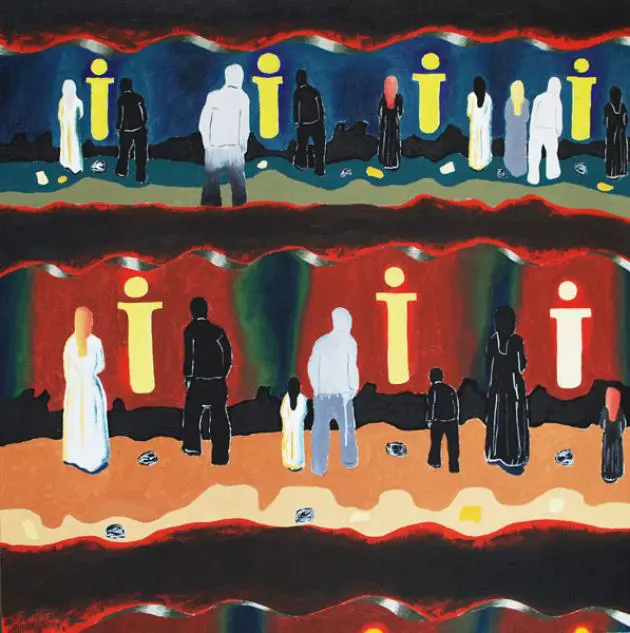


Artist Kritsana Chakitwattana reflects on dualism in the context of the political crisis
YOU DON’T HAVE to be a supporter of either anti-government protest leader Suthep Thaugsuban or caretaker Prime Minister Yingluck Shinawatra to be affected by the political crisis that’s split Thailand into two.
Kritsana Chaikitwattana, considered one of Thailand’s most thoughtful young artists, expresses his tension through a set of brand new paintings in his solo show “Two Sides to Every Story”, opening on Saturday at the Thavibu Gallery
Among his new works is a painting of a Thai flag juxtaposed with Van Gogh’s masterpiece “Sunflower”. Another portrays Munch’s “Scream” against a backdrop of an anonymous black-and-white cityscape.
Kritsana’s work is concerned with dissonance – that rather disconcerting realm between fact and fiction, reality and illusion, spiritual and secular and lost and found. This is not an easy place to be. Kritsana’s recognition of the fact that there must be a place where opposites meet, however uncomfortable that might be, is the place where the bonds of solidarity begin.
In earlier works, Kritsana has addressed the consequences of oppositional positions.
Bangkok is a place where the have and the have-nots live cheek by jowl. Tenement sprawls of urban slums fashioned out of sheets of rusting corrugated iron press hard up against the high walls that enclose luxurious gated compounds with their spacious mansions and three car garages or high-rise condominiums with lush gardens, sparkling water features and uniformed guards in constant attendance.
His images of the urban poor reflect his view that art should do more than simply offer an aesthetic experience. Likewise, his juxtaposition of work by artists who formed part of the canon of Thai modernist masters and discarded student sculptures seeks to examine the source of aesthetic beauty in art. His current works do not aim to show the consequence of these oppositional positions but instead aim to express the emotional nature of the conflict itself.
“His draws on his Buddhist beliefs. In other faiths dualism may be seen to refer to any system of thought that describes human existence as comprising two fundamental yet opposing principles. Dualistic concepts of reality hinge on the conscious ego as an anchor but it is one that then creates a dichotomy between subject and object. A self that consists of a perceiving subject or “I” and a perceived object or other will lead inevitably to other similar pairings such as good-evil, love-hate, superior-inferior which all depend on each other for their definition,” notes curator Jonathan Thomson.
“In contrast, a Buddhist approach to reality posits that a person must rid themselves of dualism in order to arrive at the true nature of reality which is at one with the nature of self. Enlightenment comes from an ability to live in awareness of the existence of perfect unity,”
Kritsana’s work is an embodiment of this struggle. Some of his recent works express his concerns with conflict through a clear homage to a number of Western masters. Van Gogh is very special to him. He notes that “he was never a success during his life as an artist but he never quit. I think his life is like a sun that burns itself to express the spiritual all the time till the end. Van Gogh’s ‘Sunflower’ represents both his success and failure in the same time.”
Similarly Munch is also important. “For me Munch’s work is like a moon full of loneliness, screaming something not loud from the mouth but loud from the heart. I feel something between life and death.”
In these recent works, Kritsana conveys emotion through abstraction and a sense of objective religious intelligibility. His work expresses anxiety and suffering and does so with an informed sensibility and integrity. It is also an expression of the artist life, the goal of human life and the space between the idealistic and realistic. It is at once intensely personal and a metaphor for the present-day struggles in Thai society.
He believes we have to keep the ideal goal but at the same time we must change the ideal.
OPPOSING SIDES
- “Two Sides to Every Story” opens on Saturday at 5pm at Thavibu Gallery in Silom Galleria. It runs until March 15.
- Find out more at www.Thavibu.com.
