
At speed through the PIPES


Play
Why the 19th-century pneumatic post is still thriving in the digital age
In an age of instantaneous electronic-borne communications – mobile telephony, SMS, e-mail, to name a few – it seems antediluvian to send documents through air-pressurised pipes.
But amazingly, pneumatic-tube mail systems, which were invented in 1853 in London, are still being built today, albeit on a reduced scale compared to their heyday in the 19th century.
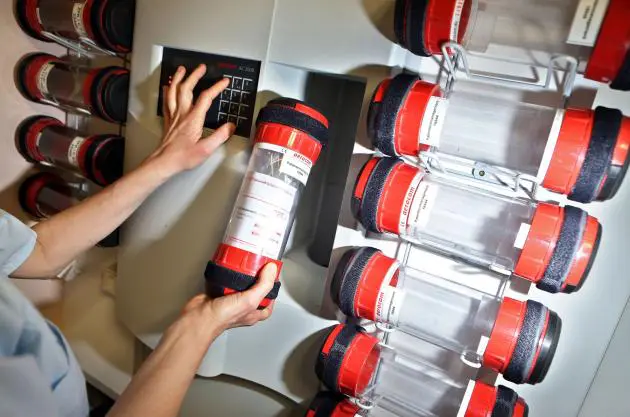
Users pop a document or medical sample into a cylindrical, plastic capsule, insert it into a tube and it whizzes away.
Pneumatic-tube systems once laced through networks of miles upon miles in the world’s great cities – London, Paris, Berlin, New York and many more – carrying high-speed communications between people.
Today’s systems are usually confined to one building or one campus. Quick and effective, if a bit clunky-looking and sounding.
Leipzig University medical hospital in Germany this year upgraded to a higher-capacity system.
At the gynaecology department, a clear plastic capsule will land with a thud in a box behind the reception desk. A nurse takes it out and unscrews the black-and-red cap in order to get to the medical documents inside.
Many other corporate sites around Germany, up to and including Chancellor Angela Merkel’s office building, use them. This is one form of communication within a building that the US National Security Agency (NSA) can’t bug.
Almost every department of the Leipzig medical clinic is connected to the pneumatic post, making 21 kilometres of tube altogether.
It and a similar system in Heidelberg are the largest hospital pneumatic post systems in Germany, says Christian Pohlenz, the engineer in charge of maintaining the Leipzig system.
Each day, he says, about 3,300 capsules are whizzing through the Leipzig tubes.
“Everything that is part of the everyday life of a clinic and can fit inside a capsule will get despatched,” Pohlenz says. “Every kind of sample – blood, stool, skin - as well as medications and documents.”
Though the capsules are propelled inside the pneumatic tubes by a combination of high and low air pressures, today’s networks are not primitive. Traffic is addressed digitally and the pressure is controlled by computers.
The capsules travel at six metres per second. That’s 21.6 kilometres per hour.
Sounds kind of slow, but back in 1853, when a man named J Latimer Clark set up a 200-metre-long pneumatic tube to connect the London Stock Exchange with the Electric Telegraph Company, it was amazing.
The system quickly proved its advantages over the human messenger-carriers scurrying through the streets.
The triumphal march of the pneumatic tube system proceeded on to Berlin (1865) and Paris (1866) and many more major cities around the world. In many cases, the pneumatic tube system became an integral part of the postal services.
In Paris, the pneumatic post system was still in use up to the early 1980s.
At the Museum for Communication in Berlin, Veit Didczuneit says that despite being more expensive – a letter on the public pneumatic post network cost 30 German pennies, as against 5 pennies by normal mail – the Berlin pneumatic post in the late 19th century was very popular.
That was because it was so much faster, almost like e-mail.
The decline of the pneumatic post systems set in and accelerated after World War Two, Didczuneit notes.
“The increasing use of telephones in the 1950s and 1960s led to a rapid drop in pneumatic post despatches,” he says.
In West Berlin the system was shut down in 1971, while East Berlin’s system lasted five more years.
Curiously, Hamburg’s system came to a dramatic close in 1962 – not due to the advance of other technologies, but because the system was all but destroyed by a massive flood that year in the city.
But while inner-city pneumatic post slowly eased out, the idea continues to thrive for internal mailings inside a company, or as in the case of Leipzig, on the sprawling grounds of the university medical centre.
The pneumatic post system was set up there in 2006. Before that, human messengers had transported documents between the laboratories and clinics.
“They would often stop for a cigarette break,” Christian Pohlenz remembers. A capsule speeding through a pneumatic tube does not take a cigarette break, he adds, proudly noting that his system has a 99-per cent punctuality rate.
About a dozen companies in Germany offer to build modern pneumatic post systems, according to Pohlenz. Today’s pipes are plastic, not metal. The one in Leipzig cost 1.8 million euros (Bt80.6 million). Annual operating costs are between 40,000 and 50,000 euros.
This is much more economical than employing humans to carry samples, blood supplies and documents back and forth through the large clinic grounds. Pohlenz says Email could transport documents, but not samples, and he sees no alternative to the pneumatic post.
“At least not until somebody invents tele-transporting like you see in Star Trek,” he grins.
