
Same same but different


South Korean and Chinese artists look at similar aspects of two societies
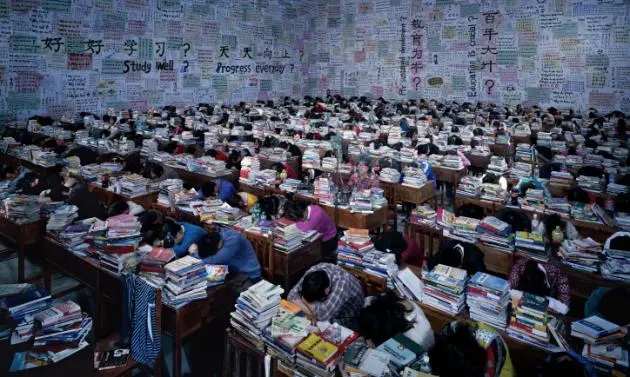
HUNDREDS OF students take a nap with their heads down on wooden desks. There are piles of books, Coke and juice bottles on the long rows. Posted on the wall are slogans encouraging students to stay awake and study harder. The sight offers a hint of strict study plans and the weight of pressure on students before their big exam day.
The exhausting scene recalls the intensive study that South Korean students endure in their final year of high school.
“The competitive college entrance exam poses a lot of social problems in China. I staged the scene after I heard a story about a mother who died in a car accident shortly after taking her son to an exam venue for the college entrance exam. The father didn’t tell his son that his mum had died until the exam finished because he didn’t want his wife’s death to affect his son’s exam,” says Chinese artist Wang Qingsong.
The “Follow You” photograph is on display at the group exhibition of South Korean and Chinese artists at the Seoul Museum of Art. The show runs until May 11.
Wang satirically criticises the cutthroat competition of the college-entrance exam with a humorous photo featuring the artist himself getting a glucose injection inside the classroom.
“And I also heard that Koreans consider the college entrance exam as important as the Chinese do,” Wang adds.
The exhibition, held as part of a cultural exchange programme between South Korea and China, presents reactions of Korean and Chinese artists to their fast-moving societies. It was organised by the Korea Foundation and Seoul Museum of Art in cooperation with Songzhuang Art Centre and White Box Museum of Art in Beijing.
Borrowed from the title of Zygmunt Baumans popular book “Liquid Times: Living in an Age of Uncertainty,” the exhibition “Liquid Times” portrays the anxiety and confusion prevalent in the minds of people.
Performance artist Li Wei captures the stress of young generations and delivers it with humour in his gravity-defying photograph series. Using wires tied to his body, Li does dangerous stunts – getting punched on the top floor of a tall building, jumping off the building and flying with a high-speed train. The places where he performs, such as construction sites, building roofs and abandoned factories, are part of what makes modern-day China what it is.
South Korean artist Lee Yong-baek’s video depicts the distinct anxiety and tension from the unfinished war between North and South Korea. Using the sound of news on violence, wars and protests as background noise, the artist filmed the ride of the flower-decorated tank from Gyeongbokgung Palace to the inter-Korean border and edited it into a 2-minute, 54-second video.
Lee Won-ho turns his focus to members of Korean society. He sets a financial deal with beggars on the streets of Seoul to test the one-sided relationship of beggars and givers.
Lee asks them to give him their money baskets and donations collected for a day. He then pays them whatever amount they ask him in exchange for their money basket and donation. The discrepancies in the amount are listed on a excel sheet posted on the wall.
“What’s ironic was that 95 percent of the beggars I met refused to sell their money baskets,” the artist said during the exhibition tour.
While Korean artists chose to express their inner views through installations and media art, their Chinese counterparts portrayed diverse social aspects through photographs, paintings and media art.
