
The mystery of a tale of a tail


Play
How Phantom's aggression fades with a little gentle brushing
FINALLY, I think I’ve figured out a little mystery about eight-kilo Phantom, the household’s latest cat. Why does he have arthritis in his tail?
Phantom joined us a few weeks ago after his owner decided to have the vet euthanise him. He’s elderly – 16 years old – he has arthritis, and perhaps the owner thought he had no quality of life.
As soon as he arrived, the boy showed us just how non-elderly he is. One of his favourite activities is attacking my other cats. He chases them down, corners them and then jumps on them.
His weight alone gives him an advantage. No victim of his can get away when he’s on top of them. He really is a big boy, and pulling him away from his prey isn’t easy. I just don’t have the upper-body strength.
Besides, Phantom’s personality is different from my other cats’. They watch me, trying to figure out what I’m thinking. Phantom doesn’t care what I’m thinking. He expects me to know what he’s thinking, and if I don’t, he bats me gently with a paw to point me in the right direction.
If he’s in the middle of crushing another cat under his weight, he doesn’t want any interference from me. He’s tried to bite me when I wanted to stop a cat fight.
To end a cat fight, lots of people would simply grab Phantom by his tail, pulling him away from the other cat.
I won’t do that. It’s too dangerous for the cat, or for any animal, in fact. A strong pull could easily injure the nerves and bones in the tail. With a cat, it’s worse, since the tail is actually an extension of its spine. A powerful yank of the tail could injure the animal’s back as well.
Before Phantom joined us, I had the vet give him a complete medical check-up, including an X-ray. The previous owner had said that the cat suffered badly from arthritis. Phantom is elderly after all, and arthritis could be expected in a 16-year-old cat, but I wanted to know just how bad his arthritis really was.
To my surprise, the X-ray indicated that the arthritis was relatively mild. More surprising to me, however, was the location of the arthritis. On Phantom, it’s found at the root of his tail, nearest his body, moves into the spine itself and then towards his hips.
The arthritis in my other elderly animals has always started in their hip and shoulder joints. No one has ever had arthritis in the tail or spine. We really don’t know how Phantom’s owner treated him – but I suspect the worst.
Perhaps when he attacked another cat, she simply grabbed his tail to pull him off. If she did it once or twice, he wouldn’t have suffered any effects.
With such a heavy cat, however, constant tail-pulling would have ultimately affected his spine and upper hips, leading to arthritis.
So I don’t pull his tail. I break up the fight in other ways, sometimes with a piece of heavy cardboard placed between the two cats or a heavy bucket.
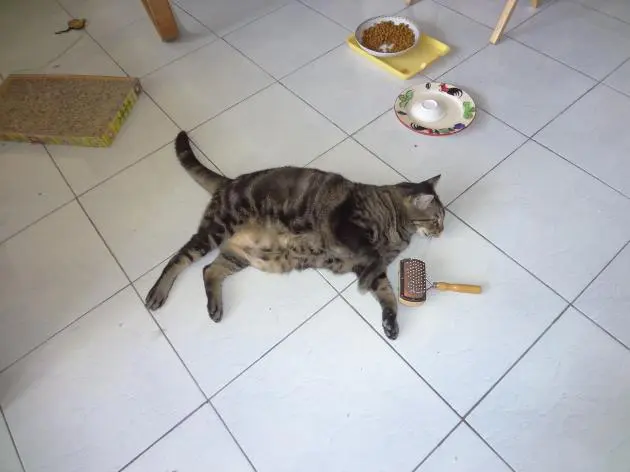
When I have Phantom’s attention, I wave his brush at him.
No, I don’t hit him. Never. I don’t have to. Even more than fighting or his food, Phantom loves his brush, one with tipped bristles to protect his skin.
He usually follows me anywhere, as long as he sees the brush.
Dropping down at my feet, he stretches out and relaxes. As I run the brush down his body, he purrs quietly, thoughts of killing fading away.
