
Gentlemen of the court
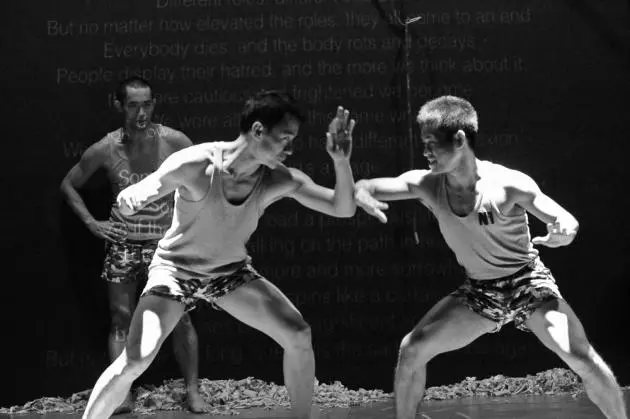


Pichet Klunchun looks at Royalty's men-in-waiting in a new performance commissioned by Singapore's theatre works
LAST NIGHT AT Chulalongkorn University’s Sodsai Pantoomkomol Centre for Dramatic Arts following his performance with Yum Keiko Takayama in A.lter S.essio’s “Loss”, Pichet Klunchun was formally recognised for his contributions to the world of art and culture by the French Ministry of Culture and Communication, as ambassador Thierry Viteay pinned the insignia of Chevalier of Arts and Letters on his lapel.
“The honour is half for me, and half for the art of khon [masked dance theatre]. This is evidence that our art is recognised globally,” a delighted Pichet said after the event.
The male members of his company were not in the audience to congratulate Pichet, though – they’re now in Singapore busy rehearsing the company’s new work “Nay Nai”. The new chevalier will join them there this morning.
Pichet says he’s been interested in the relationship between the LGBT community and performing arts – not only here in the gay capital of Asia but also worldwide – for many years. When he pitched the idea to Tay Tong, Theatreworks’ managing director, neither of them really knew how the performance would turn out. The production concept became more concrete last year when Pichet picked up Chanan Yodhong’s controversial book “Nay Nai Samai Ratchakan Thi Hok” (literally, “Men-in-Waiting During the Reign of King Rama VI”).
“I found it fascinating”, says Pichet. “What I’ve been working on, khon, is directly relevant to what King Rama VI did. Thanks in part to his educational background in the UK, he reorganised the production process of khon – for example, the writing of khon’s production script. Reading this book taught me that these men were trained not only as actors and dancers, but also soldiers and athletes. In other words, they became ‘gentlemen’ in the Western sense of the term.”
Pichet then met with Chanan and discovered that the book was an adaptation of the thesis he had prepared for his master’s degree in women’s studies at Thammasat University. Chanan based it on his study of primary and secondary sources of documents as well as personal interviews and had come up with “Nay Nai” by himself.
“Nay nai represents a major change in the male-female power in the Siamese court during the reign of King Rama VI,” Pichet says,
“Afterwards, they were replaced by nang nai [ladies-in-waiting] and shortly afterwards we became a democratic country. What’s also fascinating for me is that these nay nai were honoured more highly than their female counterparts in the previous reigns. Moreover, dance, music and theatre masters in this reign were bestowed with prestigious titles like never before. In contrast, dance, music and theatre artists nowadays are frequently viewed with the ten kin ram kin – ‘dancing to make ends meet’ – attitude.”
As intriguing as the subject matter is the presentation style he’s chosen – that of a reality TV show.
“In reality TV shows, contestants are trained together in various skills. Apart from camaraderie, there’s inevitably a high level of competition among them. Reality TV contestants become winners purely subjectively by SMS votes, and not necessarily based on their skills. Likewise, the men-in-waiting were promoted by winning the heart of the sole member of the jury, the king.”
In the performance, the four members of Pichet Klunchun Dance Company will engage in games that were used to train nay nais in physical strength and energy, as documented in Chanan’s book. In the last part, they’ll perform in a play “Mit Thae” (“True Friends”), King Rama VI’s adaptation of Arnold Golsworthy and EB Norman’s “My Friend Jarlet”. But viewers shouldn’t expect to enjoy it in the style of the spoken drama style, as its author intended.
“We’re thinking, but without emotions; we’re moving, but one movement has no relationship whatsoever to the next – we’ve become odd characters living in our unique world, similarly to that of those men-in-waiting,” Pichet says.
To make the final scene even more fantastical, Pichet has been working with King Mongkut’s University of Technology Thonburi computer engineering professor Priyakorn Pusawiro who is applying her skills to the performance’s set and costume designs.
And while Chookiat Sakveerakul’s “Home: Love, Happiness, Memories” was released in the island state though it was given the NC-16 rating due to its gay subject matter, Pichet Klunchun Dance Company’s “Nay Nai” is rated G, for general audiences.
That sounds right for Theatreworks’ aim “to present innovative contemporary performances, artistic expressions that offer Singapore audiences alternative viewpoints to the accepted” for this commission.
COMING OUT
IN STYLE
- “Nay Nai” is at 72-13 in Singapore from Tuesday until June 21.
-Tickets are S$35 ($18 for students and seniors above 62).
- Book at NayNai.peatix.com. For more, visit Facebook.com/PKLifeWork.
