
Inside Chumpol's rogues gallery


Play
Art is wielded as a weapon when political portraits serve to condemn corruption
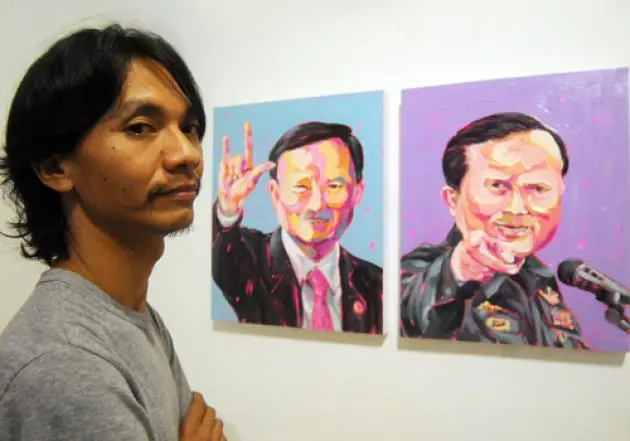
We can't actually expect military junta chief General Prayuth Chan-ocha to go head-to-head in the same room with Thaksin and Yingluck Shinawatra, with Abhisit Vejjajiva and Suthep Thaugsuban lurking menacingly, but that’s exactly what they do in the art of Chumpol Kamwanna.
Chumpol has assembled these figures and 77 other political movers and shakers in his latest solo exhibition, “3P: People: Politics: Power”, at the Bangkok gallery Rebel Art Space.
The small hall somehow finds room on its walls for 82 stern-faced portraits and, to enhance your viewing pleasure, it pipes in the racket of parliamentary debates and those doleful announcements from the National Council for Peace and Order.
On one wall General Prayuth does indeed point an accusing finger more or less toward the self-exiled Thaksin. On another, Yingluck faces off against Abhisit, two former premiers in silent but nevertheless expressive conflict.
Chumpol is commemorating the 82nd anniversary of “the Siamese Revolution” that brought the country a semblance of constitutional democracy. At the show’s opening last Tuesday the sharp-tongued artist and political activist Vasan Sithiket, who runs the eight-month-old gallery, took turns with visitors delivering harangues from a Hyde Park-style Speaker’s Corner platform. The previous exhibition had offered a swath of tormented art from Myanmar.
Chumpol spent more than a year painting the portraits in this show, documenting Thailand’s political history since the 1932 coup. Rather than realism he’s gone for quick strokes and thick paint, the resulting distortion better reflecting our political “illness”, he says.
More than eight decades after the Siamese Revolution ended seven centuries of absolute monarchy, echoing global changes of the era, Thailand is again under military rule, and Chumpol, 41, fails to see any evidence of progress.
“We have never learned from our history,” he complains. “The politicians are still corrupt and the citizens’ political movement is still young.” He’d participated in both the anti-Thaksin protests in 2005 and this year’s anti-Yingluck demonstrations, though he denies partisanship.
“I’m just sick of corrupt politicians. Instead of being concerned about the people’s interests, they play games in Parliament. It upsets me when I see them bickering on TV.”
Chumpol historical focus is primarily on the current situation, the red-yellow epoch. He tracks it from media mogul Sonthi Limthongkul launching the anti-Thaksin People’s Alliance for Democracy in 2005 to the coup led by General Sonthi Boonyaratglin the following year to Prayuth’s take-over this last month.
Chumpol’s vivid portraits of government and opposition figures are as male-dominated as real life, with only four women depicted: Yingluck, Thaksin’s other sister Yaowapa Wongsawat, former Pheu Thai Cabinet minister Praveena Hongsakul, and the Democrat Party’s sharp-tongued Rangsima Rodrasamee. Most of the subjects wear the business-suit “uniform” and are speaking into microphones, and the presentation of the paintings on the walls makes no distinction as to their party affiliation either.
Sticking out like the thorn he intends to be among the politicians is a portrait of Chumpol’s artist hero, Vasan, who once listed the Artist Party on election ballots in an attempt to gain votes and a voice for the cultural community.
Chumpol too regards art as a political weapon. He was among the country’s top satirists who created anti-government art last December, when the protest rally at the Democracy Monument featured the exhibition “100 Square Metres: 100 Artists”. National Artist Naowarat Pongpaiboon had a poem among the more than 100 paintings. Chumpol depicted Thaksin as a demon, wearing a skull on his head.
“I’m not a political activist,” he insists, nevertheless, and his shirt is neither red nor yellow. “My art just reflects the illness of society.”
For him and Vasan, the continuing coups d’etat are a symptom of the disease.
Vasan took aim at the violence of Black May 1992 in his own series of political portraits, “Black Lists”. That episode was the reactive culmination of the February 1991 coup against the Chatichai Choonhavan government by Generals Sunthorn Kongsompong and Suchinda Kraprayoon, who had labelled their ruling regime the National Peace Keeping Council.
“I painted over 100 portraits for that collection,” says Vasan, 59. “I put them on show at my friend’s gallery in Thonburi. There were very few viewers because everyone was afraid after the coup.” But eventually almost all of those paintings found buyers.
GET A PEEK AT POWER
“3P: People: Politics: Power” continues through July 31 at Rebel Art Space on Sukhumvit Soi 67.
The gallery can be visited by appointment only. Call (087) 112 7774.
