
The face of Asia reborn


Play
Borders dissolve as an exhibition of contemporary Asian art travels the world
Acclaimed Thai artist Navin Rawanchaikul’s huge and vivid figurative painting “Places of Rebirth” from 2009 joins a wealth of other Asian art in the exhibition “No Country: Contemporary Art for South and Southeast Asia” on display at the Centre Contemporary Art in Singapore’s Gillman Barracks, ending this Sunday.
Curator June Yap assembled the country’s first Guggenheim show, offering works by 22 artists and art collectives in Bangladesh, India, Indonesia, Malaysia, Myanmar, Pakistan, the Philippines and Vietnam, as well as Singapore and Thailand.
Yap spent more than a year travelling around Asia selecting pieces for the museum. She and Alexandra Munroe, the Guggenheim’s Samsung Senior Curator of Asian Art were in Bangkok last November 2012 for the inaugural public-education programme “MAP: Regarding South and Southeast Asia”. The programme was hosted in collaboration with and took place at the Jim Thompson Art Centre in Bangkok.
Yap met several Thai contemporary artists during that visit and bought three pieces for the Guggenheim's permanent collection under the auspices of the Guggenheim UBS MAP Purchase Fund.
Besides the one by Navin, the museum know owns Araya Rasdjarmrearnsook’s 12.37-minute video “The Treachery of the Moon” from 2012, which has been included in the “No Country” shows in New York and Hong Kong, and Kamin Lertchaiprasert’s massive installation “Sitting (Money)”, now stored in New York.
The last work, from 2004–06, features 366 meditative figures pieced together from decommissioned Thai banknotes, conflating spiritual wellbeing with material wealth.
The exhibition’s title comes from the opening line of WB Yeats’ 1928 poem “Sailing to Byzantium”, which Cormac McCarthy later borrowed as the title of his novel “No Country for Old Men”. In the case of the Singapore show, it evokes the concept of a culture without borders. Contemporary art in South and Southeast Asia depicts how complex relationships and cultural influences connect citizens to each other and to the rest of the world as borders shift and dissolve.
“No Country” is a five-year project of three parts, focusing on geographical, cultural and historical aspects of each region.
For Yap, “No Country” is returning to the region of its focus at the Centre for Contemporary Art. The journey began in New York in February 2013, at the Solomon R Guggenheim Museum, introducing artists who for the most part had never been shown in the US.
The exhibition moved to Hong Kong in October, where it acknowledged Asia as the fount of several influential faiths and ethical teachings and the new home to an expanding Islam. In considering the impact of spiritual, cultural and moral tenets, “No Country” delved into complex histories that shaped communities. It was presented at the Asia Society Hong Kong Centre, a building that in the 19th century housed an explosives compound for the British colonial masters.
“The artists of ‘No Country’, I believe, are no strangers to us within the region,” Yap says. “The question that arises for us is what can the exhibition further illuminate? I did want viewers to immediately say, ‘Oh, this is Asia.’”
The show is comprehensive. On display are 19 pieces by 16 artists and collectives, reflecting on relationships of history, culture and social politics.
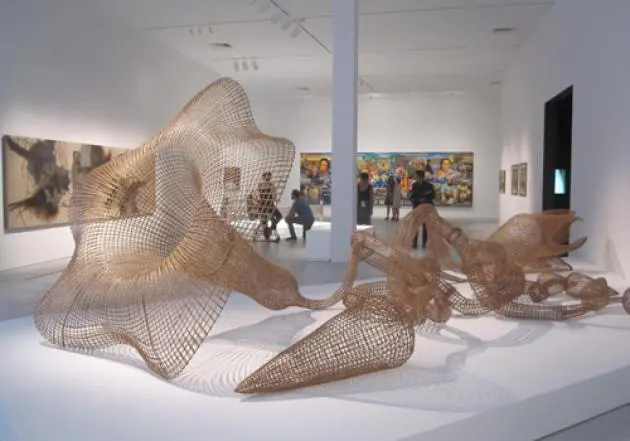
Cambodian Sopheap Pich’s impressive sculpture “Morning Glory” (2011) combines traditional techniques of hand-crafting rattan and bamboo with modern materials like wire, plywood and steel. It suggests his countrymen’s shared experience and a sense of renewed life.
Bangladeshi Tayeba Begum Lipi’s brilliantly eye-catching sculpture “Love Bed” (2012) is a double bed made of razorblades, evoking the problem of domestic violence.
Nearby is Navin’s huge Bollywood-style movie billboard “Places of Rebirth”, 23 feet long and packed with portraits, including those of the artist and his family, and depictions of historical events. He’s rendered a 1947 photograph by Margarret Bourke-White of a young refugee contemplating his future. Born in India, raised in Chiang Mai and living in Japan, Navin has taken a lot onboard in his life and it’s reflected in his painting.
Navin’s work speaks loudly alongside Indian Shilpa Gupta’s installation “1:14.9", (2011-2012), a huge egg-shaped ball made of polyester thread inside a glass box. It alludes to the tense political situation on the Pakistan frontier. Gupta wound 80 miles of thread into the egg-shaped ball that stands inert in contrast to the volatile border.
Also on view is Vietnamese-American Tuan Andrew Nguyen’s video installation “Enemy’s Enemy: Monument to a Monument”. It’s a baseball bat carved with a likeness of Thich Quanc Duc, the monk who famously and fatally set himself afire in 1963 in protest against the corrupt government of South Vietnam. Its meaning encompasses both the artist’s own dual identity and the juxtaposition of violence and serenity.
Yap speaks of “the beauty of art – that you can approach it at so many levels”.
“Maybe you are attracted by the colours or the history or even the complex theories. It doesn’t matter. What’s more important is the experience you have. As long as you see what you see, it’s able to transform you in some way. It’s that experience that changes life.”
NEXT COUNTRY
n “No Country: Contemporary Art for South and Southeast Asia” ends on Sunday at the Centre Contemporary Art in Singapore.
n The next Guggenheim UBS project focuses on Latin America with the exhibition “Under the Same Sun: Art from Latin America Today”. Catch it at the Guggenheim Museum in New York until October 14.
n For more information, visit www.Guggenheim.org.
Who gets to be hub?
Compared to other countries in the neighbourhood, Singapore is much more developed in terms of contemporary-art “infrastructure”. For a decade its artists have been participating in international shows and the island-state itself has hosted the Singapore Biennale and Art Stage, attracting thousands of art lovers from around the globe.
But how, sceptics wonder, could Singapore ever become even a regional arts hub when freedom of expression remains curtailed? Does it have the potential nonetheless?
“You should ask someone from the government,” curator June Yap laughs. “I think it’s wonderful – where we’re situated with so many connections. You don’t really feel there are any boundaries. But I don’t know if it will become the hub. Maybe it will or maybe not.”
To marshal the region’s focus, Singapore would need more than the “hardware” – the museums and galleries, Yap says. Hosting competitions is important, and both Indonesia and the Philippines have strong arts communities.
“In Thailand, in Chiang Mai, there are lot of arts communities too, and a lovely convergence of artists and academics. In Bangkok you have a lot of galleries that together can create a dialogue.”
Although the event’s primary focus will be on China, Thailand’s stature might rise when the Guggenheim Museum and Professor Apinand Poshynanda of the Culture Ministry open another symposium on Southeast Asian art in Bangkok in September. The fourth Asian Art Council meeting will be the first one held in Southeast Asia.
PHATARAWADEE PHATARANAWIK
THE NATION
