
Still the 'TOP' guy in greening


Play
Pipat Apiruktanakorn takes his clever environmental ideas to the Art Centre
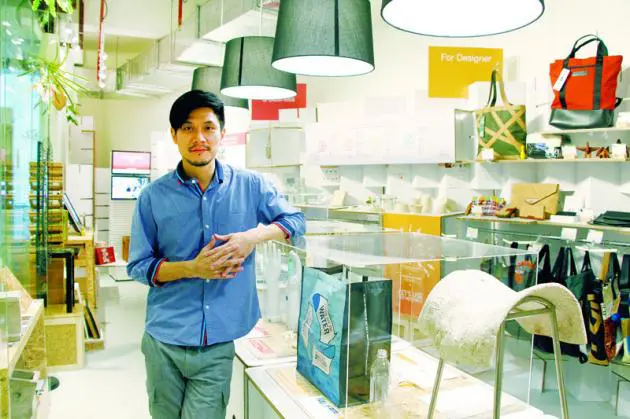
ACTOR TURNED environmental activist Pipat “Top” Apiruktanakorn has earned the moniker “Mr Eco” thanks to his “O” line of Earth-friendly products sold out of the Eco Shop.
Green products remain a niche market, but Top’s been working hard for six years to make a difference, motivating people to change their ways and do the planet less harm. Formerly located in the Digital Gateway mall at Siam Square, the Eco Shop has relocated to the Bangkok Art and Culture Centre with the lengthened name Eco Shop Common.
“I added the word ‘common’ to illustrate that it’s easy to do good things for our world,” Top says. “Lots of people are capable and willing to contribute, but they just don’t get the proper education when they’re young. In countries like Japan, children learn about these things in school and their parents set an example, so it automatically becomes a habit.”
Even with just 30 square metres, Eco Shop Common is as much a learning centre and materials library as it is a retail outlet. Up front is an edutainment area that explains how you can earn money by sorting your trash into different categories. Plastic bottles can be sold for Bt15 per kilogram, corrugated cardboard for Bt4, newspapers for Bt3.5 and milk cartons for Bt1. And, if you have any bronze wiring you don’t need, it’s worth Bt180 per kilo.
The same little education centre points out that every Thai goes through 60,000 grams of paper a year on average, which ends up as 3,900,000 tonnes of waste. And every time you switch on the air-conditioner, you’re using enough electricity to power 30 electric fans.
It’s Top’s contention that getting many people to exert even minimal effort to help the environment can have a huge impact. He shows how it’s done in a four-minute video titled “Eco 24 HRS”, in which 24 people each offer a clever green suggestion. It’s also on YouTube.
Among the tips:
- Use a stainless steel water bottle for all your mobile drinking needs, not plastic ones;
- Never put your electrical devices on standby;
- Turn the air-conditioner down just a couple degrees;
- Use handkerchiefs instead of facial tissues;
- Carry a cloth shopping bag and shun the plastic ones.
Top studied product design at Srinakharinwiroj University before getting into acting and hosting TV shows. While researching buying trends in “eco-design furniture” for his master’s degree, he learned about architect Singh Intrachooto, who turns “junk” into appealing, innovative housewares sold under the Osisu brand.
Singh became Top’s thesis adviser and Top ended up designing a chair called “Need” for Osisu, moulding plywood into an organic form. It was beautiful, simple – and endearingly eccentric.
Eco Shop Common reserves a space for displaying just such innovative designs, some of them available in stores and some still prototypes. The latest collection includes a stool with a seat fashioned from discarded eggshells, and yet it can support 70 kilograms. There’s a sheet of paper that can be folded into a broom, a paper dustpan, and a light-as-a-feather splint for broken limbs that, unlike the plastic variety, doesn’t irritate the skin.
You can also see an interesting collection of items – a tote bag, scarf and purse – made from woven cotton and dog fur clipped in pet salons and spun into yarn.
Top’s even made an “ecolele” – a prototype ukulele that’s just a teak neck with four strings attached. Since there’s no body to it, it requires 70 per cent less wood (and is 20 per cent lighter), and yet you can’t tell the difference in the sound. Head back to YouTube again and listen for yourself in the video “ecolele from Singto & Pango”. It features Singto Numchoke, the country’s best-known ukulele player, creating astonishing music with his ecolele.
“Public awareness about the need to conserve resources is growing steadily, but many people simply don’t know how to start,” says Top. He also laments that some firms entering the business are so keen to cash in that they “have no idea about material and funding sources”. Grants and advice are readily available from a slew of government agencies and private backers for anyone wanting to start a commercial venture, he says.
Eco Shop Common is a good source of materials in itself. Top has another display of clever materials created by Thais, with info cards explaining the samples in both Thai and English, and a computer ready for searching a database for more information and specifications.
You can panel a floor with leftover wood chips and discarded milk cartons. You can package food in a carton formed from tapioca flour and seeds – and then plant the used container in the dirt and it will sprout a new shrub. There are construction boards made from a fibre extracted from durian husks, and translucent roofing sheets of resin-coated rice straw. Top has decorative stick-on wall panels fashioned from fabric scraps that can be reused over and over, dozens of times.
Top is a driving force behind the Eco Design Thai Thai collective, set up two years ago by more than 20 environmentally concerned designer brands. Their products draw attention at the Baan Lae Suan Mid-Year Fairs and some are also on sale at Eco Shop Common. You can pick up Good/Rak’s paper-and-felt iPad case, Concept Tree’s bamboo memory stick and Re+Pair’s portable speaker for iPhones and MP3 players, the main component of which was once a bamboo container holding sticky rice. It requires no batteries, either, since it runs off the iPhone’s own power.
O, Top’s brand, has a new collection of tote bags fashioned from woven hemp. Inside are straps for securing an umbrella. “Hemp’s more durable than cotton, absorbs moisture better than nylon and provides more warmth than linen,” he says. “It also gets softer they more you wash it.”
Then there’s 0.4921, his 160-page notebook of A5-size pages. The name refers to the height (in centimetres) of the space between the 48 lines on each page. A typical A5 notebook has 34 lines per page. By narrowing the space between lines, you get an extra 1,280 lines to fill in every book.
“Most products on the market can be made smaller, thinner, narrower or lighter with sustainable and renewable materials, without diminishing their functionality,” Top points out.
And, with an ever-increasing number of citizens trading in four wheels for two, there’s a line of O bicycle accessories, all made with “leftovers”. A pair of leather straps called 88 is made from factory discards. They’ll hold your water bottle, umbrella, a newspaper or just about anything narrow to the bike frame. Next, save power in your tail-light battery with Top’s rear reflector made from recyclable polypropylene. It’s lightweight and lasts a long time.
GREAT NOTIONS
>>> Eco Shop Common is on the ground floor of the Bangkok Art and Culture Centre at the Pathumwan intersection.
>>> It’s open daily except Mondays from 10 to 8.
>>> Call (087) 099 0639 or www.EcoShop.in.th.
