
Back in sight


Play
Why the new Trifocal Diffractive IOL, which allows good vision at an intermediate distance, is the best option for cataract implants
As Thailand’s population gets older, the risk of cataracts grows higher as seemingly evidenced by the some 200,000 cataract surgeries now being conducted every year.
A clouding of the lens inside the eye, which leads to a decrease in vision, cataract is the most common cause of blindness and can affect anyone over the age of 40.
There are many causes of cataracts and ageing is at the top of the list. Over time, yellow-brown pigment is deposited in the lens, and this, together with disruption of the lens fibres, reduces the transmission of light and leads to visual problems. Heavy exposure to UV rays, radiation from chemotherapy, smoking, taking steroids and diabetes also increase the risk of cataracts.
Cataracts are today easily treated through micro-surgery and, according to Associate Professor Manchima Makornwattana, chief of the Glaucoma Unit at Thammasat University’s Department of Ophthalmology, this relatively easy treatment option is as much responsible for boosting the numbers as the greying of Thailand’s population.
“The technologies are well-recognised and widely accepted and bring patients successful results. And because surgery is assured, people affected by cataracts tend to opt for an operation at an earlier age,” she says.
“Also, in the past, the surgery was not without complications. Most patients would wait for the cataract to be mature before undergoing surgery. The procedure itself took 11mm of lens operation and stitching, and the patient would need to rest for 6 weeks, so the statistics for numbers of operations were far lower.”
“In other words, it’s the demand for surgery that has increased rather than the number of patients requiring treatment,” she adds.
In recent years, the treatment of cataract problems has traditionally involved the removal of the natural crystalline lens within the eye and its replacement with a high-performance intraocular lens (IOL) implant. The first intraocular lens used was the Mono-focal IOL which allows patients to see at only distant vision. The patient would still require glasses for reading or seeing near and intermediate objects. Then came the Multi-focal lOL, also called the Bi-focal lens, which provide far and near focus. However, the results tend not to bring satisfaction to patients who experience difficulties in other ranges.
Now, Dr Damien Gatinel, head of the Cataract and Refractive Surgery Department at the Rothschild Foundation, has introduced a better option for cataracts patients. His Tri-focal IOL is the first diffractive trifocal lens and allows the patient to experience intermediate vision to handle such daily activities as driving, working on computers, accessing smartphones, making up and even reading. Unlike Bi-focal lenses, the Tri-focal provides three distinct points of focus (far, intermediate and near), thus allowing the patient to be completely free from using spectacles and contact lens. Moreover, the lens can also treat toric conditions such as astigmatism, offering alternatives to people who really want to have normal eyesight.
“I would like to suggest that patients looking to implant a bi-focal lens opt for a tri-focal lens instead,” Gatinel says. “If patients achieve only distant and near vision, then there will be a drop in or a loss of vision for distances which correspond to intermediate vision. To me, this is particularly important in the smartphone era as it does away with the need to don spectacles to look at the screen.”
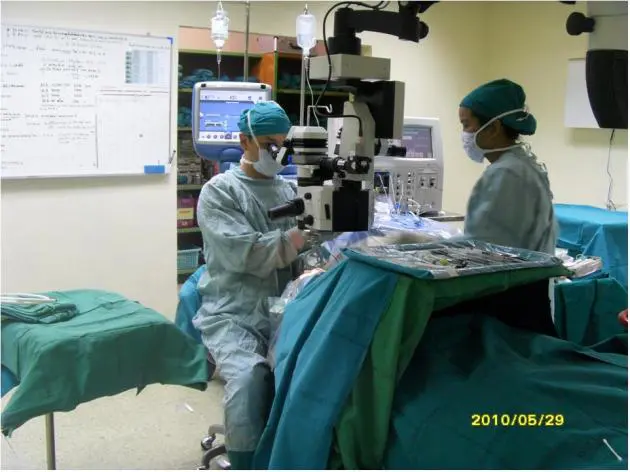
Tri-focal lens implants have received a good response from both surgeons and patients. The operation using this new technology takes only 5 to 7 minutes, requires only 2 mm of eye operation, and needs no stitching.
“There are also no side effects the recovery period is lowered,” says Assoc Prof Manchima, adding that patients can read normally as early as 2 hours after surgery.
Patients might experience some halos and glares after surgery around bright lights but will be able to continue with their daily activities without problem. The eye becomes stable in two or three weeks.
Gatinel stresses that surgeons first need to identify any pre- existing conditions. For example, the patient should not encounter any ocular pathology such as glaucoma because this condition might lead to less satisfying results.
“The trifocal diffractive lens is embedded with a blue-light filter that includes a yellow tint and this helps protect the eyes from rays from the sun and LEDs that are detrimental to retinal and macular health,” he says.
Trifocal lenses are now accessible at all top medical universities and public hospitals including Thammasat and Lerdsin, Khon Kaen, Udon Thani General and Nakhon Phanom hospitals.
The overall cost of a cataract operation in Thailand varies between Bt49,000 and Bt90,000 per eye with the implant of the tri-focal lens costing an additional Bt30,000. While this might seem expensive when compared to the existing multi-focal lens offered, the difference in terms of vision is high enough to make the price worthwhile.
The eyes are one of the most important organs so it makes sense to take care of them. Although surgery is very easy and accessible and the technologies to treat cataracts continue to develop, it is better to prevent the problems associated with this common ocular pathology before it complicates our lives.
And prevention is not even difficult: Wearing sunglasses with UV 400 for protection, avoiding exposure to bright environments and stopping smoking, as well as taking vitamins C and E, all delay the clouding of the eye and promote good retinal health.
