
Doctrine on the social networks


Play
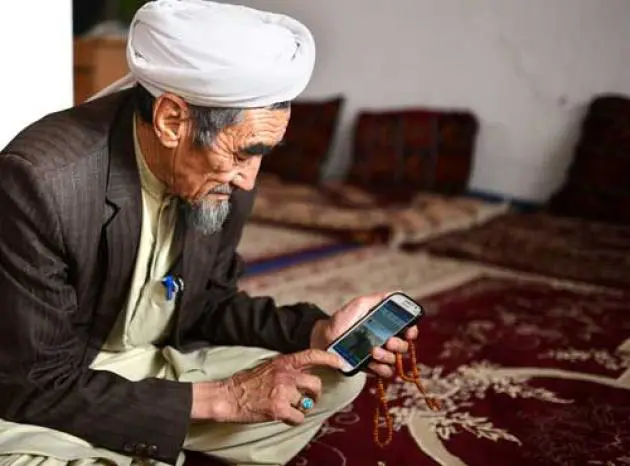
An Afghan mullah adopts Facebook to counsel his Islamic faithful
The biggest predicament for Mullah Sajjad Mohsini in his three decades of life as a Muslim cleric was when Laura Bush, wife of then US President George W Bush, extended her hand to shake his.
Mohsini was one of the welcoming party for Bush on her first visit to Bamiyan, an Afghan province in the central highlands, in 2008.
“You know that Islam does not permit a man to shake hands with a stranger woman. But I could not refuse it, morally,” he tells DPA.
In an instant, the photo of him, a Shiite mullah, shaking the hand of an American woman went public on the Internet, followed by a storm of criticism of him in Afghan online social media.
That was when Mohsini was forced to learn what the Internet was to discover how he was being criticised. His son taught him to use Google and Facebook on their desktop computer at home.
“A human being does not pay attention to something until he or she is in need for it, or comes under social pressure to think about it,” Mohsini explains.
Now 67, he now uses Facebook to help young men and women who seek guidance on how to lead an Islamic life.
In impoverished Afghanistan, there were very few phone lines before the US-led invasion in 2001. Now there are 18 million mobile phone users in a country of 30 million.
The Internet penetration is around 5 per cent, according to government officials, with around 1 million Facebook users.
Five companies provide a 3G mobile Internet service, introduced in 2012. Online social media are flourishing.
“Whether we agree or disagree with science and technology, it is continuously evolving. Human beings have been developing amenities for more comfort since the beginning,” Mohsini intones.
“People used to go to Mecca or Karbala (two important holy places for Shiite Muslims) by donkey in the past. Now they fly by plane. Maybe they will travel there in six minutes in the future.”
Muslim clerics have been divided about the usage of social media. Many top leaders have condemned Facebook and other social media as un-Islamic and sinful to use.
Mohsini disagrees, saying it is “crazy to live in the 21st century with all these technologies, but still continue to use the amenities of the 7th century and live like people from that time.”
“Imam Ali Hussein says that the human is the enemy to what he does not know. Our clerics do not know about the Internet, so some of them are against it,” said Mohsini, quoting the founder of Shia.
“Some of them only think about the negative aspects of Facebook. But we can choose whether we use the positive, moral aspects, or only look at its negative, more sexual topics.”
He has tried to encourage other clerics to use Facebook, telling them about the benefits of spreading their message online.
The Shiite Clerics' Council of Afghanistan encourages mullahs to use the Internet, he says but a nationwide council mixing both the Sunni and Shiite branches of Islam, the National Ulema Council, has been “heedless” of the recommendation.
“Sunni clerics want to limit the Internet usage, as I have heard from their mullahs. I think they dislike it. I have not managed to encourage one single Sunni mullah to use Facebook,” Mohsini says.
“I am fascinated by the Internet and I use it to my level best. Facebook is a good tool for communication. You can use the Internet to solve complex social, political and cultural issues.”
He said he uses Google to find answers that are not readily available from books.
“In the past when I did not know something from the Holy Koran, I had to spend days to find it out. But now I can find it in a few seconds,” Mohsini said, brandishing his Samsung Galaxy S Duos.
Every day, he posts “lessons on Islamic morals” in his Facebook page. When inspired, he also posts some poetry, he said.
“I think freedom is the fundamental need for all humans, but it has limits. It is freedom provided we do not harm others’ freedom. When you harm others, it is violence and aggression.”
During the brutal Islamic Taleban regime (1996-2001), Mohsini was imprisoned by local commanders, “because I was speaking my ideology, which was against theirs”.
Mohsini, like most Bamiyan residents, is a Hazara, of an ethnic group who follow the Shiite branch of Islam, while the Taleban are Sunni extremists. Many of them perceive Shiites as heretics.
After a suggestion from a cleric in Iran, Mohsini has started teaching Islamic subjects through Facebook. He likes the new-found glory, especially among youth.
“Before Facebook, even my son disliked me, because I was a mullah. Now they have changed their view. So many youths like my page, because I am open-minded and I use social media,” he says.
“I really like Baba Mohsini because of his liberal views on modern ideas,” says Reza Ali, a Bamiyan youth who works for a UN. “He is very progressive, but still religious and he has inspired us to think about Islam as something that is not against modernity."
Mohsini says Facebook has an unexpected advantage from an Afghan point of view: privacy.
“The young ask me personal questions which they would feel ashamed to ask in person. I answer them. Even the girls ask me their personal questions and I answer them,” he says.
They have asked him about everything, from mundane daily issues to complex life questions.
“A young man recently asked about the hajj pilgrimage. A woman asked me about an issue in her married life, and her rights and responsibilities to her husband.”
“A person asked me once how many letters there are there in Koran. I could not find out via the Koran itself, because that is difficult. I searched on Google and found his answer.”
