
The city of cinema


Play
Luang Prabang is set to again transform itself with its fifth annual celebration of Southeast Asian films
With temples, hotels, the scenery of the Mekong and myriad other attractions, Luang Prabang boasts many activities to keep tourists busy, and to help them unwind. But one thing you won’t find in Laos’ former royal capital are any working cinemas. Except for one week a year, when the World Heritage city hosts the Luang Prabang Film Festival.
“One of the greatest things about putting on this event in Luang Prabang is that the town offers so much to the international tourist,” says festival director Gabriel Kuperman. “We’ve got terrific restaurants, world-class hotels, incredible history and ethnic diversity and many activities for the adventurous.”
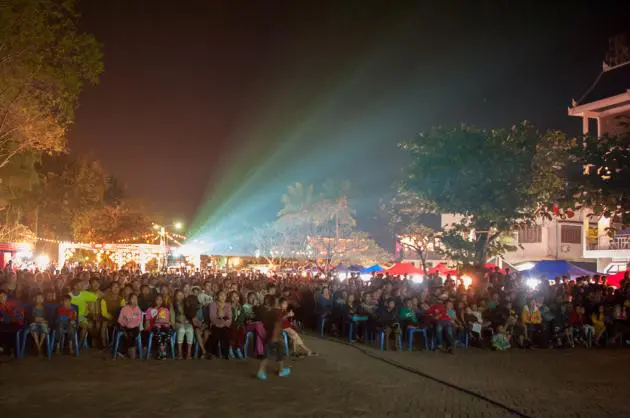
Now in its fifth year, the festival continues its single-minded focus on Southeast Asian films, screening them in an 800-seat outdoor venue in the historic Handicraft Market. And there’s a new venue, an old house on stilts, which will be the daytime screening room.
Opening on December 6, the night’s big presentation will be the world premiere of “Vientiane in Love”, a romance omnibus by four young members of Laos’ burgeoning filmmaking community – Vannaphone Sitthirath, Xaisongkham Induangchanthy, Phanumad Disattha and Anysay Keola. They offer four love stories set in Laos’ capital.
Two other Lao films will also show – the road-trip romance “Really Love” by Jear Sirivongsa and “Tuk-Tuk” by Simon Luang Kiyé, which also takes a journey, following a man as he returns from exile in France. He drives sputtering motor rickshaw into the mountains to honour his late father’s spirit.
Owing to cultural and language similarities, Thai films are hugely popular in Laos, and there are seven of them in this year’s fest, including the blockbuster horror comedy “Pee Mak Phrakhanong”. It’s among the outdoor screenings, along with two documentaries, “By the River” by Nontawat Numbenchapol and “The Songs of Rice” by Urupong Raksasad. The outdoor crowd will also get to gaze at the hit romantic drama “The Teacher’s Diary”, which is Thailand’s submission to next year’s Oscars.
Edgier fare can be found at the daytime venue, which shifts this year to the Hotel de la Paix, a French colonial five-star resort. A bit further from centre than the daytime venue of past years, the five-star Amantaka Hotel, the new place is still within walking distance of the night venue, but a free shuttle will run between the two locations and offer relief to the foot-weary.
“We will show three or four films each day in their meeting room at the rear of the property,” says Kuperman. “This room is built in the style of an old wooden house on stilts, and can accommodate around 50 people.”
Here’s where those adventurous types can catch Lee Chatametikool’s “Concrete Clouds”, covering financial meltdown and heartbreak in 1997 Bangkok and “Mary Is Happy, Mary Is Happy”, Nawapol Thamrongrattanarit’s portrait of a stubborn, mouthy schoolgirl, based on a real girl’s Twitter timeline.
Cross-border cooperation is represented by the Thai-Lao production “My Teacher”, in which a Lao man returns to his village to fulfill a childhood vow to a dead friend. It’s by Thai director Niyom Wongpongkham.
Other countries represented are Cambodia, which offers “3.50”, Chhay Bora’s thriller about a documentary filmmaker investigating Phnom Penh’s sex trade. It’ll show indoors, but another Cambodian entry, the Oscar-nominated “The Missing Picture”, brings director Rithy Panh’s mournful musings on the Khmer Rouge atrocities to the main screen as the closing film on December 10.
Two other Oscar-hopeful pics come from Singapore – the family drama “Ilo Ilo”, which was the city-state’s Oscar selection last year – and this year’s submission, the drama “Sayang Disayang”, in which a live-in nurse cares for a lonely and bitter old man. She hopes to soften his heart by finding a missing ingredient to the man’s late wife’s signature dish.
Indonesia has five films, among them “We Are Moluccans”. Showing on the main screen, the drama has a motorbike-taxi driver starting a youth football team in a bid to bring healing to a village ripped apart by violence between Christians and Muslims.
The Philippines checks in with a selection of so-called “maindie” movies – independent films that are aimed at mainstream audiences. They include the youth drama “Catnip” by Kevin Dayrit, the romantic comedy “Shift” by Siege Ledesma and crime drama in “The Patriarch” by Alfonso Torre.
Malaysia and Myanmar have one film each, “The Boatbuilders of Mermaid Island”, a documentary on Malay boatbuilders, and Midi Z’s “Return to Burma”, which follows a young labourer as he comes back from Taiwan to his hometown in Shan State.
There are also two from Vietnam – the award-winning musical “The Talent” and “Madam Phung’s Last Journey”, capturing the final ride of a touring transgender theatre troupe.
There are 27 feature films in all, with more than half represented by guests in attendance. They include “Sayang Disayang” director Sanif Olek from Singapore, and “Songs of Rice” producer Pimpaka Towira.
There are also dozens of short films screening in the festival’s information centre, with a selection from Malaysia’s TropFest, Indonesia’s ChopShots and a selection from the Lao capital’s own shorts fest, the Mini-Vientianale. There will also be five shorts from the American Film Week’s competition on wildlife protection, which Kuperman says “will show just how far the Lao film industry has come in recent years”.
Further encouragement for the industry will come in two panel talks, one on writing films and the other on getting them shown.
The scriptwriting panel will discuss the challenges of creating a good script. Those taking part will include “Streetside” director Daniel Ziv from Indonesia and “Boatbuilders” maker Azharr Rudin from Malaysia, along with Laos’ Anysay, Thailand’s Pimpaka and Torre from the Philippines.
Representative of Thailand’s biggest theatre chain, Major Cineplex, will talk about theatrical distribution – a challenge in Laos, which has only a handful of working cinemas and no formal film distribution system.
“We are really looking forward to Major Cineplex’s involvement with the Luang Prabang Film Festival,” says Kuperman. “In addition to giving a talk about theatrical distribution, representatives will be in attendance to review all the films, and hopefully select one that they feel has great potential for limited distribution in Thailand. This is a great opportunity for LPFF positioning itself as a platform to get more Southeast Asian cinema seen and out into the world.”
Chiang Mai-based photographer and researcher Philip Jablon will present an exhibition of his work in documenting the region’s single-screen cinemas.
And to warm up the crowd at the main stage, there are nightly performances, including a show by Aluna, one of Laos’ most-loved singers, as well as b-boy breakdancers, shadow puppets by the Khao Niew Theatre and a display of traditional Lao dance and music by the Children’s Cultural Centre.
Free movies
_ The Luang Prabang Film Festival runs from December 6 to 10. All screenings are free.
_ For travel arrangements, check with festival partner Exo Travel at [email protected].
_ For the schedule, see www.lpfilmfest.org.
