
Hope for rebuilding Nepal's heritage


Play
Thanks to preserved skills and salvaged components, Unesco's local chief is optimistic about restoration
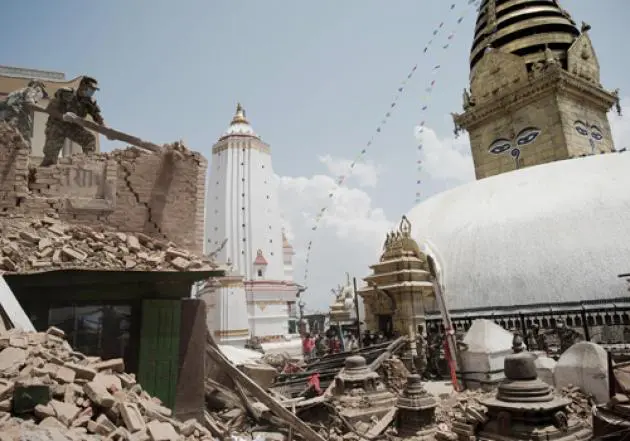
Nepal has suffered a devastating impact on its cultural heritage. In some areas as much as 80 per cent of the temples were destroyed in the April 25 earthquake.
Prime Minister Sushil Koirala last week vowed to rebuild “all structures of historical, religious and archaeological significance”, even if, for now, all efforts are directed at aid and relief.
Here the head of Unesco in Nepal, Christian Manhart, describes the scale of destruction and hopes for restoration.
WHAT KIND OF IMMEDIATE PROTECTION IS THERE AT THE DAMAGED SITES?
All the sites are rather well protected now and fenced off. The police are there, and the locals are securing the vicinity. The southern Kathmandu Valley district of Patan was already secured two hours after the earthquake.
Locals protect most of these sites because the communities there live among them. They belong to them, and they’re part of their daily lives. They have worshipped there for ages. But there is a danger of any site being looted, always, all over the world, in these situations.
IN SOME AREAS THE FIRST RESPONDERS |WERE CRITICISED FOR BULLDOZING TO SAVE LIVES. HOW MUCH DID THAT DAMAGE |THE HERITAGE SITES?
We tried to prevent this immediately when we learned of it. It was very difficult to convince the authorities because they were under this pressure to save lives.
And they thought that with |bulldozers they could quickly remove the rubble and pull out the bodies there. I do not want to comment on this.
You need helping hands. Two hours after the earthquake there were already 100 locals in Patan doing the rescue work by hand.
If you use hands to remove the |rubble, you save the culture, as well as lives because it’s a much softer approach than bulldozing.
WHAT ARE YOU DOING CURRENTLY?
We are planning the assessment and emergency consolidation for the sites. We have started the process for the flash appeal of the UN for US$400,000. It is usually for humanitarian action. We have taken this exceptional measure because culture in Nepal is a major source of income due to tourism. You also have all these professions linked to culture, like masons and carvers and painters. When we reconstruct, we will provide jobs to all these people.
IS RESTORATION FOR ALL THESE SITES POSSIBLE IF THERE IS MONEY?
I am confident restoration is possible. There are many architectural features that are rather undamaged, like sculptures, wood carvings, wooden beams, cornerstones and lintels. All these features are in the rubble. We hope they’ll be recovered and safeguarded. These pieces then can be used for the reconstruction. It’s mostly the brick walls that have collapsed. They’re not easy to rebuild but can be, using the original pieces.
There are also enough skilled craftsmen who can recreate the structures just as they were made in the 16th and 17th centuries. These crafts have survived in Nepal, which is not the case in many countries.
We also have excellent documentation, including detailed photographs, of most of the sites, such as architectural drawings, plans and measurements.
COULD WE HAVE PREPARED BETTER?
We knew the earthquake was |coming. The traditional building technique in a way has some resistance to earthquakes.
It’s a mix of brick with wooden beams. This is supposed to float together with the waves, because it’s flexible, and move with the movements of the earth, which are normally horizontal.
This earthquake was special – movement was not just horizontal but also vertical, probably because the epicentre was just 11 kilometres underground. And because there was mixed movement, many historical buildings fell down.
