
Sounds Like Sax
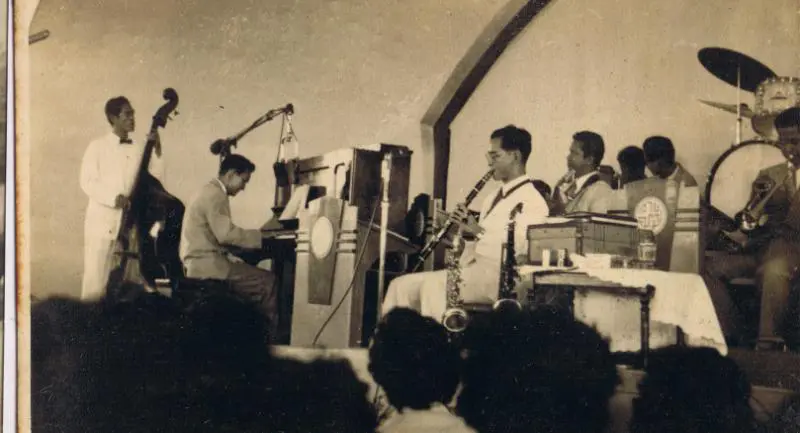


A former member of His Majesty the Late King's Au Saw Friday Band brings his instruments and compositions to an exhibition in downtown Bangkok
A member of the Au Saw Friday Band, the jazz outfit founded more than 50 years ago by His Majesty the King Bhumibol Adulyadej, Dr Pathorn Srikaranonda is highlighting the late Monarch’s musical talents and the instruments he loved in a new exhibition “Kitarat, The Royal Music Legacy” at the Quartier Gallery of EmQuartier.
“These seven musical instruments have never been shown before,” says Dr Pathorn, who is the founder of the Kitarat Foundation. “This exhibition has two objectives. The first is to commemorate His Majesty, who always said ‘music is an integral part of me’. Forty years ago, His Majesty the King played to relax and later as a form of therapy, ‘medicine for the mind’ as he liked to call it. Secondly, the King’s compositions have all been arranged so that Thais are able to play them. We must help to keep, preserve and propagate them. I would love to see His Majesty’s musical works recognised by Unesco as a Memory of the World.”
Like his father, National Artist Manrat, who was one of the original members of the band, Dr Pathorn is a jazz musician. He remembers how his father nurtured his interest in music by enrolling him for courses in electrone and violin at Siam Kolkarn music school. He later studied saxophone with a master of the Royal Thai Air Force and at 14 joined the Au Saw Friday Band.
His secondary schooling complete, Pathorn won a scholarship from His Majesty the King to study music abroad and more than lived up to his promise, earning a Bachelor of Music in Composition and Saxophone Performance at University of Michigan in 1994, a Master’s of Music in Composition at Yale University in 1996 and following up with a doctorate degree in Music Composition at the University of Edinburgh in 2001.
“I came back home twice a year and joined Au Saw Friday Band, which at that time played every Friday and Sunday at Chitralada Palace. His Majesty the King offered me advice on my techniques,” he says.
“When I returned to Thailand after graduation, His Majesty the King was staying at Klai Kangwon Palace in Hua Hin and the band could only play every Saturday as the musicians were working in Bangkok.”
The “Kitarat, The Royal Music Legacy” exhibition is divided into two parts. The first focuses on the late Monarch’s genius for music, the Au Saw Friday Band, and the timeline of his royal compositions.
In the early 1950s, His Majesty brought together a group of relatives and close friends to form a musical ensemble, Wong Lay Kram (The Vintage Band). That later saw a change in its members and its name, becoming the Au Saw Friday Band and playing live on air from the Au Saw Radio Station every Friday. Dr Pathorn Srikaranonda was one of those members.
At the opening of the exhibition last week, Dr Pathorn showcased his talents by playing His Majesty’s composition “Chata Cheewit” (“Hungry Men’s Blues”) on the saxophone.
“Because the lyrics of the song are all about life and fate, the melody is in the classic of 12-bar blues styles,” he explains.
“His Majesty composed four blues numbers, among them ‘Sang Thien’ (‘Candlelight Blues’). That has complicated chords and is harder to play than ‘Chata Cheewit’. He also wrote ‘Blues for Uthit’ in memory of Uthit Thinnakorn Na Ayuthaya, who was a member of Aor Sor Wan Suk band.”
But while it is common knowledge that the late King composed 48 songs, that number is in fact 49 when the sung version of “Rachawallop” (“Royal Guards”) is included. The song is derived from “March Rachawallop” an instrumental, that His Majesty composed in 1948 for the 1st Infantry Regiment, the King’s Own Bodyguard (Thailand) to use during military parades. His Majesty referred to the songs as “khon la phleng diew kan” – two different songs but the same composition.
“About 10 years ago, His Majesty had all his songs rearranged so that they could be played by Thai musicians of every level. He wrote ‘Sang Thien’ in 1946 and His Royal Highness Prince Chakraband Pensiri penned the lyrics. The composition was very complicated because of the accent, scale and form of the 12-bar blues. The song was performed for the first time in 1947. It was too hard for Thai musicians of that time to play. His Majesty arranged ‘Sang Thien’ four times over 30 years. That last time he asked my father and I to separately write the notes and chords of the song without consulting each other. The original key chord was E Major, which was rarely used for the alto saxophone, and later changed to Eb and key C,” Dr Pathorn explains.
The second part of the exhibition showcases seven musical instruments – four of them played by His Majesty and three that were built from scratch for the late King, as well as his musical notebook.
“His Majesty played his King alto saxophone and later gave it to my father so he could instruct HRH Crown Prince Maha Vajiralongkorn, who at that time was studying at Chitralada School. It was the first music instrument I played and I took it with me when I went to study abroad. The Selmer Mark VI Alto Saxophone is the second instrument that His Majesty presented to me in 1989 as a replacement for the first. In 1995, His Majesty gave me a Yamaha trumpet and told me to learn to play it. At that time, American jazz alto saxophonist Benny Carter, who played both sax and trumpet, was in Bangkok for a concert and also played before His Majesty. He was one of His Majesty’s favourite artists. It isn’t easy for a musician to play woodwind and also brass, but His Majesty could play both. As for the upright Steinway piano, His Majesty played it with Au Saw Friday Band and gave to my father as a birthday gift.
“The other three instruments are unique because they were especially made for the King to use while he was in hospital. The Vibratosax Limited Edition #009 is made of polycarbonate plastics and weighs just 300 grams, which is much lighter than the normal two kg weight of a saxophone. The Jazzophone trumpet is vertical while the Stainer baritone saxophone was built so His Majesty could play it while sitting.
“His Majesty’s compositions are all written from the heart and that makes them invaluable,” Dr Pathorn concludes.
MAGNIFICENT MUSIC
- The “Kitarat, The Royal Music Legacy” exhibition is at Quartier Gallery on the M floor of The EmQuartier ShoppingComplex until Sunday.
