
Coming out of their shells
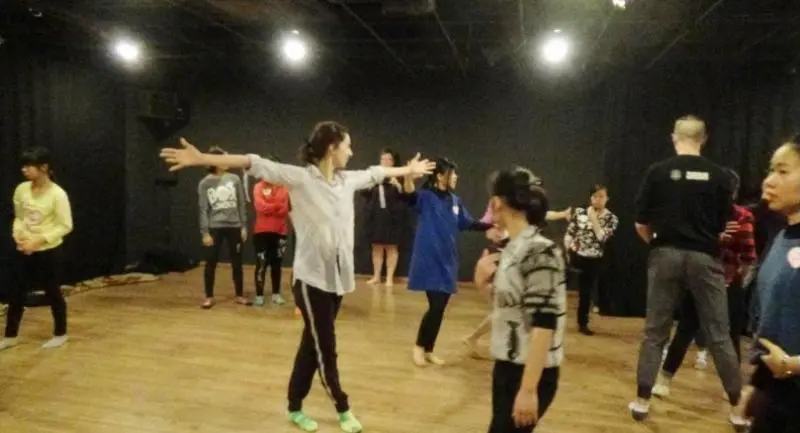


US dancers help disabled Vietnamese children to communicate through movement
Bringing her hands together to form a reptilian head and gently moving forward, 16-year-old Nguyen Thi Thao carefully imitates the slithering movements of a snake. Together with four friends she is taking part in a workshop run by a young trainer from the Stephen Petronio Company.
They all lose themselves in the simulation, undeterred by the language gap – the trainer only speaks English and the dancers are hearing impaired.
Dozens of other hearing-impaired teenagers from Hanoi’s Caring Centre for Children with Disabilities are also following the movements of their American teachers at a dance centre downtown.
The students are divided into four groups, each representing an animal, and are asked to move their bodies like that animal.
Quiet Thao, for example, turns into a dangerous snake zigzagging toward some bait, naughty Lam appears to be an arrogant rooster while witty Phuong transforms into a clever monkey.
Faces shine and eyes sparkle as all 16 students stretch, fold, roll and jumping, their movements precise and full of joy.
The healing workshop is being offered by the Dance Motion USA programme of the Bureau of Educational and Cultural Affairs of the Department of State, produced by the Brooklyn Academy of Music, which aims to facilitate cultural exchanges while showcasing the best in contemporary American dance.
“This is the first time I’ve had a chance to join a movement workshop,” Thao says. “I’m extremely excited and relaxed. It’s quite different from my lessons in class, where I acquire knowledge. Here everything is like a game. I’ll remember this better.
“I’ll tell my friends, who are joining this session, to organise the same dancing opportunities for ourselves and other friends at my school for those who did not have an opportunity to come here today,” she adds.
“The children here are absolutely fantastic,” says dancer Jaqlin Medlock from New York. “They pick things up very quickly. They communicate well... happy, positive excited to be moving and learning new things, which is wonderful.”.
“This kind of extra curricular activity is attractive,” adds Nguyen Thi Quyen, one of the teachers at the centre. “The students are encouraged to move as much as they can. They are not just sitting and listening to teachers passively. Here they tend to be more active, freer to make up their minds. Anyone can be the leader and can change the games’ rules in the group.”
Quyen has taught at the centre for five years and says this is the first time she has seen her students so comfortable, free and excited to join non-verbal activities, like dancing and moving.
“I hope there will be more activities like this for more students in my centre,” she says.
According to Le Hong Ha, a co-ordinator from the Vietnam Dance/Movement Therapy (DMT), which co-operated with the US Embassy to organise the workshop, free movement is used as therapy.
“Children with disabilities like these hearing-impaired teenagers cannot talk, so they can express themselves better through movement. They will find the way to ‘speak out’ and communicate better,” she says.
The Brooklyn Academy of Music has worked with the DMT since last September to plan two workshops for children with autism and deaf-mute students in Hanoi, in addition to staging performances in Hanoi and Hai Phong.
This first project will be followed by another DMT project supported by the American Embassy using dance and movement to heal disabled children.
“We will also undertake other projects for vulnerable groups, like women suffering from domestic violence,” she says.
DMT organises regular workshops for children and parents to help them interact and understand one another through movement and dance in activities like creative games, painting and role-playing.
“Dance and movement therapy has been applied in other countries like the UK and the US for 50 years,” Ha says.
“Yet not many people understand the therapy. What we want to do is bring a fresh way for more people to develop themselves.”
