
Anutin orders tighter gun controls after Nonthaburi school shooting
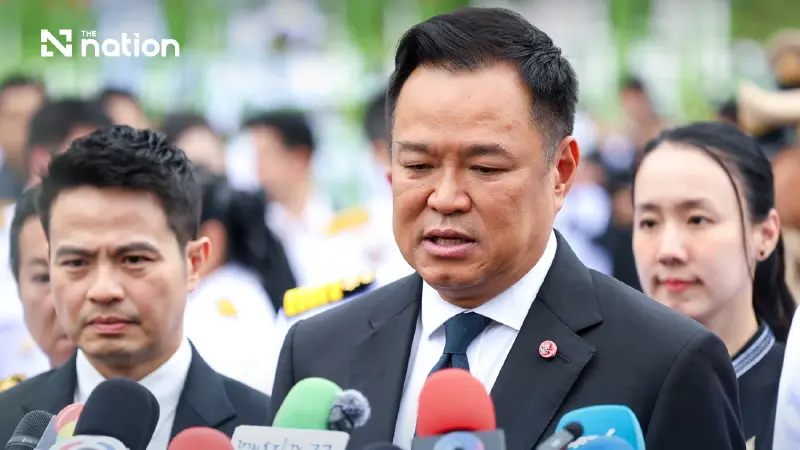


Anutin Charnvirakul has ordered strict enforcement of firearm restrictions after a Nonthaburi school shooting left teachers and pupils dead and injured.
Prime Minister and Interior Minister Anutin Charnvirakul has ordered local administrative officials to tighten firearm controls and take immediate legal action against people carrying guns in public following a fatal shooting at a school in Nonthaburi.
Addressing subdistrict and village heads at Government House on Friday (August 7), Anutin stressed that neither ordinary citizens nor government officials who were off duty should be permitted to carry firearms outside their homes or in public places.
He issued the directive after the shooting at Debsirin Nonthaburi School, where teachers and pupils were killed and injured. Anutin described the incident as a tragedy that had damaged society and demanded stronger preventive action from administrative authorities nationwide.
Speaking while presiding over the 2026 awards ceremony for outstanding subdistrict and village heads at the Phakdi Bodin Building, Anutin called on officials who were not present at the event to treat firearm control as an urgent responsibility.
“We cannot allow this to happen,” he told local administrators, adding that those responsible for maintaining public order must work to prevent similar incidents from recurring.
Shooting leaves lasting impact on survivors
Anutin said the consequences extended beyond those killed or physically injured in the attack.
The deaths had deprived families of loved ones and, in some cases, important sources of support, while those who escaped without physical injuries could still suffer severe psychological effects. Local administrative authorities therefore had a responsibility to reduce the risk of further violence, he added.
The prime minister reiterated that the Interior Ministry under his leadership had consistently opposed the carrying of firearms by ordinary members of the public.
People who possess or use firearms must be capable of exercising sound judgement, he argued. However, emotionally charged situations could cause individuals to lose control and use weapons in ways they would not otherwise have contemplated.
He said public policy should therefore limit access to tools that could make a violent act easier to carry out.
Public safety placed above commercial interests
Anutin acknowledged that he and the Interior Ministry had faced criticism from businesses connected to the firearms trade, which argued that tighter controls could damage their commercial activities.
However, he insisted that the value of human life and the safety of society must take precedence over the economic interests of gun-related businesses.
Thailand could not prioritise the commercial value of firearms while tolerating an environment in which serious violence could occur, he said.
The prime minister also warned that a shooting in one location could encourage imitation elsewhere. Publicity surrounding an attack or other emotionally provocative circumstances could influence people who were already struggling to control their behaviour.
Strict enforcement was therefore necessary to prevent further incidents before they occurred, he added.
Off-duty officials also covered by restrictions
Anutin referred to a Department of Provincial Administration order prohibiting the carrying of firearms outside the home or in public.
The restriction also applies to government officials when they are not performing duties that require them to be armed. Ordinary citizens should likewise not carry guns in restaurants, public areas or other locations outside their homes, he said.
Anutin said his administration had maintained and renewed restrictions on public firearm carrying during the three years since he took responsibility for the Interior Ministry.
Broader changes to gun legislation had not yet been achieved because of political constraints, including the lack of a parliamentary majority during the previous administration, he added.
He rejected suggestions that the latest order represented action taken only after a tragedy, arguing that preventive restrictions were already in place but that some weapons and offenders had continued to evade enforcement.
Local officials told to act without leniency
Anutin instructed subdistrict and village heads to monitor gun possession closely within their communities.
Anyone seen openly carrying a firearm, taking one into a restaurant or displaying one outside their home should face legal action without special treatment or leniency, he said.
Failing to prosecute offenders could encourage them to repeat the behaviour and regard guns as an easy means of settling conflicts or intimidating others.
The prime minister also warned that firearms were particularly dangerous in the hands of people without proper training. A person attempting to target one individual could injure someone else, while even an attempt to shoot at a limb could result in a fatal injury.
Such risks were unacceptable and could not be allowed to persist in Thai society, he added.
Anutin said he had spent much of Friday morning receiving reports and overseeing the response to the Nonthaburi shooting. He also indicated that he expected to visit the scene of the incident.
