
Nearly 1,500 missing after Nepal-Tibet flash floods
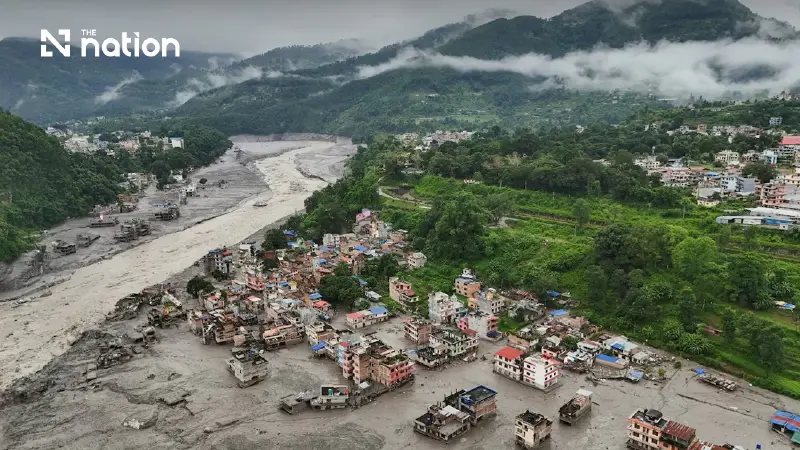


Helicopters are searching for survivors after Himalayan floods left at least 165 dead in Nepal, three in Tibet and nearly 1,500 missing.
Nearly 1,500 people, including more than 700 foreigners, are missing across Nepal and China's Tibet, authorities said on Thursday, after a wall of mud and rock collapsed into a Himalayan river, causing catastrophic flash floods.
Rescuers used helicopters to search for survivors and deliver food, tents and other emergency supplies to thousands of people cut off after the disaster swept through mountain towns and valleys on Wednesday (August 26, 2026).
Nepalese police said the death toll had reached at least 165 and was expected to rise as search teams resumed operations in areas buried beneath mud and debris. China reported three deaths in Tibet.

Nepal recorded 826 people missing, almost 500 of whom were foreign nationals, according to police and tourism officials. Chinese state broadcaster CCTV reported that 558 people remained missing in Tibet’s Gyirong County, including 260 foreigners.
Among the missing tourists in Nepal were 177 Indians, 63 Americans, 34 Australians, 33 Britons and 25 Canadians. Malaysia’s Foreign Ministry separately said 55 of its citizens could not be contacted, although it had received no official confirmation of casualties.
Helicopters reach communities cut off by debris
More than 5,000 Nepalese army and police personnel joined the rescue operation. Authorities said 125 people, including 20 foreign nationals, were brought to safety on Thursday.

Helicopters dropped emergency supplies provided by neighbouring India in some of the worst-affected districts, where damaged roads and thick sediment had made ground access difficult.
Keshav Prasad Baral, a 68-year-old survivor receiving hospital treatment, described seeing a surge of mud rise as it approached his home. He tried to take his wife to the terrace, but she was swept away, while a helicopter rescued him about four hours later.
Another survivor escaped by clinging to a mango tree as the house where he had been working disappeared in the flood.
Verified footage showed water, rocks and mud sweeping people away at the Gyirong border crossing. Homes, roads, vehicles and power infrastructure were destroyed as the flood travelled downstream into Nepal.
The disaster struck a route linking Kathmandu with Lhasa that is frequently used by trekkers, tourists and religious pilgrims.
Evidence points to glacial rock and ice collapse

Initial reports from Nepalese officials suggested that an earthquake might have caused part of a glacier to collapse and trigger the flood.
The US Geological Survey later said seismic energy initially reported as a magnitude-4.4 earthquake had instead been generated by the collapse of glacial rock and ice, followed by a debris flow.
An initial assessment of Planet Labs satellite imagery indicated that a landslide of ice and rock released a debris-laden flood into the Lhende River, about 20 kilometres northeast of the Nepal-China border crossing at Rasuwagadhi.
Chinese authorities were also monitoring a lake that remained dammed upstream in Gyirong. Forecast rain could complicate rescue work and increase the danger of a further release of water and debris.
Australians among missing pilgrimage groups

Australian Foreign Minister Penny Wong said information about the whereabouts of at least 34 missing Australian citizens remained very limited because of the scale of the disaster and restricted access to the affected region.
She said the Australians were travelling with several separate pilgrimage and tour groups and that officials were urgently trying to establish their welfare.
Tour operator Himalayan Glacier confirmed that 15 of the missing Australians were Indian-Australians taking part in a religious journey to Mount Kailash and Lake Manasarovar in Tibet. The youngest member of the group was an 11-year-old boy.
The wider tour also included travellers from India, the United States, Canada and Singapore.
Himalayan Glacier chief executive Sagar Pandey said he had surveyed the flood zone by helicopter. In a bleak personal assessment rather than an official rescue estimate, he put the group’s chances of survival at about 1%, saying the settlements and constructed structures in the area appeared to have been flattened.
International assistance reaches Nepal
The United States said it would send a disaster-response adviser and provide US$500,000 in assistance. United Nations teams and partner organisations were also deploying personnel and supplies to support affected communities, while Canada said it was closely monitoring the disaster.
Nepalese Prime Minister Balendra Shah travelled by road to assess conditions in Nuwakot, one of the worst-affected districts. Families seeking information about missing relatives gathered near an army training centre being used as a base for helicopter operations.
Search and relief work continued across the disaster zone as crews navigated destroyed transport links, mud several metres deep and the continuing risk posed by unstable terrain and the dammed lake upstream.
